
How to Install a Towel Warmer: Hardwired, Plug-in & Dual Connect
last updated april 7, 2026

In This Article
Installing a towel warmer is one of the most straightforward bathroom upgrades you can make — but the right approach depends entirely on which connection type you choose. Plug-in models take minutes and require no electrician. Hardwired models deliver a seamless, cord-free finish and require a licensed electrician for the final connection. Dual connect models give you both options. This guide walks through all three.
Quick Facts: Towel Warmer Installation
- Wall-mounted plug-in install time: 15–30 minutes — mount to wall, plug into GFCI outlet, done.
- Hardwired install time: 1–2 hours with a licensed electrician.
- Freestanding install time: 0 minutes — place and plug in, no wall mounting required.
- Electrician required: Only for hardwired models — plug-in and freestanding are DIY-friendly.
- Outlet type: GFCI outlet required for plug-in models within 6 feet of the unit.
- Minimum clearance: 24” from the edge of any tub or shower enclosure.
- Mounting height: Bottom bar 24–36” from the floor for easy access.
- Support: WarmlyYours offers free 24/7 technical support at 800-875-5285.
Step 1 — Choose Your Connection Type
Before picking up a drill, confirm which connection type your model uses. This determines everything about the installation process.
| Connection Type | DIY Friendly? | Electrician Needed? | Cord Visible? | WarmlyYours Models |
|---|---|---|---|---|
| Freestanding Plug-in | ✅ Yes — zero installation | No | Short cord to outlet | Barcelona, Ibiza |
| Wall-Mounted Plug-in | ✅ Yes — mount + plug in | No | Yes (cord cover included) | Elements, Palma |
| Hardwired | ⚠️ Partial — mounting only | Yes — for electrical | No | Bellagio, Grande, Malta, Maple, Maui, Milan, Ontario, Rome, Tahoe, Vancouver, Vida |
| Dual Connect | ✅ Yes (plug-in mode) | Only if hardwiring | Optional | Infinity, Metropolitan, Riviera, Sierra, Summit |
Not Sure Which to Choose?
If you’re renovating and have wall access, go hardwired — it’s the cleanest long-term solution. If you’re renting, working with a finished wall, or want flexibility, choose plug-in or dual connect. Freestanding models like the Barcelona or Ibiza require zero wall mounting — just place and plug in.
Step 2 — Choose Your Location
Placement matters for both performance and code compliance. Follow these rules before marking your wall:
Placement Checklist
- Shower Clearance: Maintain at least 24” from the edge of any tub or shower enclosure.
- No Enclosures: Never install a towel warmer inside a shower or tub enclosure.
- Mounting Height: Position the bottom bar 24–36” from the floor for easy access.
- Power Proximity: Ensure a GFCI outlet is within 6 feet for plug-in models.
- Wall Choice: Use an interior wall where possible for better heat retention.
- Avoid Vents: Keep the unit away from windows, doors, and HVAC vents.
- Side Clearance: Allow at least 2” of clearance on each side of the unit.
GFCI Protection Required
All WarmlyYours towel warmers must be installed on a GFCI-protected circuit or outlet, per NEC, CEC, and local electrical codes. Hardwired models require a GFCI-protected circuit; plug-in models require a GFCI outlet. This is non-negotiable for bathroom electrical safety.
The ideal location is within arm’s reach of your shower or tub — close enough to grab a warm towel immediately when stepping out, but outside the splash zone. Interior walls are preferred for hardwired models because they offer easier access to electrical wiring and better heat retention.
The wall behind the door is a frequently overlooked option — especially in small bathrooms. A narrow model like the Maple 8 (20.4” wide) fits perfectly there without interfering with door swing.
Step 3 — Electrical Installation: Hardwired, Plug-in, or Dual Connect
The final step in your installation is the electrical connection. Whether you’re looking for a quick DIY project or a seamless, cord-free look, WarmlyYours provides options for every scenario. Below, we’ll walk through the specific steps for Plug-in, Hardwired, and Dual Connect models.
Option 1: Install a Plug-in Model
Wall-Mounted Models
Once mounted, simply plug the unit into a nearby GFCI outlet. The outlet must be within 6 feet of the unit. A cord cover is included to route the cord neatly along the wall — most homeowners paint it to match the wall color for a cleaner look.
Freestanding Models
For freestanding models like the Barcelona and Ibiza, follow these assembly steps from the installation manual:
- Verify components: Ensure you have the main towel warmer assembly, two mounting platforms (feet), and four long screws.
- Prepare work area: Set up in a convenient area. It may be easier to attach the feet if the bottom of the unit slightly overhangs a workbench.
- Attach feet: Use a screwdriver to secure the mounting platforms to the bottom of the unit using the provided screws.
- Level the unit: Turn the levelers on the feet clockwise or counter-clockwise until the unit is stable and level.
- Connect power: Plug the unit into a compatible 120 VAC, GFCI-protected outlet.
- Operation: Use the control switch on the side of the unit to turn it on or set the timer (2H or 4H).
Option 2: Install a Hardwired Model
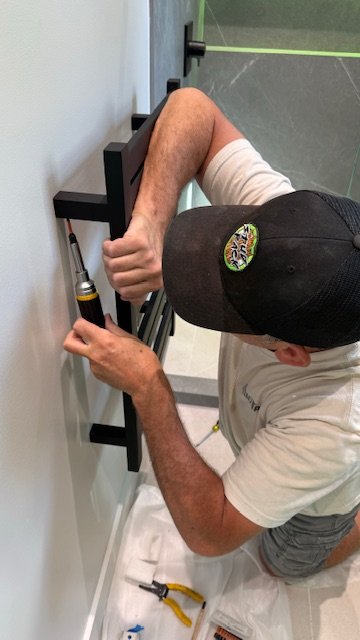
The physical mounting is identical to plug-in — but the electrical connection must be completed by a licensed electrician. Your electrician will connect the unit to a dedicated GFCI-protected circuit in the wall. Plan this step during a bathroom renovation when wall access is easiest.
Hardwired Installation Steps
For hardwired-only models like the Grande, Maple, or Milan, follow these steps from the installation manual:
- Prepare mounting tubes: Insert the short mounting screw through the center of each mounting tube.
- Attach tubes to unit: Fix the mounting tubes to the threaded pads on the vertical bars on the back of the towel warmer. Ensure the set screw holes point towards the floor.
- Electrical connection tube: Guide the electrical cord through the specific electrical connection mounting tube and tighten it to the vertical bar using the long mounting screw.
- Mark the wall: Use the shipping box as a template or measure the distance between bracket centers to mark the four mounting points on the wall. The electrical point (typically point C) determines the junction box location.
- Install brackets: Drill holes at the marked locations, insert drywall anchors, and secure the mounting brackets to the wall using the long screws.
- Mount and secure: Slide the mounting tubes onto the wall brackets and tighten the set screws using the provided Allen wrench.
- Final wiring: A licensed electrician will connect the Hot (black/blue), Neutral (white/brown), and Ground (green/yellow) wires to a 2”x4” electrical box on a GFCI-protected circuit.
Option 3: Install a Dual Connect Model
Dual connect models ship ready to plug in. To convert to hardwired, your electrician removes the plug cord and connects the internal wiring directly to the wall circuit. This makes dual connect models ideal if you want to start plug-in now and convert to hardwired during a future renovation.
Conversion Steps for Hardwiring
If you decide to hardwire your dual-connect model, follow these steps from the installation manual:
- Prepare the unit: Your electrician will cut the power cord and remove the power leg to access the internal wiring.
- Install the plug: Insert the provided plastic plug into the power leg where the cord exited.
- Rough-in: Drill a hole in the wall at the power leg location and fish the house power supply cord through.
- Mount the bracket: Secure the 3/4-size mounting bracket to the wall at the power connection point.
- Connect wiring: While an assistant holds the unit, a licensed electrician will connect the towel warmer to a GFCI-protected circuit.
- Final assembly: Push the connected wires into the power leg, slide the unit onto all four mounting brackets, and tighten the set screws to secure.
Not Sure Which Model to Install?
Browse the full towel warmer collection or read our buyer’s guide to find the right model for your bathroom before you install.
Need Help?
WarmlyYours offers free 24/7 technical support for installation questions — call 800-875-5285 or visit our support center. Every towel warmer ships with a full installation manual, and you can find digital copies for every model on our towel warmer support portal. Our team is also available to walk you through any step of the process.
Frequently Asked Questions: Towel Warmer Installation
Choose a hardwired model for a clean, cord-free look during renovations, or a plug-in unit for easy DIY installation. Many WarmlyYours models feature dual-connection, allowing you to plug in now and hardwire later. Hardwired units require an electrician, while plug-ins simply require a nearby GFCI outlet.
Installing a wall-mounted towel warmer typically takes 30-60 minutes. After selecting a location at least 24 inches from the floor, use the included template to mark and install mounting brackets with wall anchors or screws. Once the unit is hung, simply plug it into a GFCI outlet or have an electrician complete the hardwired connection.
The best place for a towel warmer is on an interior wall within arm's reach of your shower or tub, but outside the "splash zone." Electrical codes require a distance of at least 24 inches from the water source. For optimal access, install wall-mounted units with the bottom bar 24-36 inches above the floor.
A WarmlyYours electric towel warmer can't be installed in a tub or shower enclosure. A WarmlyYours electric heated towel rack should be installed at least 24” away from a wet location like a shower, tub, etc. Always install a WarmlyYours electric towel warmer in compliance with all local building and electrical codes.
For plug-in towel warmers, usually not—they mount to the wall or stand on the floor and plug into a standard outlet. For hardwired models, you’ll want a licensed electrician to ensure safe, code-compliant installation.
WarmlyYours electric towel warmers require no more power than is generated from your standard 120V wall outlet. For hardwired towel warmers, all the wiring is done through the wall. A separate power source is not required; power can be pulled from the nearest available source. For plug-in towel warmers, all that is required for electric hookup is that the unit is plugged into a properly grounded outlet located within 6 feet (1.8m) of the unit.
Have Questions About Your Project?
Our team of Radiant Experts is ready to help!
Related Articles
Not All Towel Warmers Are Created Equal: A Buyer's Guide to Quality, Features & Value
What Towel Warmer is Right For You?
Small Towel Warmer Guide: Best Towel Warmer for Small Bathroom (2026)
Are Towel Warmers Worth It? Here's What You Need to Know
Stay Updated
Get the latest radiant heating news and tips delivered to your inbox.


