

Heated Bamboo Floors
A heated bamboo floor pairs eco-friendly style with radiant warmth. Bamboo flooring works beautifully with radiant heat—sustainably sourced, available in varied designs and colors, and warm underfoot in every season.
Get an Instant Quote
Answer a few quick questions and we'll match you with the best floor heating system.
Jump to
Why Install Floor Heating Under Bamboo?
Bamboo flooring pairs beautifully with radiant heat when installed correctly. Its natural warmth and eco-friendly profile make it a popular choice for heated floors.
Bamboo-Safe Heating
Our systems maintain gentle, even heat below the 85°F threshold—keeping bamboo floors stable without warping, cupping, or gapping.
Easy to Install
Environ Mats for floating bamboo, TempZone mats and cables for glue-down bamboo. Both install quickly—most rooms take just a few hours.
Pennies Per Hour
Operating costs as low as C$0.01/hour. Use our calculator below to estimate costs for your space.
Eco-Friendly & Energy Efficient
Bamboo is a renewable resource, and radiant heat is one of the most energy-efficient heating methods. A green combination from floor to ceiling.
Safe & Certified
All our systems are cULus listed. Smart thermostats maintain safe floor temperatures automatically—protecting your bamboo investment.
24/7 Expert Support
Free SmartPlan™ with every quote—typically within 1 business day. Plus 24/7 installation support, fast shipping, and an industry-leading warranty.
Bamboo Floor Heating Customer Reviews
We take pride in providing both exceptional service and great products. But don't just take our word for it, check out what some of our customers have had to say.


How Much Does Bamboo Floor Heating Cost?
The cost of heating bamboo floors depends on the installation method. For floating bamboo, Environ Flex Rolls cost C$12–C$18 per square foot with no adhesive required. For glue-down bamboo, TempZone products cost C$6–C$17 per square foot plus self-leveling cement. A 200 sq.ft. living room with about 140 heated square feet would cost between C$840 and C$2,380 for heating materials.
Bamboo is naturally a good conductor of heat, making it well-suited for radiant floor heating. The key is choosing strand-woven or engineered bamboo (which handles temperature changes better than solid bamboo) and keeping the floor temperature below 85°F. Operating costs are typically C$0.15–C$0.35 per hour for a living room zone. Use the calculator below to estimate your costs.
Operating Cost Calculator for Floor Heating
Estimate your daily and monthly energy costs based on room size and local rates.
ft²
¢/kWh
Estimated Cost
C$0.21
per hour
C$0.85
per day
C$25.50
per month
Free SmartPlan
Get a custom installation plan for your bamboo floor in just 1 business day.

"I'll create a custom installation layout showing exactly where your heating elements go, plus a complete materials list with pricing."
Floor Heating Systems for Bamboo
Bamboo flooring is typically installed as a floating floor, making it ideal for our Environ floating floor heating system. No adhesives or nails are needed, helping save on the overall cost of the project.
See an example from our project showcase »
Cut, Turn, and Heat
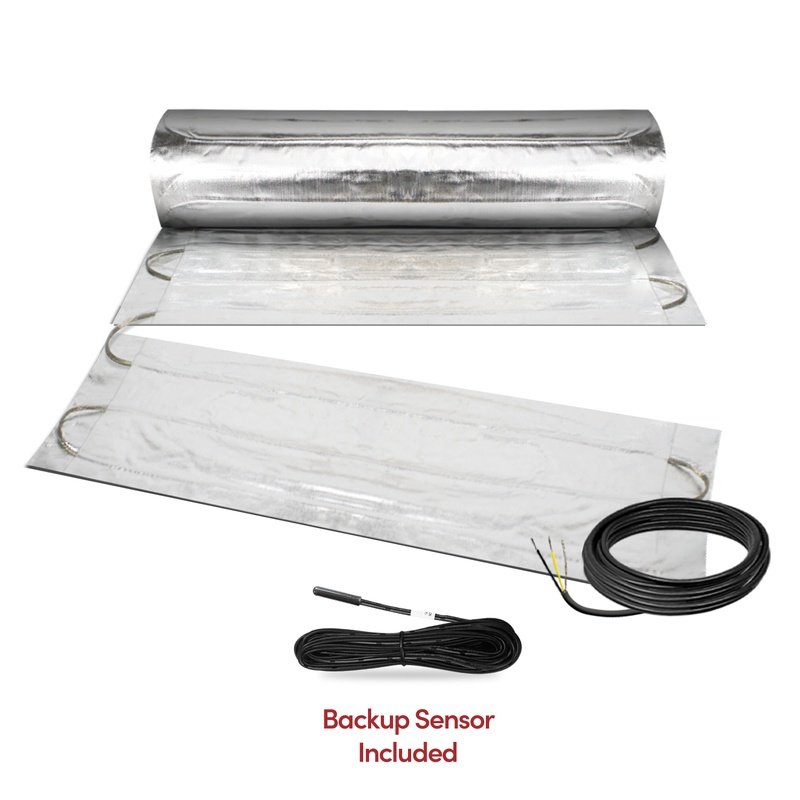
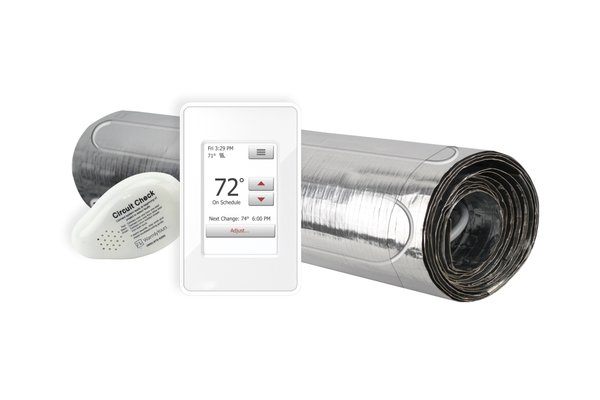
WarmlyYours Environ Flex Rolls are designed for use under carpet (U.S. only), laminate and floating wood. The mats can be installed easily and quickly for large spaces.
Features
- Flexible roll design cuts and turns to follow your layout
- Ideal for floating laminate, engineered wood, or carpet
- Dry installation—no mortar or adhesives
- 10 Year Warranty under Laminate & Floating Hardwood, 5 Year under Carpet (Us Only)
- 12 Watts Per Sq. Ft
We've Got Your Back: A Backup Floor Sensor
Every complete WarmlyYours floor heating system—TempZone™, Environ™, or Slab Heat—ships with two floor sensors: one with the heating mat or cable and one with the thermostat. Install the backup right beside the primary sensor and run both leads to the thermostat box, but connect only the primary; the backup stays disconnected until it is needed.
The floor sensor lives under your tile, wood, carpet, or concrete, where it tells the thermostat how warm the floor really is. If that sensor is ever nicked during installation or fails years down the road, replacing it would normally mean tearing up the finished floor.
With the backup already embedded in the floor, the fix takes minutes: turn off power at the breaker, disconnect the original sensor at the thermostat, connect the backup, and your heat is back on. No torn-up floor, no new flooring, no second installation. Follow your thermostat's instructions, or have a qualified electrician make the swap.
Installer tip: Install both sensors side by side, centered between the heating wires, and test each one for 8–15 kΩ before covering the floor. For Slab Heat, place the sensors in capped 3/4″ rigid metal conduit between cable runs, clear of the heating cable, as the Slab Heat installation manual describes.
How to Install Floor Heating Under Bamboo
The installation method depends on how your bamboo flooring is installed. Floating bamboo (click-lock) pairs with our Environ system—a simple, adhesive-free installation. Glue-down bamboo uses TempZone products embedded in self-leveling cement. Choose strand-woven or engineered bamboo for best results with radiant heat.
Floating Bamboo (Environ Mats)
- Step 1: Clean and level the subfloor (concrete, plywood, or existing flooring).
- Step 2: Roll out Environ Mats according to your SmartPlan layout.
- Step 3: Secure mats with tape and connect leads to the thermostat location.
- Step 4: Test the heating system with an ohmmeter (test before, during, and after).
- Step 5: Install a thin, radiant-compatible underlayment such as cork over the mats.
- Step 6: Install floating click-lock bamboo flooring over the underlayment.
- Step 7: Wire the thermostat, set maximum floor temperature to 85°F, and enjoy!
Glue-Down Bamboo (TempZone Mats or Cable)
- Step 1: Clean and level the subfloor.
- Step 2: Roll out TempZone Flex Roll or install TempZone Cable with fixing strips per your SmartPlan layout.
- Step 3: Test the heating system with an ohmmeter (test before, during, and after).
- Step 4: Embed the heating element in self-leveling cement and allow it to cure.
- Step 5: Adhere bamboo flooring to the cured surface using the manufacturer's recommended adhesive.
- Step 6: Wire the thermostat, set maximum floor temperature to 85°F, and enjoy!
Compatibility Tips
- Bamboo type: Strand-woven or engineered bamboo handles temperature changes better than solid bamboo and is strongly recommended for radiant heating applications.
- Temperature limit: Keep the floor surface at or below 85°F to prevent warping or gapping. Our smart thermostats with floor sensors enforce this automatically.
- Acclimate flooring: Allow bamboo flooring to acclimate in the room for the manufacturer's recommended period before installation.
Bamboo Floor Heating Videos
Documents

PDF

PDF

PDF
Bamboo Radiant Floor Heating Posts







Frequently Asked Questions
Showing 10 of 24 questions
The short answer is yes but there are some other factors to keep in mind. For example, Bamboo flooring typically has a higher thermal resistance than tile, so the heating performance may be slightly diminished. Wood, bamboo, linoleum, cork and carpet all have different R-values (from 1 to 3) and they typically use an underlayment or a pad with an R-value of 1 to 2. The question naturally arises whether the radiant heat can effectively heat through all of that. Radiant heat transfers energy depending upon the density, humidity, and thermal resistance of the object. Ideally, the lower the R-value in the floor and underlayment, the better. Some underlayments, made from synthetic rubber, have extremely low R-values and are ideal for radiant heated floors because they allow the heat to transfer through more quickly.
Yes, acclimation is an important first step to extending the life of bamboo flooring. Typically you want to place it in the room where you’ll be installing it for at least 3 to 7 days, with the radiant heating system on. This allows the bamboo flooring to acclimate to the room’s standard temperature and balance with the environment. However, make sure to always defer to the bamboo flooring manufacturer's instructions.
Installing Environ™ under wood laminate flooring requires a suitable underlayment beneath the heating elements. Never install Environ™ between two hard surfaces. Underlayments that are less than 2mm in thickness and that are not Robinson-rated are not acceptable. Underlayment is necessary to prevent Environ™ Flex Rolls from damage due to the weight of the floor, furniture, and people. Unavoidable wooden floor movements will not harm Environ™.
Installing Environ™ under carpeting(USA only) requires a suitable cushion/pad beneath the heating elements. Never install Environ™ between two hard surfaces. Carpet padding must have a density of at least 6 pounds per cubic foot, the higher the R-Value the better. 1/2“ Prime Urethane (R-2.15) and 1/2“ Bonded Urethane(R-2.1) are good choices. Adhere to Restrictions on Furniture Placement outlined on page 12 of Environ Install manual when installing under carpeting.
Environ™ must not be installed in direct contact with concrete, it is mandatory when installing over concrete to use a 1/4“ (6mm) Robinson-rated underlayment.
Certain underlayments, such as 1/4” (6mm) thick cork, or 6mm ThermalSheet are recommended for Environ™. It is also acceptable to place a vapor barrier, such as a plastic sheet, beneath the underlayment. Underlayment paper is not an acceptable underlayment choice.
Always check with the manufacturer of the flooring, carpeting, and underlayment for limitations and compatibility with electric radiant heating. Adhere to national and local code regarding electric radiant heating systems.
Yes. Floating engineered bamboo works perfectly with Environ™ Flex Rolls. You must strictly adhere to expansion gaps to allow for natural wood movement. Ensure your subfloor is clean and level, install a ¼"–½" thick underlayment (cork or polystyrene), lay the heating mats, then click your bamboo planks together. For best results and warranty compliance, consult your bamboo manufacturer's floating installation instructions for underfloor heating systems.
Yes. Glued-down bamboo is often recommended for use over underfloor heating because it provides better stability than floating installations. For glued-down installations, embed either TempZone™ Floor Heating Cable or TempZone™ Floor Heating Mats in thinset or self-leveling cement, then glue your bamboo directly over the embedded heating element. Both products work equally well when properly embedded—the key is that the heating element is sandwiched between the subfloor and the flooring material.
Yes, radiant floor heating can serve as a primary heat source for bamboo flooring even in colder climates like Illinois, provided your home has proper insulation and limited heat loss. This works best in newer, well-insulated homes where the radiant system can efficiently maintain comfortable temperatures throughout the heating season. The key is ensuring the system is sized correctly to meet your heating needs without exceeding the safe bamboo temperature limits (81–85°F).
Request a heat loss calculation from WarmlyYours to determine if radiant floor heating alone can meet your climate's demands. If your home has significant heat loss or is in an extremely cold climate, you may need radiant heating paired with supplemental heating. Proper insulation, air sealing, and system design are critical to success as a primary heat source.
Yes, radiant heating can cause bamboo to split, but it's usually due to low humidity from the heat drying out the planks or exceeding temperature limits (over 85°F/29°C), causing contraction and cracking. Bamboo naturally expands and contracts with moisture changes, so preventing splits requires controlling both temperature and humidity.
Using engineered bamboo instead of solid bamboo significantly reduces splitting risk due to its superior dimensional stability. Proper installation—including a moisture barrier, appropriate underlayment, correct acclimation (3–7 days), and maintaining humidity at 40–60% RH—prevents this damage.
WarmlyYours thermostats automatically limit surface temperature to safe levels, and our 24/7 tech support can help you monitor and adjust settings to protect your investment.
While DIY installation is possible, WarmlyYours recommends professional installation for optimal performance. Bamboo requires precise temperature control, proper moisture management, and careful acclimation—professionals understand these nuances. Hiring an experienced, licensed, and insured professional (potentially a member of the Infrared Heating Panel Association or familiar with NWFA guidelines) is a wise investment to ensure a successful, long-lasting floor.
When using bamboo flooring over radiant heat, it is best to set the temperature and leave it at that temperature. Bamboo flooring will naturally withstand temperature changes(it’s one of the many advantages of bamboo flooring), however, it performs best when radiant heat is set to a constant temperature without changing more than a few degrees per hour. Also, never let the "floor temperature" for the radiant heating system exceed the maximum temperature identified by the flooring manufacturer.
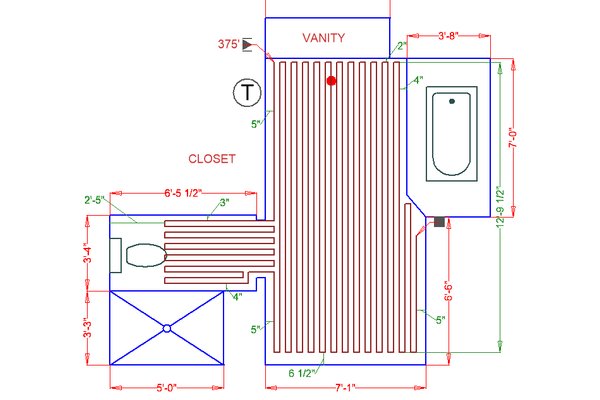
Submit a floor sketch to WarmlyYours showing room dimensions, bamboo type (engineered or solid), installation method (floating or nailed), and desired heated areas. You'll receive: custom installation diagram, electrical plan with circuit info, estimated operating costs, and bamboo-specific installation guidance. This ensures you order the right system and understand the heating investment.
Use a digital ohm meter to test each heating mat or cable. The reading should fall within ±15% of the value on the UL label. Measure continuity between core and ground wires (expect infinity). WarmlyYours tests each mat three times before shipping to ensure reliability. After the bamboo is installed, monitor the floor surface temperature with an infrared thermometer to verify it stays within the safe 81–85°F range. Also check that heat distribution is even across the bamboo floor—uneven heating can cause localized temperature spikes that damage the material. If you notice cold spots or temperature variations, contact WarmlyYours' 24/7 tech support for diagnostics.
Acclimation is important for extending the life of bamboo flooring. Place the bamboo in the room where you'll be installing it for at least 3–7 days with the radiant heating system on. This allows the bamboo to acclimate to the room's standard temperature and balance with the environment. Then gradually increase temperature to allow the wood to adjust slowly. Always defer to the bamboo flooring manufacturer's instructions for their specific product.
Operating costs depend on three factors: system wattage, room size, and your local electricity rate. These costs apply only during the heating season (colder months when the system is in use). Wattage varies by product: Environ™ Flex Rolls deliver 12 watts/sq.ft., while TempZone™ Flex Rolls deliver 15 watts/sq.ft., and TempZone™ Cable ranges from 9–15 watts/sq.ft. depending on spacing.
Keep in mind that heating systems typically don't extend wall-to-wall. Most installations stay 1–2 feet away from walls because the heating system cannot run underneath furniture with a base, such as bookshelves, cabinetry, and built-ins. This means your actual heated floor area is usually smaller than the total room size.
Use this formula to calculate your hourly cost:
Hourly Cost = (Heated Room Size in sq.ft. × System Wattage) ÷ 1,000 × Your Local kWh Rate
Example: 300 sq.ft. living room with Environ™ Flex Rolls (typical North American size)
- Total wattage: 300 sq.ft. × 12 watts = 3,600 watts (3.6 kW)
- At $0.12/kWh (US average): 3.6 kW × $0.12 = $0.43/hour
- Running 8 hours/day during heating season = $3.44/day or ~$103/month
Your actual cost will vary based on local electricity rates (check your utility bill), climate, system wattage, heated floor area, and how many hours per day you run the system during the heating season. Use WarmlyYours' operating cost calculator to get a precise estimate for your specific project and region.
Yes. Engineered bamboo is ideal for radiant floor heating because its layered plywood core provides superior dimensional stability. This allows the flooring to withstand temperature fluctuations and moisture changes without significant expansion, contraction, or warping. Solid bamboo, while beautiful, naturally expands and contracts more with heat and humidity changes. This movement increases the risk of damage—such as gaps, cupping, or splitting—when paired with a constant heat source like a radiant system. If you prefer solid bamboo, consult your manufacturer's warranty and installation guidelines to confirm it's certified for radiant heat use and to follow specific acclimation and temperature limits.
Yes. Radiant floor heating under bamboo is energy-efficient because bamboo's natural properties allow excellent heat conduction, delivering warmth directly to the room. Radiant heating is also more efficient than forced-air systems because it heats objects and people directly, not the air. With bamboo, the moderate 81–85°F temperature range actually reduces energy consumption compared to heating to higher temperatures with other flooring types.
However, efficiency depends on choosing the right system: engineered bamboo is best for radiant heating, and strict installation rules are essential. Most importantly, keeping floor temperatures below 84°F prevents damage like warping and ensures stable, efficient warmth that lasts for years.
For floating engineered bamboo, WarmlyYours recommends Environ™ Flex Rolls—an electric radiant foil mat system. These foil mats are excellent for floating floors because they are thin, easy to install, and don't add height to your subfloor. Environ™ Flex Rolls use a dry-install system, meaning no adhesives are required—they simply lay flat over your subfloor before your bamboo planks are clicked together. The system delivers 12 watts/sq.ft. of consistent heat distribution and temperature control optimized for wood floors. WarmlyYours thermostats automatically limit surface temperature to safe levels (81–85°F), protecting your bamboo investment. Environ™ Flex Rolls come with a 10-year warranty on engineered bamboo installations. For a custom installation plan tailored to your space, get a free SmartPlan™ from WarmlyYours.
For nailed bamboo floors, TempZone™ Floor Heating Cable embedded in thinset or self-leveling cement is the recommended option. The cable is installed between the subfloor and the bamboo, providing reliable heating with custom spacing options. Always follow both the cable installation instructions and your bamboo manufacturer's guidelines for nailed installations.
Cupping (edges higher than center) or crowning (center higher than edges) usually indicates moisture problems or temperature fluctuations. Check: floor surface temperature (should be 81–85°F), moisture barrier integrity, humidity levels (40–60% RH is ideal), and thermostat settings. Avoid placing large objects or thick carpets on the floor, as they trap heat and cause localized temperature spikes. Contact WarmlyYours' 24/7 tech support for diagnostics.
To prevent cupping or crowning, follow these best practices: acclimate bamboo in the home's environment before installing (3–7 days minimum), maintain consistent indoor humidity around 35–55% using a hygrometer, and ensure proper expansion gaps around the perimeter during installation. For floating floors, use spacers to allow for natural wood movement. Consistent temperature control with a WarmlyYours thermostat is equally important—avoid rapid temperature swings that stress the material.
Uneven heating usually indicates one or more of the following issues:
Installation Problems:
- Underlayment gaps or improper placement that disrupt heat transfer
- Improper mat or cable placement during installation
- Air pockets trapped beneath the heating element
Electrical System Issues:
- Damaged heating elements or cables: A break or fault in the heating cable will prevent heat in specific areas. A qualified electrician can use specialized tools (like a multimeter or thermal imaging camera) to locate the precise spot of the damage and repair or replace the affected section.
- Thermostat issues: A malfunctioning or improperly calibrated thermostat may send incorrect signals to the system. Check the thermostat settings and wiring connections. If it is old or unresponsive, it may need to be replaced.
Sensor Problems:
- Thermostat sensor misplacement or malfunction that prevents accurate temperature readings
Because bamboo is especially sensitive to temperature variations, even distribution is critical to prevent damage. Contact WarmlyYours' 24/7 tech support for diagnostics and adjustments. Our team can help identify the root cause and recommend the best solution.
Use ¼"–½" thick underlayment made of synthetic cork or polystyrene—avoid foam or rubber-based products. Cork is ideal because it provides thermal conductivity, moisture protection, and sound dampening. Never use underlayment with attached moisture barriers, as it interferes with heat transfer. For floating installations, ensure your underlay is specifically designed for heating systems.
Bamboo floor surfaces should not exceed 27–29°C (81–85°F), depending on your specific bamboo manufacturer's specifications. Always check your flooring manufacturer's warranty and installation instructions before proceeding. The optimal indoor environment combines temperature control with humidity management: maintain 18–26°C (60–80°F) room temperature and 40–60% relative humidity (RH). Use a hygrometer and thermometer to monitor both. After installation, turn on the heating system at a low setting and increase temperature gradually—by 2–3°C per day over a 7-day period—to allow the bamboo to acclimate and prevent damage. Avoid placing large objects or thick carpets on the floor, as they trap heat and cause localized temperature spikes that increase damage risk.
Warranty coverage depends on your specific system and bamboo manufacturer. Environ™ Flex Rolls typically offer a 10-year warranty on engineered bamboo installations. TempZone™ systems offer a 25-year warranty. Warranty registration is required and must be completed online after installation. Always follow your bamboo manufacturer's installation guidelines to maintain warranty coverage.
While bamboo is inherently heat-resistant and can withstand high temperatures in industrial settings, bamboo flooring is sensitive to rapid temperature changes and moisture fluctuations in residential applications. The issue isn't that bamboo can't handle heat—it's that sudden temperature swings cause the material to expand and contract unpredictably, leading to gaps, cupping, crowning, or splitting. This is especially true for solid bamboo, which moves more than engineered bamboo. Radiant floor heating systems maintain consistent, moderate temperatures (81–85°F), which prevents these damaging expansion/contraction cycles. Gradual temperature increases during acclimation allow the bamboo to adjust slowly and safely.


