How to Install Radiant Floor Heating under Luxury Vinyl Tile
last updated february 21, 2026

In This Article
Luxury vinyl tile (LVT) is the fastest-growing flooring category on the market — and for good reason. It's waterproof, durable, realistic-looking, and fully compatible with electric radiant floor heating. This step-by-step guide walks you through exactly how to install a TempZone® floor heating system under LVT, from subfloor prep to thermostat connection.
Want the full picture before diving in? Start with our complete LVT & radiant floor heating guide first.

Why LVT Works So Well with Radiant Floor Heating
According to Zack Zehner, Vice President of Commercial Hard Surfaces for Mannington Commercial, LVT has enjoyed strong double-digit growth even through economically challenging years. Consumers are drawn to it for its realistic designs, ease of maintenance, superior performance, water resistance, and installation flexibility.
On top of all that, LVT accommodates electric underfloor heating beautifully — as long as it's installed correctly. Follow the eight steps below to get it right.
The 8-Step Installation Guide
Step 1 — Prepare the Subfloor
Clear the subfloor of all debris. Dam off any areas — air vents, entryways, transitions — where you don't want self-leveling cement to flow. Use a marker to indicate how the heating element will be laid out per your SmartPlan® installation plan.
Installing in a Basement?
Concrete slabs have specific moisture and insulation requirements. See our Step-by-Step Basement LVT Installation Guide before you start.
Step 2 — Test the Heating Element
Using a digital ohmmeter, test the heating element and record the resistance reading — it should match the factory specification on the label. At this stage, run the cold lead from the heating element up through the thermostat box if it's already in place. Attach your Circuit Check and turn it on — it will alarm if the circuit is broken at any point during installation.
Step 3 — Install the Heating Element
Lay out the heating element according to your SmartPlan® layout and floor markings. Secure the mesh to the subfloor every 6–8 inches using hot glue, staples, or duct tape — but never staple through the heating cable itself.
Secure It Well
The heating element will naturally want to float to the top of the self-leveling cement when poured. Secure it carefully every 6–8 inches to keep it in position.
Step 4 — Place the Floor Sensor
WarmlyYours strongly recommends using a floor sensor wire when heating under LVT — it prevents the floor from ever exceeding the vinyl manufacturer's maximum temperature threshold. Place the sensor at least 6 inches into the heated area, running it parallel between the heating cables and never crossing them. Secure with hot glue.
Test Before You Bury It
Test the sensor with a digital ohmmeter before installation to confirm a good reading. Once it's under cement, you can't easily replace it.
Step 5 — Affix the Cold Leads
A 15-foot cold lead is factory pre-attached at the start of the heating element. Route it above the subfloor to the thermostat location — without crossing over the heating cable. Secure it with tape or hot glue so it doesn't shift during the cement pour. Take another ohmmeter reading to confirm no damage has occurred.
Step 6 — Embed in Self-Leveling Cement
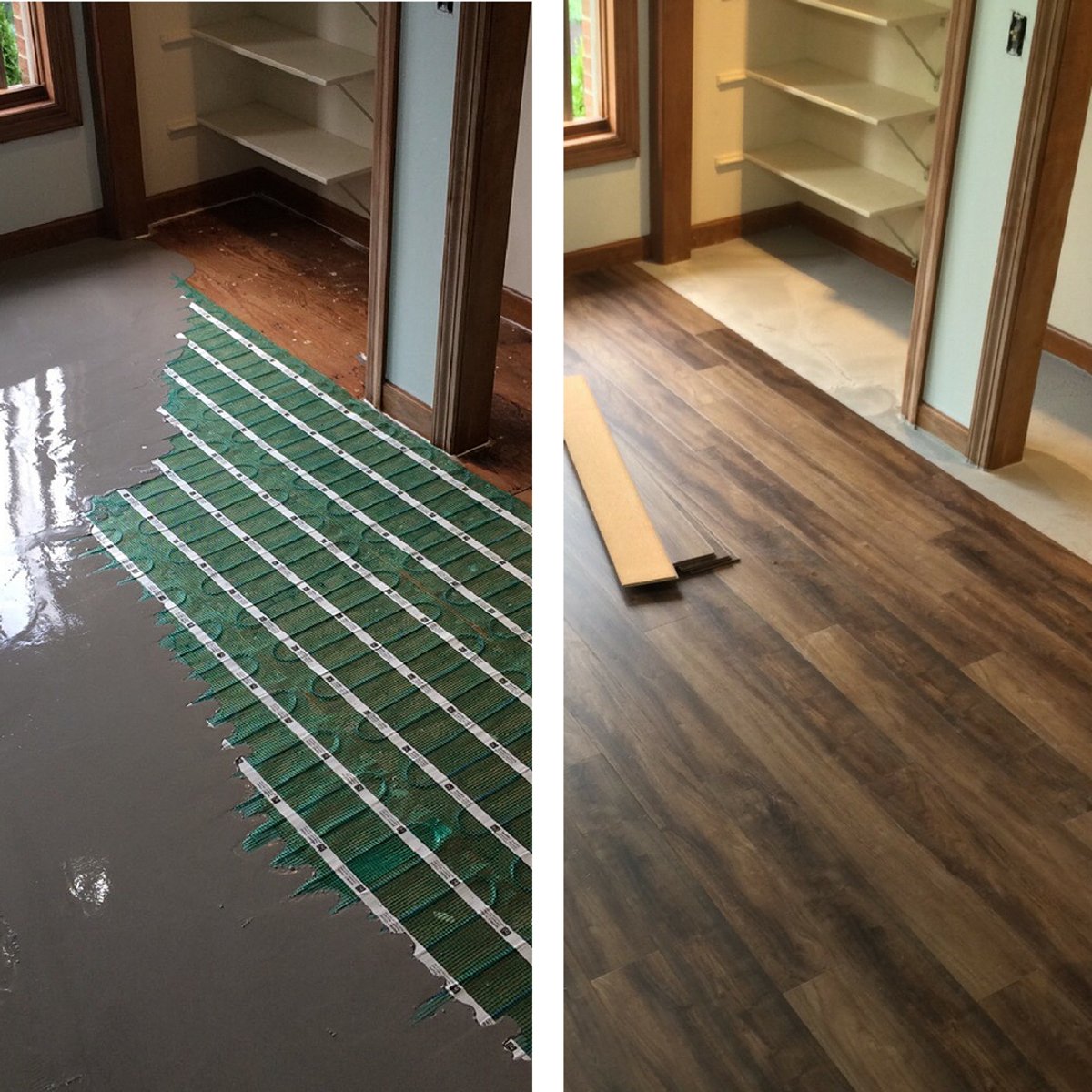
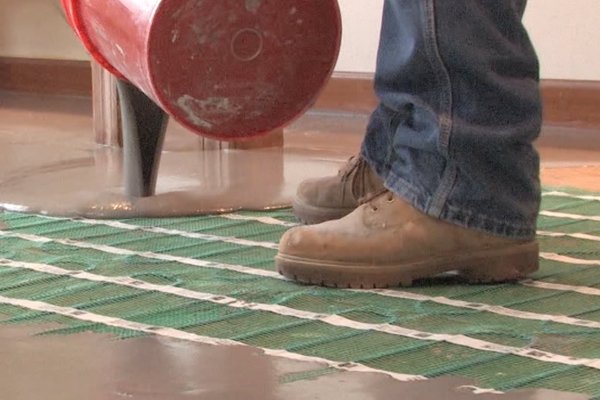
With the Circuit Check still connected and showing green, mix and pour self-leveling cement to fully encapsulate the heating system. Apply a minimum ⅜-inch layer — enough to protect the cable and create a smooth, flat surface for the LVT above.
Step 7 — Install the LVT
Once the self-leveling cement has fully cured and the surface is verified flat, install the LVT per the flooring manufacturer's instructions. This may be click-lock, glue-down, or loose lay depending on the product — follow the manufacturer's method exactly.
Step 8 — Connect the Thermostat
Have a licensed electrician connect the cold lead and floor sensor to the thermostat. Set the floor temperature limit on the thermostat to the vinyl manufacturer's maximum — this ensures the sensor will cut power before the floor ever reaches a damaging temperature.
Choosing a Thermostat
Always use a thermostat with a floor sensor input when heating under LVT. Look for programmable scheduling and energy-saving modes. See all compatible options on our floor heating thermostats page →
Watch: TempZone Installation Under LVT with Self-Leveling Cement
This video walks through the full installation process — from laying the Flex Roll to pouring self-leveling cement and finishing with LVT.
Frequently Asked Questions
Can LVT be installed over radiant heating?
Yes — LVT is an excellent match for radiant floor heating. Its composition allows for efficient heat transfer and durability, making it one of the best flooring choices for heated floors.
What temperature limits should I follow?
Most LVT products have a maximum surface temperature of 80–85°F. Always follow your specific flooring manufacturer's guidelines — they vary by brand and product. Using a thermostat with a floor sensor is the best way to stay within limits automatically.
How long does LVT with radiant heating last?
With proper installation, LVT floors with radiant heating can last 20–30 years. The WarmlyYours heating system itself carries a 25-year warranty.
More LVT & Floor Heating Resources
- Luxury Vinyl Tile & Floor Heating: The Complete Guide →
- LVT vs. LVP: Which Is Right for Radiant Heat? →
- Real Project: Installing Radiant Heat Under LVT in a Basement →
Ready to Get Started?
Use the WarmlyYours Quote Builder to get an instant, personalized quote for your LVT floor heating project — or request a free SmartPlan® layout from our engineers.
Have Questions About Your Project?
Our team of Radiant Experts is ready to help!
Comments
Related Articles

Stay Updated
Get the latest radiant heating news and tips delivered to your inbox.
No need for a thermo underlayment between heated layer and subfloor?
That's a great question! You would only need to use an insulating underlayment when installing a floor heating system over a concrete slab.
Can I go over ceramic tiles?
Yes, you could install a radiant heated LVT floor over a preexisting ceramic tile floor. However, you'll need to make sure that the tile floor is primed and prepared to accept the self-leveling compound (SLC) that the heating system will be embedded in. Then the LVT flooring can be installed on the flat surface created by the cured SLC.
Is Warmly yours able to be installed safely under any luxury vinyl planks or only some types? What types will work? What types are best?
Typically speaking, our TempZone heating elements are compatible with almost every Luxury Vinyl Plank or Tile product but, of course, you should always check the manufacturer's guidelines to confirm that the product can be used with radiant floor heating. One thing to keep in mind is that it's probably a good idea to select a heating system that will be embedded in self-leveling compound as this will create a perfectly flat surface to install the floor covering on later. The best types of LVP or LVT products to use for electric floor heating will have a relatively low r-value (so that heat can efficiently be transferred and the floor covering shouldn't have any (or at least very minimal) padding or attachments of any kind.
Is any waiting period required before turning on the floor heating permanently?
That's a great question and the answer is yes, there is a waiting period before you'll want to energize your floor heating system if there's an adhesive like thinset or self-leveling compound involved. You'll want to wait until that adhesive is completely dry (or "cured") before turning on the system. Turning the floor heating on too early can turn the adhesive brittle. You'll want to refer to the adhesive's manufacturer's guidelines for estimations for how long it will take for it to cure. But after that, it should be smooth sailing. Thanks for the question and for reading! Hope that helps!
Why does it require a self-leveling compound? Is this only to ensure leveling?
This is a great question and you're right it largely has to do with ensuring a level surface. While many luxury vinyl products (plank or tile) are very durable, many of them are malleable, particularly when exposed to heat. So it would be possible that your floor covering would form around the heating wires underneath after enough time and use had elapsed. Embedding the heating cables in self-leveling compound will ensure a smooth installation surface and protect the floor covering from deformation around the heating wires.
How can a potential user of whole house electric radiant heat under Luxury Vinyl flooring do a comparison vs gas forced air heating operating costs?Understanding many variables contribute to the answer, are there existing studies or operating cost calculators available?
Thanks for reading and taking the time to ask a question. We have two great tools that might be able to help you get the information you're looking for. First, our Floor Heating Operating Cost Calculator (https://www.warmlyyours.com/floor-heating/cost-calculator) is great for getting an idea for how much a floor heating system would cost to run based on your project size. Secondly, we have a Heat Loss Calculator (https://www.warmlyyours.com/floor-heating/heatloss-calculator) that can be used to identify if a floor heating system would be able to function as a primary heat source. If you have any further questions, please don't hesitate to give us a call at 1-800-875-5285.