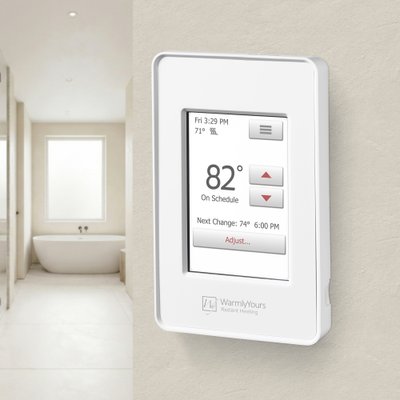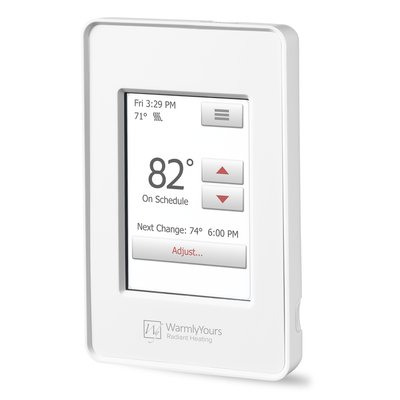
nSpire Touch Programmable Thermostat with 15 mA EGFPD
Part Number: ADG4-4999
The nSpire Touch thermostat offers all the things you expect from a smart touchscreen thermostat – intelligent, adaptive control and intuitive operation.
This support page provides publications, manuals, specifications, videos, support articles, and common support questions
The nSpire Touch thermostat offers all the things you expect from a smart touchscreen thermostat – intelligent, adaptive control and intuitive operation.
This support page provides publications, manuals, specifications, videos, support articles, and common support questions
Jump to
Support Questions
Showing 10 of 40 questions
How to figure out the Kilowatt Load usage for your WarmlyYours floor heating system?
On the new touchscreen thermostat UDG4-4999, during the startup menu, users will be prompted to enter their KW load usage. Floor Load is the total wattage of the floor heating system that can be found on the installation or electrical plan. A lot of our customers may not know this for a number of reasons (they did not install or order the floor, it may be a replacement, and info on the installation has been lost, etc.) Here is an easy way to help out and get the Kilowatt load they need for this menu step.
Kilowatt load usage can be figured by taking the square footage of the open floor space multiplied by 15 (for tile) or 12 (for carpet and laminate). This gives us the total wattage which we then divide by 1000 to get the Kilowatts.
An example: the user has a 100-square-foot room that is tiled. The math would look like this: 100 sq feet X 15 watts per square foot = 1500 divided by 1000 = 1.5 KW
The breaker and wire sizes are selected based on the total amperage of the WarmlyYours heating system connected to a single thermostat. This information is on the WarmlyYours heating system's installation plan, electrical plan, or UL label. Based on guidelines from the National Electrical Code: loads up to 16 Amps may utilize 12 gauge wire with a 20-Amp breaker, and loads up to 12 Amps - 14 gauge wire with a 15-Amp breaker. Local code and/or other factors may change these guidelines.
One thermostat can control multiple heating mats/cables as long as all the heating elements are using less than 15 amps:
TempZone™ will cover aprx. 120 sq. ft. for 120V systems and 240 sq. ft. for 240V systems on one thermostat.
Environ™ will cover aprx. 150 sq. ft. for 120V systems and 300 sq. ft. for 240V systems on one thermostat.
Slab Heat will cover aprx. 90 sq. ft. for 120V systems and 180 sq. ft. for 240V systems on one thermostat.
In theory, it is possible, if no other options are available. We do not recommend it, but If the thermostat is controlling the floor temperature with a floor sensor, then it can go on an exterior wall. It is important that the floor sensor gets located in an area of the floor not hit by sunshine.
If the thermostat will be controlling the air temperature with the built-in ambient sensor, then it should go on an interior wall.
A GFCI/GFEP (Ground Fault Circuit Interrupter / Ground Fault Equipment Protection) works differently than a circuit breaker by specifically detecting a small imbalance in electrical current between the hot and neutral wires, which indicates a potential ground fault (like a person touching a live wire), and instantly shutting off the power to prevent shock, while a circuit breaker only trips when there's a significant overload in current flow on the circuit, like a short circuit or too many appliances plugged in.
The default is 10k. If this is a new installation, that is the answer. In the very rare occasion that this is replacing an older Energy stat (eg. square OJ Microline from before 2010 with red and green sensor wires), choose 12k. If this is a replacement for the other 99% of the thermostats WarmlyYours sold (Honeywell TH115 and TH111 thermostats), 10k is the value.
Always start with the default 10kΩ and change later if needed.
Pressing and holding (2-3 sec) physical power/reset button will turn the unit completely OFF. Same process turns the unit back on.
(nHance and nJoin units will have the button on the front faceplate, nSpire Touch WiFi, nSpire Touch and nTrust will have the button on the right side of the faceplate.)
Relays can fail due to excessive current or voltage. When a relay is exposed to too much current, the contacts can burn out. High voltage can also damage the coil. Other reasons include mechanical wear and tear, dust or dirt buildup, and moisture. These factors can cause the relay to malfunction or stop working entirely. Regular maintenance and using the relay within its specified limits can help prevent failures.

No, a circuit breaker will NOT protect against a power surge; a circuit breakers primary function is to protect against excessive current flow (overload), while a surge protector is specifically designed to handle voltage spikes, which are what power surges are considered to be.
You can control your slab heating system with any WarmlyYours nSpiration Series thermostat. Depending on the size of your project, you may also need to add a relay or nJoin power module.
The flashing digits indicate that the actual (measured) floor temperature exceeds the thermostat temperature limit.
The temperature limit is set for either tile (104°F/40°C) or laminate (82°F/28°C) when the thermostat is first set up or re-configured.
For example: When the floor type (protection) is set to laminate, the limit defaults to 82°F/28°C. If the floor temperature goes above this - whether due to radiant floor heating or external heating sources, then the digits will flash and the heating is switched off.
Turning the temperature up or down will not affect the flashing digits. And leaving the thermostat alone with flashing digits does not harm the system.
Tip: To turn off the heated floor (ex. for months when it is not needed), on the outer edge of the thermostat, depress the lower right side button for 3-5 seconds. This will also turn it back on.
Yes, this model is dual-voltage and compatible with both 120V and 240V systems. However, ensure your supply voltage matches the voltage requirement of your specific floor heating element (e.g., do not connect 240V power to a 120V heating mat).
For a visual guide on these thermostats, you might find this video helpful:
... OJ Microline UWG4 and UDG4 Touch thermostats overview ...
This video details the features and installation concepts for the UWG4/AWG4 series, confirming its dual-voltage capabilities.
Yes. The floor never free-runs — the thermostat’s floor sensor governs output, and you set a maximum floor temperature limit in the thermostat itself. Most heated tile bathroom floors are set between 80°F and 85°F. Set that limit during commissioning and record it on the handoff sheet so the homeowner does not raise it past the flooring manufacturer’s rated maximum.
No. Electric floor heating cable is listed for installation under floor coverings only, and NEC 424.38(A) does not permit heating cable to be installed in walls. Running it vertically voids both the UL listing and the warranty. For warm towels and a little extra room heat, specify a heated towel rack, which is designed and listed for wall mounting.
No separate GFCI breaker is required — every WarmlyYours thermostat has a built-in Class A (5mA) GFCI. Stacking a GFCI breaker on top of it is one of the most common causes of nuisance tripping. Run a dedicated breaker sized to the load at 80% continuous duty: a 15A circuit carries up to 1,440W at 120V, a 20A circuit up to 1,920W. Loads beyond the thermostat’s 15A rating need a power module or relay.
Turn the power (circuit breaker typically) to the thermostat off for 5 minutes and then back on to reset the thermostat.
If there is power to the thermostat and it still doesn't appear to work, then the next step toward a solution is to take Ohm measurements of the floor heating system.
This is done with a digital multi-meter that can select a low 200 Ohm (Ω) scale. To conduct this test, turn off the circuit breaker. Remove the thermostat completely from the wall and disconnect the wires connected to the LOAD connections at the back of the thermostat. Disconnect the ground wires from the house ground, and do the test shown on the links below. If you are uncomfortable doing this test, contact a qualified electrician.
Please follow one of these guides based on the type of heating system installed:
For a quick overview of the testing process:
Here is a video showing how the test is done
Here is a video showing how to locate and identify the floor heating wires
If the system still does not function, contact +1 (800) 875-5285 WarmlyYours Technical Support and provide the Ohm measurements for further assistance.
- If we aren’t using it for floor, how do we handle the Load Measurement. Do we set that to on or off?
If you do not desire the reporting feature, turn it off.
- For set the floor load, what do we put there?
If you desire the reporting feature, enter the result of your panel’s wattage divided by 1000. For example, the Ember Flex Infrared Heating Panel Heater - 700W parameter would be set to .7
- Set floor protection - what do we put in there, “disabled”?
Yes, since the infrared heating panel is not reliant on an external floor sensor it should be disabled.
- For the Ember Flex panels, do they actually heat up and cool down based on the set point/target temperature? We’ve been running them on timer plugs and they seem to either be all on or all off.
You are correct, they operate as an on/off operation. The panels in this configuration will run until the ambient set temperature is achieved.
Menu > Installer Settings > Sensor Application > Select Floor > Press checkmark to save.
See video here: https://www.warmlyyours.com/en-US/videos/switching-modes
Check these common causes:
- Trapped heat: a heavy or rubber-backed rug or furniture over the sensor makes it read high. Move the item.
- Two sensors connected: disconnect the extra sensor and leave one pair of wires on terminals C+D.
- Changed calibration: this setting should never be changed. Do a factory reset (Installer and User resets).
- Older system: some older systems, especially those with an OJ Dual/Energystat thermostat, used 12kΩ sensors. Change the installer setting from the default 10kΩ to 12kΩ.
Need more help? Contact WarmlyYours technical support.
Error code “E2” means the floor sensor is defective, damaged or not connected. Check the connections, and replace the sensor if needed. Test the sensor with a digital multimeter on the 20k scale. Because the sensor is a thermistor, its resistance changes with temperature: it typically reads about 8kΩ–15kΩ at normal room temperature, lower when warm and higher when cold. A reading of 0 ohms or OL (open line) indicates a failed sensor. Only one floor sensor can be connected to a thermostat.
The best home features for cold climates include a simple gable roof to shed snow, covered entrances for protection, airtight triple-pane windows to prevent heat loss, and radiant heating systems. These features work together to maintain interior warmth, reduce energy bills by up to 25%, and ensure structural safety during harsh winters.
WarmlyYours controllers incorporate built-in Class A GFCI protection for all new floor heating systems. Class A GFCI provides personnel protection and trips when ground fault current exceeds 5 mA (milliamps). Class B GFCI protection is pretty much obsolete, but older systems may still require it. WarmlyYours controllers with built-in Class B GFCI provide equipment and circuit protection and operates when a fault to ground exceeds 15 mA.
GFCI can fail for various reasons, such as wear and tear, moisture, corrosion, power surges, faulty wiring, or improper installation. Some of these causes can be prevented by regular inspection and maintenance, while others may require professional assistance. It is important to note that GFCI devices (ex. thermostat, breakers, outlets) should be tested regularly as these do wear out over time.
A floor sensor measures floor temperature so a compatible thermostat can regulate comfort and enforce the flooring manufacturer’s temperature limit. Some thermostats, including nTrust 2.0, offer a regulator mode without a sensor, but that mode does not measure floor temperature. Use sensor-based temperature control whenever required by the flooring or heating-system instructions.
Documents
Wiring Diagrams
- nSpiration Series Thermostat Wiring Diagram (120V & 240V) (English)
- Wiring Diagram for 120V & 240V Floor Heating Products with Relay with Thermostat (English)
- Wiring Diagram for Multiple Twin Floor Heaters with nSpire Series Thermostat Using a Junction Box (English)
- nSpiration Series Thermostat Environ Wiring Diagrams (English)
- nSpiration Series Thermostat TempZone Twin Wiring Diagrams (English)
Operation Manuals
- nSpire Touch (UDG4-4999) Interactive User Manual (English)
- nSpire Touch (UDG4-4999) Interactive User Manual (Spanish)
- nSpire Touch (UDG4-4999) Quick Start Guide and Specifications (English, French, Spanish)
- nSpire Touch UDG4-4999 Interactive User Manual (Spanish)
Technical Information
Sell Sheets
Installation
Specifications
Warranty / Certifications
| Approvals | cULus listed |
| Ingress Protection (IPxx) Rating | IP20 |
| UL File Number | E157297 |
| Warranty | Limited 3-year warranty and lifetime technical support |
Electrical
| Battery | 5-year battery backup of clock and calendar |
| Connection | 4 wires, double pole |
| Connection Method | Hardwired |
| Ground Fault Protection | 15mA EGFPD |
| Maximum Current | 15 A |
| Maximum Power | 1800 W @ 120 V, 3120 W @ 208 V, 3600 W @ 240 V |
| Supply | 120 VAC - 50/60Hz, 240 VAC - 50/60Hz |
Appearance
| Color | White |
Product Dimensions
| Depth | 2″ |
| Installed Depth | 0.75″ |
| Length | 5⅛″ |
| Weight | 0.75 lbs |
| Width | 3¼″ |
Controls
| Display | Backlit Display |
| Display Size | 2″ W x 3″ H (3.5″ Diagonal) |
| Languages | English, French, Spanish |
Thermostat
| Floor Sensor Compatibility | 10k ohms, 12k ohms and custom |
| Included Floor Sensor | 10k ohms, 15′ lead |
| Maximum Ambient Temperature Setting | 77 °F |
| Maximum Floor Temperature Setting | 104 °F |
| Minimum Ambient Temperature Setting | 32 °F |
| Minimum Floor Temperature Setting | 41 °F |
| Temperature Rise Limit in Laminate Floor Protection | ~10°F/hr (~5.58°C/hr) |
Identifiers
| SKU | ADG4-4999 |
| UPC (GTIN-12) | 881308059590 |
Videos
Articles
- Choosing wood flooring for electric radiant heating
- Electric radiant heat under LVT, vinyl and resilient flooring
- ETI Floorstat FWT-3: operation and replacement considerations
- Extending floor-heater cold leads and sensor wiring
- Finding LVT products compatible with electric floor heating
- Floor heating and implanted pacemakers: checking compatibility
- Floor sensor options for nSpire Touch and nTrust 2.0
- FLOR carpet tiles over radiant floor heating
- Ground-fault trips when a floor thermostat controls a relay panel
- How to reduce winter gaps in wood flooring
- nSpire Touch thermostat errors and locked screens
- Replacing a TH115 with an nSpiration thermostat
- Viewing energy-use history on nSpire Touch thermostats
Similar Items
Do you need support or specifications for a specific model? Identify your model below.