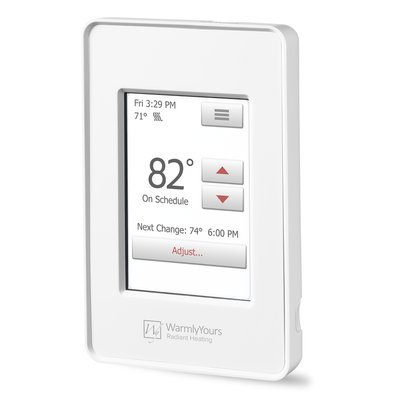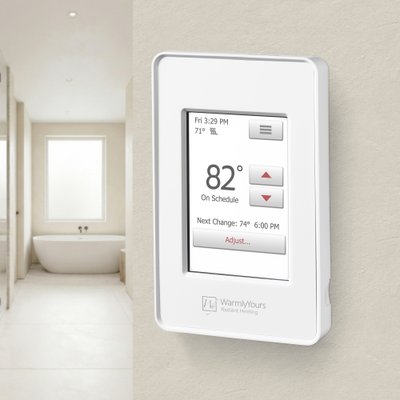
nSpire Touch Programmable Thermostat (UDG4-4999)
Part Number: UDG4-4999
The nSpire Touch thermostat offers all the things you expect from a smart touchscreen thermostat – intelligent, adaptive control and intuitive operation.
This support page provides publications, manuals, specifications, videos, support articles, and common support questions
The nSpire Touch thermostat offers all the things you expect from a smart touchscreen thermostat – intelligent, adaptive control and intuitive operation.
This support page provides publications, manuals, specifications, videos, support articles, and common support questions
Jump to
Support Questions
Showing 10 of 56 questions
How to figure out the Kilowatt Load usage for your WarmlyYours floor heating system?
On the new touchscreen thermostat UDG4-4999, during the startup menu, users will be prompted to enter their KW load usage. Floor Load is the total wattage of the floor heating system that can be found on the installation or electrical plan. A lot of our customers may not know this for a number of reasons (they did not install or order the floor, it may be a replacement, and info on the installation has been lost, etc.) Here is an easy way to help out and get the Kilowatt load they need for this menu step.
Kilowatt load usage can be figured by taking the square footage of the open floor space multiplied by 15 (for tile) or 12 (for carpet and laminate). This gives us the total wattage which we then divide by 1000 to get the Kilowatts.
An example: the user has a 100-square-foot room that is tiled. The math would look like this: 100 sq feet X 15 watts per square foot = 1500 divided by 1000 = 1.5 KW
The breaker and wire sizes are selected based on the total amperage of the WarmlyYours heating system connected to a single thermostat. This information is on the WarmlyYours heating system's installation plan, electrical plan, or UL label. Based on guidelines from the National Electrical Code: loads up to 16 Amps may utilize 12 gauge wire with a 20-Amp breaker, and loads up to 12 Amps - 14 gauge wire with a 15-Amp breaker. Local code and/or other factors may change these guidelines.
In theory, it is possible, if no other options are available. We do not recommend it, but If the thermostat is controlling the floor temperature with a floor sensor, then it can go on an exterior wall. It is important that the floor sensor gets located in an area of the floor not hit by sunshine.
If the thermostat will be controlling the air temperature with the built-in ambient sensor, then it should go on an interior wall.
A GFCI/GFEP (Ground Fault Circuit Interrupter / Ground Fault Equipment Protection) works differently than a circuit breaker by specifically detecting a small imbalance in electrical current between the hot and neutral wires, which indicates a potential ground fault (like a person touching a live wire), and instantly shutting off the power to prevent shock, while a circuit breaker only trips when there's a significant overload in current flow on the circuit, like a short circuit or too many appliances plugged in.
The default is 10k. If this is a new installation, that is the answer. In the very rare occasion that this is replacing an older Energy stat (eg. square OJ Microline from before 2010 with red and green sensor wires), choose 12k. If this is a replacement for the other 99% of the thermostats WarmlyYours sold (Honeywell TH115 and TH111 thermostats), 10k is the value.
Always start with the default 10kΩ and change later if needed.
Pressing and holding (2-3 sec) physical power/reset button will turn the unit completely OFF. Same process turns the unit back on.
(nHance and nJoin units will have the button on the front faceplate, nSpire Touch WiFi, nSpire Touch and nTrust will have the button on the right side of the faceplate.)
Relays can fail due to excessive current or voltage. When a relay is exposed to too much current, the contacts can burn out. High voltage can also damage the coil. Other reasons include mechanical wear and tear, dust or dirt buildup, and moisture. These factors can cause the relay to malfunction or stop working entirely. Regular maintenance and using the relay within its specified limits can help prevent failures.

Reflective insulation is not effective with conductive heating, which is how embedded floor heating and snow-melting systems transfer heat. To be effective, the reflective insulation surface needs to face an air space (air gap), which allows the reflected heat to be redirected.
An effective solution considers the insulating material's R-Value. This is the rating of a material's insulating properties. The "R" stands for "resistance" and refers to the material's resistance to heat flow, or temperature conduction.
No, a circuit breaker will NOT protect against a power surge; a circuit breakers primary function is to protect against excessive current flow (overload), while a surge protector is specifically designed to handle voltage spikes, which are what power surges are considered to be.
The flashing digits indicate that the actual (measured) floor temperature exceeds the thermostat temperature limit.
The temperature limit is set for either tile (104°F/40°C) or laminate (82°F/28°C) when the thermostat is first set up or re-configured.
For example: When the floor type (protection) is set to laminate, the limit defaults to 82°F/28°C. If the floor temperature goes above this - whether due to radiant floor heating or external heating sources, then the digits will flash and the heating is switched off.
Turning the temperature up or down will not affect the flashing digits. And leaving the thermostat alone with flashing digits does not harm the system.
Tip: To turn off the heated floor (ex. for months when it is not needed), on the outer edge of the thermostat, depress the lower right side button for 3-5 seconds. This will also turn it back on.
Yes, this model is dual-voltage and compatible with both 120V and 240V systems. However, ensure your supply voltage matches the voltage requirement of your specific floor heating element (e.g., do not connect 240V power to a 120V heating mat).
For a visual guide on these thermostats, you might find this video helpful:
... OJ Microline UWG4 and UDG4 Touch thermostats overview ...
This video details the features and installation concepts for the UWG4/AWG4 series, confirming its dual-voltage capabilities.
Yes, many homeowners successfully install bathroom floor heating systems themselves. WarmlyYours provides detailed installation manuals, 24/7 technical support, and custom installation plans to guide you through the process. However, a licensed electrician is required to perform the final electrical connections and thermostat wiring to ensure safety and warranty compliance.
Yes. The floor never free-runs — the thermostat’s floor sensor governs output, and you set a maximum floor temperature limit in the thermostat itself. Most heated tile bathroom floors are set between 80°F and 85°F. Set that limit during commissioning and record it on the handoff sheet so the homeowner does not raise it past the flooring manufacturer’s rated maximum.
Yes, electric radiant floor heating can maintain a cozy 70°F even when outside temperatures drop well below zero. By heating the objects and people in a room directly, a properly sized and insulated system provides reliable, consistent warmth that outperforms traditional forced-air systems during extreme Midwestern winters.
Yes, but the tear-out is the real risk. Scan the floor with thermal imaging before demo to map the existing hydronic tubing, and never fasten or drill into it. Keep the two systems on fully independent controls so they cannot fight each other, and do not place the electric floor sensor directly above a hydronic loop — the false-high reading will short-cycle the electric system. Call PRO technical support at 800-875-5285 to review the assembly before ordering.
No. Electric floor heating cable is listed for installation under floor coverings only, and NEC 424.38(A) does not permit heating cable to be installed in walls. Running it vertically voids both the UL listing and the warranty. For warm towels and a little extra room heat, specify a heated towel rack, which is designed and listed for wall mounting.
Yes, radiant floor heating can be a primary heat source if its heat output exceeds the room's heat loss. For best results, we recommend using a 15-watt system, covering at least 80% of the floor, and ensuring the space is well-insulated. Use our Heat Loss Calculator to verify your specific needs.
Yes, radiant floor heating is an excellent primary heat source for tiny houses in mild to moderate climates. Because tiny houses have small footprints, the 15-watt output of TempZone™ can easily maintain comfort while saving valuable wall space. Ensure the structure is well-insulated and use our Heat Loss Calculator to confirm.
Yes, bedroom floor heating can be a DIY project. Systems like TempZone Easy Mats or Environ Flex Rolls are designed for straightforward installation under various flooring types. While you can lay the heating elements and flooring yourself, you must hire a certified electrician to connect the system to power and install the thermostat.
Yes, we strongly recommend installing insulation like ThermalSheet™ over concrete slabs. Concrete acts as a "heat sink," absorbing warmth that should go to your floor. Insulation directs the heat upward, significantly improving efficiency, reducing warm-up times, and allowing the system to function effectively as a primary heat source.
No—electric floor heating systems like WarmlyYours TempZone are designed for DIY installation. The heating mat or cable is embedded in the thinset mortar layer during tile installation, which most experienced DIYers can complete without a professional. However, the electrical connection to the thermostat should be done by a licensed electrician in most jurisdictions.
Underlayment is recommended for floating floors (laminate, LVP, wood) and installations over cold subfloors like concrete. It provides thermal insulation to prevent heat loss and improves system efficiency. For tile and stone, the system is typically embedded in thinset, so a separate underlayment is often unnecessary.
No separate GFCI breaker is required — every WarmlyYours thermostat has a built-in Class A (5mA) GFCI. Stacking a GFCI breaker on top of it is one of the most common causes of nuisance tripping. Run a dedicated breaker sized to the load at 80% continuous duty: a 15A circuit carries up to 1,440W at 120V, a 20A circuit up to 1,920W. Loads beyond the thermostat’s 15A rating need a power module or relay.
- If we aren’t using it for floor, how do we handle the Load Measurement. Do we set that to on or off?
If you do not desire the reporting feature, turn it off.
- For set the floor load, what do we put there?
If you desire the reporting feature, enter the result of your panel’s wattage divided by 1000. For example, the Ember Flex Infrared Heating Panel Heater - 700W parameter would be set to .7
- Set floor protection - what do we put in there, “disabled”?
Yes, since the infrared heating panel is not reliant on an external floor sensor it should be disabled.
- For the Ember Flex panels, do they actually heat up and cool down based on the set point/target temperature? We’ve been running them on timer plugs and they seem to either be all on or all off.
You are correct, they operate as an on/off operation. The panels in this configuration will run until the ambient set temperature is achieved.
To prepare a basement for radiant heating, ensure the concrete subfloor is level, clean, and free of debris. It is highly recommended to install a thermal break, like WarmlyYours CeraZorb, over the slab to prevent heat loss into the ground. Finally, verify that your electrical panel has sufficient capacity for the system's requirements.
Most DIY installations of electric floor heating under tile can be completed in less than a day. The WarmlyYours TempZone Floor Heating Mat is designed for quick installation—unroll the mat, embed it in thinset, connect the thermostat, and tile over it. Allow 24–48 hours for the thinset to cure before turning on the system.
WarmlyYours TempZone™ Flex Rolls and Easy Mats deliver 15 watts per square foot, the maximum allowed by the National Electrical Code. This provides 25% more heating power than the 12-watt industry standard. TempZone™ Cable can be spaced to deliver between 8 and 15 watts per square foot depending on your needs.
Because radiant systems have a thermal lag, you should increase your thermostat set point 12-24 hours before an extreme cold snap arrives. This proactive adjustment, combined with ensuring your home is well-insulated, helps your system maintain a steady, comfortable temperature without struggling to catch up.
Yes, electric radiant floor heating is ideal for basements because it warms the cold concrete slab and provides consistent heat from the ground up. In well-insulated finished basements, it can serve as the primary heat source, turning a typically chilly space into a comfortable, year-round living area.
Radiant floor heating can heat a sunroom if the space has high-quality insulation and double-pane glass. Since sunrooms have high heat loss, a 15-watt system is essential. In extremely cold climates or poorly insulated sunrooms, it is best used as a supplemental source to keep the floor comfortable.
Radiant heating is often more efficient because it eliminates the "blast and fade" cycles and noisy ductwork of forced-air furnaces. By providing steady, low-level heat that doesn't escape to the ceiling, it creates a more consistent "barefoot sanctuary" while potentially reducing your overall energy consumption.
Yes, radiant heating is highly efficient in cold weather. Unlike forced-air systems that lose heat through ductwork and rising air, radiant heat warms objects directly via far-infrared energy. This method is up to 45% more energy-efficient, providing consistent comfort while significantly lowering monthly heating costs in frigid environments.
Both 120V and 240V systems provide the same level of heat and comfort. The choice depends on the size of your project; 120V is typically for smaller areas like bathrooms, while 240V is more efficient for larger rooms. Always consult your electrician to ensure your home’s electrical panel can support the system’s requirements.
Error code "E2" means defective, damaged, or not connected floor sensor. Check connections or replace the sensor if necessary.
Sensor resistance should be in 8kΩ-15kΩ range and can be tested with a digital multimeter on a 20k scale. If the sensor resistance is out of range, it could be damaged. Please note, only one floor sensor can be connected to a single thermostat.
An uncoupling membrane like Prodeso provides a flexible layer between your subfloor and tile, preventing cracks caused by natural floor movement. It also offers waterproofing and vapor management, making it ideal for bathrooms. Plus, the membrane’s studs make cable installation fast and consistent without the need for staples or glue.
The best home features for cold climates include a simple gable roof to shed snow, covered entrances for protection, airtight triple-pane windows to prevent heat loss, and radiant heating systems. These features work together to maintain interior warmth, reduce energy bills by up to 25%, and ensure structural safety during harsh winters.
For tile floors, electric radiant heating mats (like the WarmlyYours TempZone Floor Heating Mat) are the most popular choice because they embed directly in the thinset mortar layer without raising floor height significantly. For irregular room shapes, TempZone Flex Roll or TempZone Cable with Grip Strips offer more flexibility. All three systems work with ceramic, porcelain, and natural stone tile.
For maximum barefoot comfort, most systems are designed to reach a floor surface temperature of 80°F to 85°F. This "sweet spot" ensures your room stays warm through efficient radiation while keeping the floor perfectly comfortable to walk on, even during the coldest months of the year.
Installing floor heating under carpet involves placing Environ heating mats over a pad and then covering them with the carpet. The process typically includes:
- Installing a specific radiant-compatible carpet pad.
- Laying out the Environ mats according to your plan.
- Securing the mats with tape.
- Having a professional installer lay the carpet over the mats.
A heat loss calculation is essential to ensure your radiant system produces more BTUs than your room loses to the outside environment. This professional assessment guarantees your system has the necessary power to serve as your primary heat source, providing peace of mind during record-breaking cold.
GFCI can fail for various reasons, such as wear and tear, moisture, corrosion, power surges, faulty wiring, or improper installation. Some of these causes can be prevented by regular inspection and maintenance, while others may require professional assistance. It is important to note that GFCI devices (ex. thermostat, breakers, outlets) should be tested regularly as these do wear out over time.
Most systems provide only 12 watts per square foot, which often lacks the power for primary heating in cold climates. WarmlyYours TempZone™ delivers 15 watts—a 25% increase. This higher output allows the system to overcome heat loss more effectively, providing reliable primary warmth even when outdoor temperatures drop.
A floor sensor is essential because it monitors the actual temperature of your floor, preventing overheating and ensuring energy efficiency. It allows your thermostat to maintain your desired comfort level precisely. WarmlyYours even includes a backup sensor with our systems to provide long-term peace of mind and reliability.
Bedroom floor heating is popular because it provides consistent, draft-free warmth that enhances comfort in a space where people often walk barefoot. It eliminates cold spots, operates silently, and is highly energy-efficient. Additionally, radiant heat doesn't circulate dust or allergens, contributing to a healthier sleeping environment compared to forced-air systems.
Documents
Wiring Diagrams
- nSpiration Series Thermostat Wiring Diagram (120V & 240V) (English)
- Wiring Diagram for 120V & 240V Floor Heating Products with Relay with Thermostat (English)
- Wiring Diagram for Multiple Twin Floor Heaters with nSpire Series Thermostat Using a Junction Box (English)
- nSpiration Series Thermostat Environ Wiring Diagrams (English)
- nSpiration Series Thermostat TempZone Twin Wiring Diagrams (English)
Operation Manuals
- nSpire Touch (UDG4-4999) Interactive User Manual (English)
- nSpire Touch (UDG4-4999) Interactive User Manual (Spanish)
- nSpire Touch (UDG4-4999) Quick Start Guide and Specifications (English, French, Spanish)
- nSpire Touch UDG4-4999 Interactive User Manual (Spanish)
Technical Information
Sell Sheets
Installation
Specifications
Warranty / Certifications
| Approvals | cULus listed |
| Ingress Protection (IPxx) Rating | IP20 |
| UL File Number | E157297 |
| Warranty | Limited 3-year warranty and lifetime technical support |
Electrical
Appearance
| Color | White |
| Item Shape | Rectangular |
| Material | Acrylonitrile Butadiene Styrene (ABS) plastic |
Thermostat
Product Dimensions
| Depth | 2″ |
| Installed Depth | 0.75″ |
| Length | 5⅛″ |
| Weight | 0.6 lbs |
| Width | 3¼″ |
Controls
| Display | Backlit Display |
| Display Size | 2″ W x 3″ H (3.5″ Diagonal) |
| Languages | English, French, Spanish |
Identifiers
| SKU | UDG4-4999 |
| UPC (GTIN-12) | 881308052850 |
Videos
Articles
Similar Items
Do you need support or specifications for a specific model? Identify your model below.