How Much Does Radiant Floor Heating Cost in 2026?
last updated march 9, 2026


In This Article
Quick Facts: Radiant Floor Heating Cost
- Installed system cost: CA$8–CA$17 per square foot (materials only).
- Typical bathroom project: CA$360–CA$900 for a 50–100 sq ft bathroom.
- Labor: $200–$500 for an electrician; tile installation adds $5–$15 per sq ft.
- Operating cost: As low as $0.01–$0.15 per hour — comparable to a light bulb.
- Payback period: Systems can reduce central heating bills by up to 25%, offsetting upfront costs over time.
- Warranty: WarmlyYours systems carry a 25-year No Nonsense Warranty.
Underfloor heating is one of the most searched home comfort upgrades — and for good reason. It eliminates cold spots, eliminates forced-air noise, and works invisibly beneath any flooring. But before you commit, you want to know exactly what it costs. This guide breaks down every cost variable: materials, labor, operating expenses, and how to pick the right system for your budget.
How Much Does Radiant Floor Heating Cost? (Quick Answer)
Electric underfloor heating materials cost CA$8–CA$17 per square foot, depending on the system type. For a typical 50 sq ft powder room, the total installed cost — including an electrician — runs CA$600–CA$1,100. For a 100 sq ft master bathroom, expect CA$1,100–CA$2,200.
Once installed, the system costs as little as $14–$18 per month to operate in a typical bathroom running 4 hours per day — less than a clothes dryer.
Get an Instant Custom Quote
WarmlyYours offers a free SmartPlan™ — upload your floor plan and receive a custom installation plan with exact product recommendations and pricing within one business day, at no charge.
Cost by System Type
WarmlyYours manufactures several radiant floor heating systems, each suited to different room shapes, budgets, and installation methods. Here’s how they compare on cost:
| System | Best For | Cost per Sq Ft (CA$) | Install Difficulty |
|---|---|---|---|
| TempZone™ Flex Roll | Bathrooms, kitchens, irregular shapes | CA$10–CA$14 | Easy–Moderate |
| TempZone™ Easy Mat (Kit) | Small rooms, first-timers, powder rooms | CA$9–CA$13 | Very Easy |
| TempZone™ Cable | Large rooms, custom spacing, lowest cost/sq ft | CA$8–CA$11 | Moderate |
| Environ™ Flex Roll | Laminate, LVT, carpet, floating floors | CA$10–CA$15 | Very Easy |
| TempZone™ Cable + Prodeso | Wet areas, waterproofing needed | CA$18–CA$25 | Moderate |
Cost by Room Size
Room size is the single biggest driver of total project cost. The table below shows typical material costs using a TempZone™ Flex Roll, which is the most popular system for tile floors. Labor is additional.
| Room | Heated Area | Material Cost (CA$) | Estimated Total Installed (CA$) |
|---|---|---|---|
| Powder Room | 15–25 sq ft | CA$150–CA$300 | CA$550–CA$900 |
| Standard Bathroom | 40–60 sq ft | CA$400–CA$700 | CA$800–CA$1,400 |
| Master Bathroom | 60–100 sq ft | CA$600–CA$1,100 | CA$1,100–CA$2,200 |
| Kitchen | 80–150 sq ft | CA$800–CA$1,800 | CA$1,400–CA$3,000 |
| Open Living Area | 200–400 sq ft | CA$2,000–CA$5,000 | CA$3,000–CA$7,000 |
Note on Heated Area vs. Total Floor Area
You typically heat only the open floor space — not the area under cabinets, vanities, tubs, or toilets. A 100 sq ft bathroom may have only 55–65 sq ft of heatable floor, which significantly reduces material cost.
Featured System: Start Small with a Kit
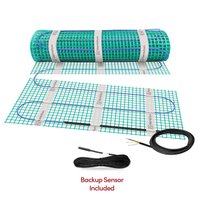
The easiest and most affordable entry point for radiant floor heating is an TempZone Easy Mat kit — everything you need in one box: the heating mat, a SmartStat™ thermostat, and a Circuit Check safety device. No separate shopping required.
The TempZone™ Flex Roll: Most Popular for Tile Floors
For tile, stone, and marble floors, the TempZone™ Flex Roll is WarmlyYours’ most popular electric radiant heat system. The heating cables are pre-spaced on a fiberglass mesh that you roll out and embed directly into the tile mortar — no additional floor height beyond the tile layer itself (just 1/8” profile).
The Flex Roll is ideal for bathrooms, kitchens, entryways, and any room with an irregular shape — you can cut and redirect the mesh to navigate around obstacles without cutting the cable itself.
What Factors Affect the Total Cost?
1. Flooring Type
Tile and stone are the best conductors of radiant heat and require no special system. Hardwood and laminate floors require lower-wattage systems like the Environ™ to prevent warping. Carpet is generally not recommended but possible in some configurations.
2. Thermostat Selection
A basic programmable thermostat adds $80–$150 to your project. A WiFi-enabled smart thermostat runs $150–$250 but can reduce operating costs by 20–30% through intelligent scheduling. It’s one of the best cost-saving investments you can make.
3. Electrical Work
Every floor heating system requires a dedicated circuit breaker and licensed electrician for final connection. This typically costs $200–$500 depending on your local market and whether panel upgrades are needed. DIY installation of the heating mat itself is allowed — only the final electrical connection requires a licensed pro.
4. Room Shape and Obstacles
Simple rectangular rooms cost less to install than rooms with multiple fixtures, islands, or alcoves. The more custom the layout, the more time it takes to plan and install the cable. WarmlyYours’ free SmartPlan™ service accounts for every obstacle in your room and produces a CAD-quality installation plan.
How Much Does It Cost to Run Radiant Floor Heating?
Operating costs are where electric floor heating consistently surprises people — radiant heat flooring is far cheaper to run than most expect. A 60 sq ft heated bathroom floor running 4 hours per day costs roughly $0.45–$0.65 per day, or about $14–$20 per month at the U.S. average electricity rate.
| Heated Area | Daily Use | Est. Monthly Cost (USD) | Est. Annual Cost (USD) |
|---|---|---|---|
| 15 sq ft (powder room) | 2 hrs/day | $3–$5 | $36–$60 |
| 40 sq ft (bathroom) | 4 hrs/day | $8–$12 | $96–$144 |
| 60 sq ft (master bath) | 4 hrs/day | $14–$20 | $168–$240 |
| 100 sq ft (kitchen) | 6 hrs/day | $28–$40 | $336–$480 |
Use the calculator below to get a precise estimate for your specific room size, local electricity rate, and daily usage schedule:
Operating Cost Calculator for Floor Heating
Estimate your daily and monthly energy costs based on room size and local rates.
"Most homeowners are surprised how affordable radiant floor heating is to operate—often just pennies a day for a bathroom. It's the kind of everyday luxury that pays for itself in comfort!"
— Rae RadiantSmart Thermostat = Big Savings
A programmable or WiFi thermostat can cut operating costs by 20–30% by heating only when you need it — for example, warming the floor 30 minutes before you wake up, then turning off while you’re at work. Over 5 years, that’s a meaningful offset against the upfront system cost.
Is Radiant Floor Heating Worth the Cost?
For most homeowners, the answer is yes — especially in bathrooms, kitchens, and entryways where you spend time barefoot. Here’s why the math works:
- Comfort value: Warm floors eliminate the #1 complaint about cold homes in winter — stepping onto freezing tile.
- Energy efficiency: Radiant systems are 20–25% more energy-efficient than forced-air heating because heat rises from the floor up, not the ceiling down. You feel warmer at a lower thermostat setting.
- Home value: Heated floors are a sought-after feature in real estate listings, particularly in master baths and kitchens.
- No maintenance: Electric systems have no moving parts and a 25-year warranty. Once installed, there’s nothing to service.
- Low operating cost: At $14–$20/month for a typical bathroom, it costs less than most people spend on coffee.
Where to Install Radiant Floor Heating
Floor heating works in virtually every room of the house. Here’s where homeowners most commonly install it and why:
| Room | Why It Works Well | Best System |
|---|---|---|
| Bathroom | Most popular room — tile floors get cold, bare feet are sensitive | TempZone™ Flex Roll or Easy Mat |
| Kitchen | Long periods of standing; tile and stone floors common | TempZone™ Flex Roll or Cable |
| Bedroom | Comfortable morning routines; works under LVT and laminate | Environ™ Flex Roll |
| Basement | Concrete subfloors are coldest; radiant is ideal for slab-on-grade | TempZone™ Cable or Environ™ |
| Entryway / Mudroom | High-traffic tile areas; melts snow tracked in from outdoors | TempZone™ Flex Roll |
| Home Office | Sedentary work means feet get cold; supplements low forced-air flow | Environ™ or TempZone™ Easy Mat |
Electric vs. Hydronic: Which Costs Less?
Two Types of Radiant Floor Heating
When people search “radiant floor heating cost,” they often don’t realize there are two fundamentally different systems. Electric systems use resistance heating cables. Hydronic systems circulate hot water through tubing. The costs are dramatically different.
| Factor | Electric (WarmlyYours) | Hydronic (Water-Based) |
|---|---|---|
| Installed cost | CA$8–CA$17/sq ft | CA$15–CA$35/sq ft |
| Boiler / mechanical room | Not required | Required ($3,000–$10,000+) |
| Best for | Supplemental heating, single rooms | Whole-home primary heating |
| Heat-up time | 30–60 minutes | 60–120 minutes |
| Operating cost | Higher per BTU | Lower per BTU (at scale) |
| Maintenance | None — 25-year warranty | Annual boiler service required |
| DIY-friendly? | Yes (mat installation) | No — requires plumber |
Bottom line: For single-room or supplemental heating — which is the vast majority of residential projects — electric is the clear winner on total installed cost, simplicity, and warranty coverage. Hydronic only makes economic sense when heating large areas of a whole home from a new construction boiler.
How to Get the Most Accurate Price for Your Project
Every floor plan is different, and the best way to get a real number for your project is to use WarmlyYours’ free SmartPlan™ service. Here’s how it works:
- Upload your floor plan — a rough sketch or photo is fine.
- Our team designs your layout — within one business day, you receive a CAD-quality installation plan tailored to your room, showing cable routing, cold lead placement, and exact coverage.
- Get your exact product list and price — no estimates, no surprises.
Frequently Asked Questions About Radiant Floor Heating Costs
Operating cost depends on your local electricity rate, the size of the heated area, and how long the system runs. A 120-watt-per-square-meter (about 11 watts per sq. ft.) system heating a 100 sq. ft. room draws roughly 1,100 watts — about — per hour, or — for a typical 8-hour day at the current national average electricity rate. Because floor heating is usually zoned and thermostat-controlled, real-world costs are typically lower than these maximums.
Radiant floor heating costs just $0.01 to $0.15 per hour to operate, making it one of the most energy-efficient heating solutions available. Installation costs vary based on room size and flooring type, but the long-term savings on energy bills make it a smart investment. Use our Operating Cost Calculator to see exactly how much you'll save for your specific space.
Radiant floor heating is highly energy-efficient, typically costing just pennies per hour to operate. Because it heats from the floor up, it warms your kitchen quickly and maintains consistent comfort, helping reduce overall energy bills compared to traditional heating methods.Calculate your exact operating costs using the WarmlyYours Operating Cost Calculator.
The answer to this question will depend on a whole host of variables related to electric floor heating, including, but not limited to, the run time (for supplemental heating, we usually recommend between 4-8 hours per day), the electric radiant floor heating system you're using, the total square footage, and your local electrical cost. Typically, the cost is just a few cents a day.
To figure out how much electric floor heating might cost to run for you, make sure to use our interactive Operating Cost Calculator.
The actual cost of operating your floor heating system will vary depending upon a number of factors including the cost of electricity in your area and the length of time you run your system. Try our Operating Cost Calculator for a quick estimate.
The actual cost of operating your floor heating system will vary depending upon a number of factors including the cost of electricity in your area and the length of time you run your system. Try our Operating Cost Calculator for a quick estimate.
Have Questions About Your Project?
Our team of Radiant Experts is ready to help!
Related Articles

Answering Some of Electric Floor Heating’s Most Frequently Asked Questions (FAQs)

Electric Floor Heating vs. Baseboard Heaters: Pros, Cons & Shared Benefits
5 Questions You Need to Ask Your Floor Right Now

9 Pros and Cons of Radiant Floor Heating (Honest Review)
Stay Updated
Get the latest radiant heating news and tips delivered to your inbox.


Comments