
Contact Us After Hours

Loading...

Loading contact options...

Sign In

Loading...

Loading...

Relay Panels Frequently Asked Questions

Don't see the answer you're looking for? Post your question

Frequently Asked Questions

Showing 10 of 30 questions

That depends on a number of variables (like the temperature outside) but generally speaking these snow melting systems are designed to melt 1" - 3" of snow per hour. Anything above 3" per hour is typically considered blizzard conditions. 

25 people found this helpful Was this helpful? Yes No

Never cut the heating cable. A heating cable will not work if it has been cut. If the heating cable is too long, call WarmlyYours to consult with a technician who will guide you in utilizing the additional length of cable.

18 people found this helpful Was this helpful? Yes No

The material costs are similar. However, electric systems are easier to install, with fewer components and significantly lower maintenance costs. Electric systems will run for a shorter period of time to give the same level of performance but with much higher energy efficiency (typically 95%-98% efficient). Controls and sensors required for the two types of systems are very similar. Electric systems do not usually require slab insulation and do not create the concerns typically associated with hydronic systems. These concerns include, but are not limited to, return temperatures, flue gas venting, waterway shrinkage and property damage caused by leaking pipes or tubes.

15 people found this helpful Was this helpful? Yes No

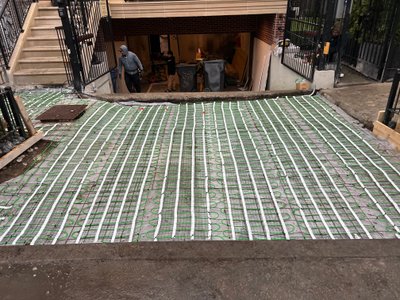
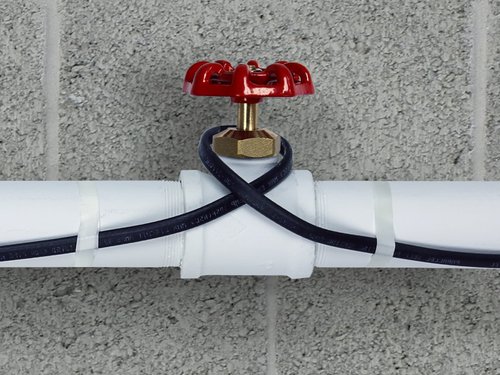
When installing outdoor WarmlyYours snow melting cables for your driveway, patio, walkway, terrace, stairs, ramp, etc. - NEVER cross, overlap, or allow the heating cables to touch each other. Doing so will quickly cause a circuit failure due to excessive heat build up. Always follow the installation instructions and/or design layout plan to ensure the cable is installed with the correct spacing required for proper operation.

14 people found this helpful Was this helpful? Yes No

Our systems can handle low temperatures, but many controls come equipped with a Low-Temperature Lockout Feature. This feature prevents the system from running in very low temperatures. At very low temperatures it can become difficult for the system to effectively melt the snow. It is however possible to turn off this feature should you need the system to keep running during such low temperatures.

14 people found this helpful Was this helpful? Yes No

Yes. The manufacturer's splice that connects the heating element to the cold lead should be entirely embedded in a noncombustible material (like asphalt, concrete, or mortar) within the outdoor surface that is being heated. 

13 people found this helpful Was this helpful? Yes No

GFEP is the National Electric Code (NEC) required protection for fixed outdoor deicing and snow-melting equipment, which may be accomplished by using circuit breakers equipped with ground-fault equipment protection (GFEP) of 30 mA. It is important to understand that this required equipment protection is NOT the same as a 5 mA GFCI used for personal protection.

10 people found this helpful Was this helpful? Yes No

To ensure optimal performance, snow melting heating elements should be installed so that they are consistently 2"-3" from the finished surface. For installations using pavers, the maximum thickness for pavers installed over heating elements is 2.5". 

9 people found this helpful Was this helpful? Yes No

All of our automatic controllers have a Hold-on time feature after the initial warming up of the snow melt system. This feature ensures that all the snow is melted from the surface, and also that the system continues to operate and evaporate the surface water without it refreezing.

9 people found this helpful Was this helpful? Yes No

This type of installation should not significantly affect the longevity of the driveway. Be sure to have a professional for your surface material type evaluate this during installation.

7 people found this helpful Was this helpful? Yes No

Pavers can be removed and reinstalled for a retrofit application of our snow melt system. Tire tracks are not typically recommended for paver surfaces, so any retrofit application would most likely need to be full coverage. In this case, it should be treated like a brand new installation, just with existing pavers.

7 people found this helpful Was this helpful? Yes No

When the design requirement's amp draw exceeds the selected controller's capacity.

5 people found this helpful Was this helpful? Yes No

If a cable is damaged during installation, recheck the system for continuity and confirm the integrity of the insulation with a megohmmeter, or "megger" tester, referring to the installation and testing instructions. If the cable fails any of these tests, take the following actions: clear a 3 foot square working area around the damaged section of cable, and record the cable part number from the UL tag and the location where you purchased the product. Call WarmlyYours with the above information. WarmlyYours will provide further assistance and supply a splice kit suitable for repairing the particular cable.

4 people found this helpful Was this helpful? Yes No

The layer of noncombustible material needed below snow melting heating elements must be at least 2" deep. 

3 people found this helpful Was this helpful? Yes No

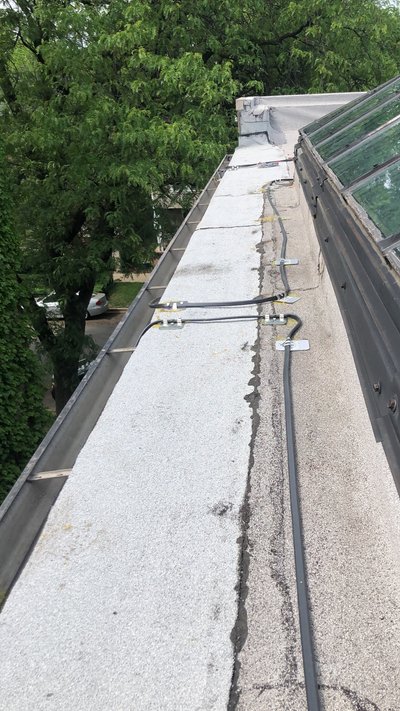
Each heating cable comes with a factory installed cold lead wire that must be routed through the rigid metal 3/4" conduit to a outdoor rated junction box where a simple wire nut connection can be made for the electrical hook-up.

3 people found this helpful Was this helpful? Yes No

Always confirm the power requirements with the electrician. Large snow melting systems usually require a new electrical panel or electrical service. Contact WarmlyYours for a quotation, indicating the actual power capacity available, and to obtain recommendations for reducing the power consumption. For example, opting for tire track coverage rather than installing the snow melting system over the entire driveway can dramatically reduce power requirements.

2 people found this helpful Was this helpful? Yes No

Once you've decided what type of heating system (manual vs. automatic), you'll need to choose a control, which may or may not utilize a sensor. You may need a relay panel(s) depending on the size of the system, and a snow melt plaque which is required by the National Electric Code. Junction box(es) may be optional depending on the distance of heating cable from the indoor power location.

2 people found this helpful Was this helpful? Yes No

It depends on how the system is intended to operate. If the expectation is manual operation (ex. WiFi or Timer Control), then no sensors are required. If the expectation is automatic operation, then the system will require at least one snow sensor.

2 people found this helpful Was this helpful? Yes No

Ground fault equipment protection (GFEP) is intended to provide protection for equipment against damaging line-to-ground currents by disconnecting all ungrounded conductors of the faulted circuit.

2 people found this helpful Was this helpful? Yes No

No, a sensor is not required with the snow melt system. However, certain automatic controllers require a temperature/moisture sensor to sense atmospheric conditions and may also require an in-slab, high temperature limit sensor to be installed (notably, asphalt installations).

1 person found this helpful Was this helpful? Yes No

This feature prevents the snow melting system from running, by default, in temperatures below 17°F (–8.33°C), or as set by the user. At temperatures this low, it becomes difficult for the system to effectively melt the snow. It is, however, possible to turn off this feature should the system be required to keep running during these low temperatures.

1 person found this helpful Was this helpful? Yes No

The relay panel is not rated for outdoors.  It can be put in a NEMA 4 box outdoors to meet this requirement.

Was this helpful? Yes No

A heated driveway can add meaningful resale value, particularly in snow-belt markets where buyers understand and appreciate the benefit. While there is no universal appraisal standard for heated driveways, real estate professionals in high-snowfall regions commonly report a 2–5% premium for homes with snow melting systems — especially when the system covers the full driveway and includes automatic controls.

Beyond the dollar value, a heated driveway is a strong differentiator in a competitive market. Buyers who have experienced the convenience firsthand — or who dread the prospect of shoveling — will often prioritize a home with a heated driveway over a comparable home without one.

The value impact is strongest in markets with 20+ annual snow events, where the system provides clear, recurring benefit every winter.

Was this helpful? Yes No

The payback period for a heated driveway typically ranges from 5 to 12 years, depending on three key factors: your local climate (how many snow events per season), what you currently spend on snow removal, and the size and coverage type of your system.

Here's a general framework:

  • Light snow climates (10–15 events/year, e.g. Denver, Kansas City): 8–12 year payback
  • Moderate snow climates (15–25 events/year, e.g. Chicago, Minneapolis): 5–8 year payback
  • Heavy snow climates (25+ events/year, e.g. Buffalo, Burlington VT): 4–6 year payback

These estimates assume you're replacing professional plowing ($300–$900/season) and salting ($50–$150/season), and factor in typical operating costs of $100–$300/season. Homeowners who currently pay for plowing see the fastest payback.

Was this helpful? Yes No

A heated driveway typically costs between $0.12 and $0.60 per hour to operate, depending on the size of the system and your local electricity rate. A 200 sq. ft. tire-track system runs at the lower end, while a full-coverage 1,000 sq. ft. driveway runs at the higher end. Most systems only activate when snow or freezing conditions are detected, so they don't run continuously. Over a full winter season, operating costs are typically $100–$300 — far less than the cost of annual salt, shoveling services, or driveway repairs from salt damage.

Was this helpful? Yes No

To calculate the system's approximate operating costs, multiply the total kilowatts of the system by your local electricity rate. Let's use the example of a 350 sq. ft. concrete patio (residential application), with 240 VAC, at the U.S. national average rate of $0.17 per kWh.

Total Watts: multiply area in sq. ft. × 50 Watts
350 × 50 = 17,500 Total Watts

Kilowatts: (the unit by which we purchase electricity) divide Total Watts by 1,000
17,500 Watts ÷ 1,000 = 17.5 kW

Cost per Hour: multiply kW by your local kWh rate
17.5 kW × $0.17/kWh = $2.98 per hour of operation

Hours of Operation: using a typical 6-hour snowfall as an example
$2.98 × 6 hours = $17.85 for that storm

All of this will vary based on your local electricity rate and "after-run time." After-run time is the period the system remains on after snow stops falling to fully dry the slab and prevent refreezing — typically 1–3 additional hours. Rates vary widely by state; check your utility bill for your actual kWh rate. Use our Operating Cost Calculator to get a personalized estimate based on your zip code.

Was this helpful? Yes No

It depends on what you're comparing it to. In light-snow climates (fewer than 10 significant snow events per year), the financial payback period is longer — typically 10–15 years — because you're replacing less snow removal spending. However, the non-financial benefits remain the same regardless of snowfall: no shoveling, no ice hazards, no salt damage to your driveway surface.

For homeowners in light-snow climates, the strongest case for a heated driveway is often ice prevention rather than snow removal. Even a light dusting followed by a temperature drop can create dangerous black ice on a driveway — and a snow melting system eliminates that risk automatically. If you have elderly family members, mobility challenges, or a sloped driveway, the safety benefit alone may justify the investment regardless of snowfall frequency.

Was this helpful? Yes No

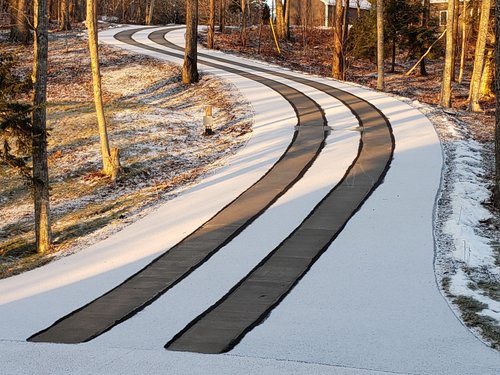
For driveways with a grade (slope) of 5% or more, WarmlyYours recommends full-coverage snow melting rather than tire-track heating. Here's why grade matters:

  • 0–4% grade (nearly flat): Tire-track heating is a cost-effective option. The unheated areas between tracks are a minor inconvenience.
  • 5–8% grade (moderate slope): Full coverage is strongly recommended. Unheated areas between tire tracks become primary slip hazards for pedestrians stepping out of vehicles.
  • 8%+ grade (steep): Full coverage is essential. Gravity significantly increases the risk of vehicle sliding and pedestrian falls on any unheated surface.

On a slope, a vehicle that makes it up a heated tire track can still slide sideways if the surrounding surface is icy. Full coverage eliminates the entire hazard — not just the vehicle path. The additional material cost is approximately 35% more than tire-track heating, but it is the only option that truly eliminates the risk on a steep grade.

Was this helpful? Yes No

The best pet-safe deicers for driveways are magnesium chloride and urea-based products. Magnesium chloride is gentler on paws than rock salt or calcium chloride, works down to about -13°F (-25°C), and is less harmful to vegetation. Sand and kitty litter are also completely pet-safe traction options, though they don't melt ice. Always rinse pets' paws after walks on treated surfaces. For a truly pet-safe solution, a heated driveway eliminates the need for any chemical deicers entirely.

Was this helpful? Yes No

The fastest way to melt ice on a driveway without salt is to use a rubbing alcohol spray (mix 2 parts 70% isopropyl alcohol with 1 part warm water in a spray bottle) or a calcium chloride-based deicer. Both work rapidly at low temperatures. For thick ice, break it up with a metal ice scraper first, then apply the deicer. A heated driveway system is the only permanent solution — it prevents ice from forming in the first place.

Was this helpful? Yes No