
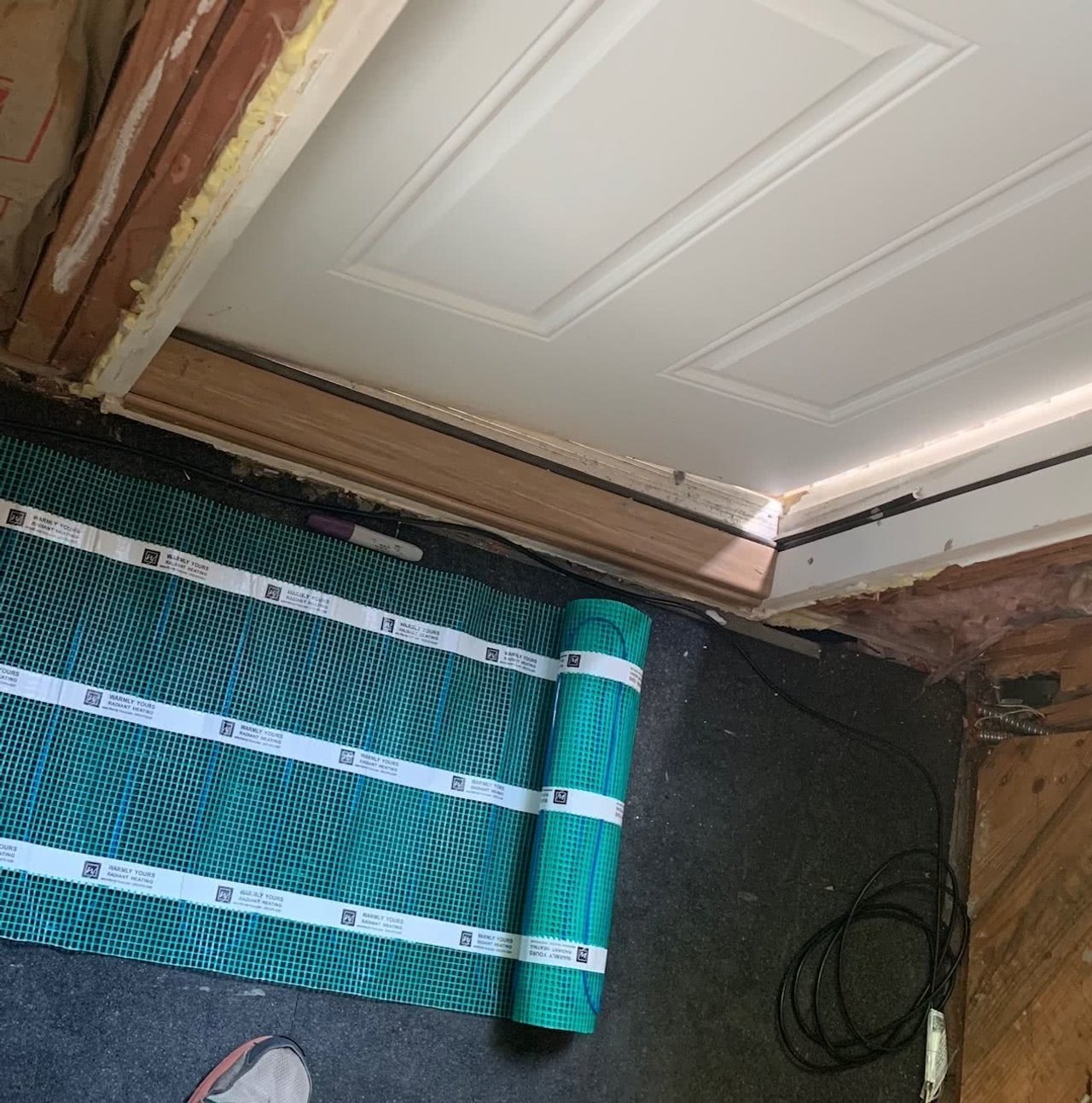
Doing laundry barefoot on cold winter tile is a small daily misery most homeowners just accept. In this New Jersey home, the laundry room doubled as the family's main entry point, so that chill greeted everyone the moment they walked in. A 22.5 sq. ft. TempZone™ Flex Roll installed over CeraZorb® underlayment now delivers gentle, even floor warming for about nine cents an hour — no ductwork, no radiators, and no lost floor space.
Project Details
| Specification | Detail |
|---|---|
| Location | New Jersey, USA |
| Space Type | Laundry Room / Mudroom Entry |
| Flooring / Surface Type | Tile |
| System Type | Electric Radiant Floor Heating |
| Room Square Footage | 53 sq. ft. |
| Heated Square Footage | 22.5 sq. ft. |
| Technical Specs | 120V / 356W / 3A |
| Wattage per Sq. Ft. | ~15.8 W/sq. ft. |
| Cable Spacing | 3 in. OC (TempZone™ Flex Roll standard) |
| Subfloor | Wood, with CeraZorb® synthetic cork thermal break |
| Products Used | TempZone™ Flex Roll (TRT120-1.5x15), nSpire Touch Thermostat (UDG4-4999-WY), CeraZorb® Insulating Underlayment (CZRG-SH5MM-24X24) |
| Operating Cost | ~$0.09 per hour (356W at $0.2531/kWh, NJ) |
| Professional Installer | Home Owner |
Behind the Warm Tile: How a 53 Sq. Ft. Laundry Room Changed Its Reputation
The Problem: A Hard-Working Room Nobody Wanted to Linger In
Laundry rooms get built for function, not feeling — and tile over a wood subfloor is a recipe for cold feet from October through April. In this home the room carried double duty as the primary entrance, so it set the temperature of the whole arrival experience. Adding a duct run or a wall unit to a 53 sq. ft. utility space wasn't practical, and the homeowner didn't want to sacrifice a square inch of usable room.
The Solution: Warmth Built Into the Floor Itself
A 22.5 sq. ft. TempZone™ Flex Roll was laid across the room's open walking zone. Because the heating cable is pre-spaced at 3 inches on center and fixed to a flexible mesh, the roll could be cut and turned around the appliances and fixtures without ever cutting the cable — full coverage exactly where feet land. CeraZorb® insulating underlaymentwent down first, creating a thermal break so the 356 watts push heat upward into the tile instead of bleeding into the wood subfloor below. Tile was then set directly over the roll in thin-set mortar, adding zero meaningful floor height.
The Outcome: A Warm First Step, on a Schedule
An nSpire Touch programmable thermostat ties it together, warming the floor before the morning routine starts and easing off when the room is empty. Tile that once radiated cold is now comfortable underfoot, laundry day stops being a barefoot endurance test, and the family's main entry feels like part of the house rather than a passage through it — all for pennies an hour, with an energy monitor on the wall to prove it.
Featured Products
- TempZone™ Flex Roll (TRT120-1.5x15) — Solved the coverage problem in an awkward, appliance-crowded footprint. At 1.5′ × 15′, the mesh could be cut and turned to trace the room's real walking path, so no watts were wasted heating the space behind the washer.
- CeraZorb® Insulating Underlayment (CZRG-SH5MM-24X24) — Chosen because the subfloor was wood, which readily absorbs heat downward. This synthetic cork layer blocks that loss, cutting warm-up time and keeping the hourly operating cost low over the system's life.
- nSpire Touch Thermostat (UDG4-4999-WY) — Turns comfort into a schedule instead of a running expense. Its floor sensor holds a steady surface temperature, built-in Class A GFCI protection covers safety in a wet-prone room, and on-screen energy monitoring shows the homeowner exactly what warmth costs.


