
Bathroom Heating & Electrical Safety: IP Ratings, GFCI, and Where Each Product Can Go
last updated july 7, 2026

In This Article
Yes—you can absolutely add heat to your bathroom. A heated towel warmer, an infrared radiant panel, a mirror defogger, and an LED mirror are all designed to live in a bathroom, and all are independently safety-certified. The catch is where each one can go. The bathroom is one of the wettest, most electrically demanding rooms in your home, so placement, circuit protection, and a product’s moisture rating all matter.
This guide explains what an IP rating actually tells you, what the U.S. National Electrical Code (NEC) and Canadian Electrical Code (CEC) require, and where each of the most popular bathroom heating and mirror products can generally go. Local code always governs the final placement of any electric appliance or heater.
Quick Facts
- IP rating: Two digits—first is protection from solids/dust, second is protection from liquids.
- The non-negotiable: In North America, local code—not the IP rating—governs placement, and bathroom heating must be on a GFCI-protected circuit.
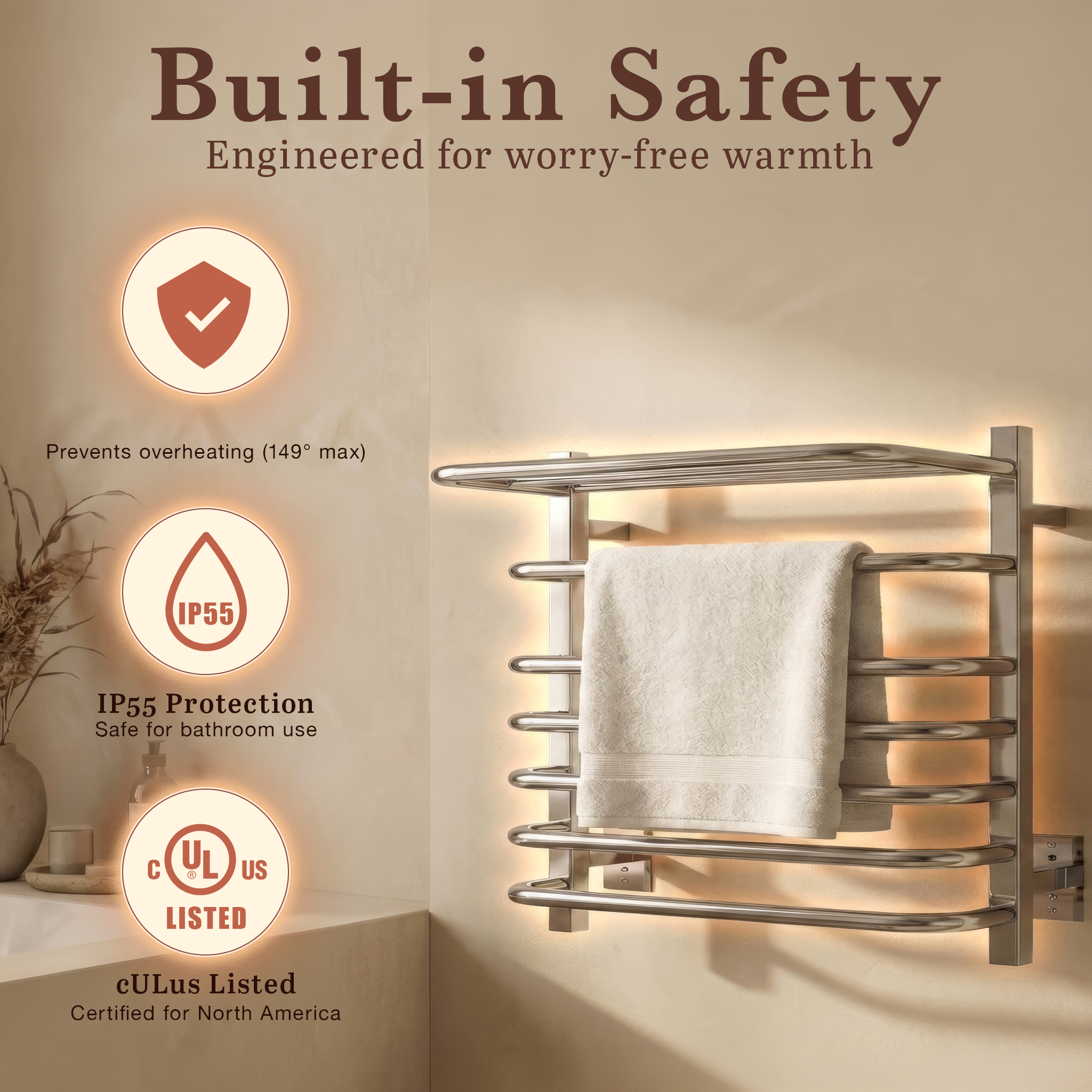
- Towel warmers: WarmlyYours models are safety-listed (cULus or cETLus, depending on the line) and rated IP44 or IP55 (varies by model)—great for the bathroom, never inside or near a shower or tub.
- Infrared panels: Ember Flex is IP65 and cTUVus certified—keep clear of direct shower/tub spray.
- Mirror defoggers: cULus listed and regulated to 104°F—mount behind a mirror, never inside a shower.
- LED mirrors: Hardwired and cULus listed—install over the vanity on a GFCI circuit, never in the shower.
What is an IP rating?
An IP (Ingress Protection) rating tells you how well a product’s enclosure resists intrusion from solids and liquids. It’s expressed as two digits, and each digit means something different.
- First digit (solids): protection against dust and solid objects—and against fingers or tools reaching hazardous internal parts. It runs from 0 (no protection) up to 6 (completely dust-tight).
- Second digit (liquids): protection against moisture, from dripping water up to powerful jets and immersion. It runs from 0 (no protection) up to 8 (continuous immersion) and beyond to 9 (high-pressure, high-temperature jets).
So an IP55 rating means “protected against dust and against water jets from any direction,” while IP65 means “fully dust-tight and protected against water jets.” When you see an “X” in a rating (like IPX4), it simply means that digit wasn’t tested or rated—not that protection is zero.
Heads up: bathroom “zones” are not a U.S. concept
You may have read about bathroom “Zones 0–3” with specific IP minimums. That zoning system comes from international (IEC) and UK wiring regulations. In the United States and Canada, bathroom electrical safety is governed instead by the NEC and CEC—using GFCI protection, listed locations, and clearance distances from the tub or shower. This guide follows the North American rules.
What the NEC and CEC require
Rather than dividing the bathroom into zones, North American codes focus on three things you should confirm for any heating product:
- GFCI protection. Bathroom receptacles and electrically heated equipment must be protected by a Ground-Fault Circuit Interrupter, which cuts power in milliseconds if it detects current leaking to ground.
- A listed product for the location. Look for a recognized safety listing (such as cULus, UL, CSA, or cTUVus). The listing confirms the product was independently tested for its intended environment.
- Manufacturer clearances. Every product’s installation manual specifies how far it must stay from a tub, shower, or other water source. Those clearances are part of the listing—follow them exactly.
Any hardwired heating product should be connected by a qualified electrician who will verify the circuit, grounding, and GFCI protection meet local code.
Note: IP ratings and bathroom zones are commonly referenced in international standards (IEC/UK). In the United States, electrical installations are governed by the National Electrical Code (NEC), which does not use zone classifications but instead focuses on wet/damp location ratings and GFCI protection.
Towel warmers
A heated towel warmer is one of the easiest and most satisfying upgrades you can add to a bathroom. WarmlyYours towel warmers are independently safety-listed (cULus or cETLus, depending on the line) and carry an ingress-protection (IP) rating that varies by model—many are rated IP55 (protected against dust and low-pressure water sprays from every direction), while some models carry an IP44 rating (protected against solid objects over 1 mm and splashing water from any direction). Both are well suited to an indoor bathroom, but an IP rating is not a substitute for code: regardless of the rating, a 120V towel warmer cannot be installed inside a shower stall, and local code always dictates the final location. Every WarmlyYours towel warmer includes built-in TempSmart™ overheat protection that caps the surface temperature.
That rating makes a towel warmer perfectly at home in an indoor bathroom, mudroom, or hotel room, mounted on a GFCI-protected circuit. The one firm rule: never install a towel warmer inside a shower, bathtub, or wet sauna, and never position the brackets where the heating elements could reach a water source. An IP44 or IP55 rating means water-resistant—tolerant of splashes and steam—not waterproof or submersible.
Browse the full collection of heated towel warmers to find a size and finish for your space.
Infrared radiant panels
Electric infrared panels are a sleek, wall- or ceiling-mounted way to add supplemental warmth. Instead of heating the air, they radiate gentle infrared energy that warms people and surfaces directly—much like the sun. Our Ember Flex panels carry an IP65 rating (fully dust-tight and protected against water jets) and are cTUVus certified.
That IP65 rating gives a radiant panel solid moisture resistance for bathroom use, but it is still not designed for submersion or direct, sustained water contact. Keep the panel clear of direct spray—don’t mount it immediately beside a bathtub, shower, or pool, especially in an outdoor installation. Position it so a person showering or bathing won’t bump it and so splashing reaching the panel is minimal.
See the full range of infrared heating panels for bathrooms and beyond.

Mirror defoggers
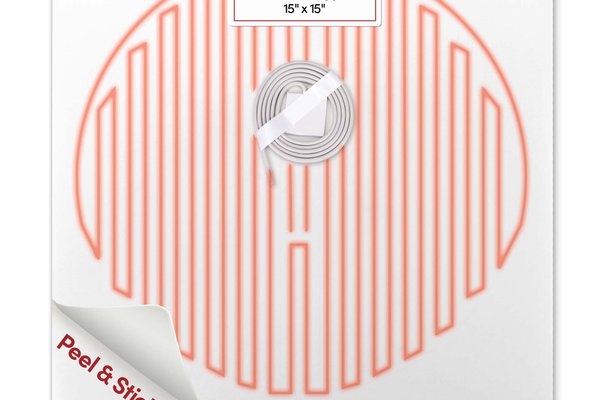
A mirror defogger is a thin heating pad that mounts directly behind your bathroom mirror to keep it clear and steam-free. Flip on the lights and the mirror stays fog-free, even after the steamiest shower. Our ClearlyYou™ defoggers are cULus listed and safely regulate the mirror surface to about 104°F using very little energy.
Because a defogger lives behind the mirror rather than out in the open, it isn’t assigned a published IP rating—but the safety rules are just as important. It must be wired by a qualified electrician to a GFCI-protected circuit (it connects to your 120V lighting circuit), and every switch in the bathroom should be properly grounded. One clear limit from the manufacturer: a mirror defogger cannot be installed in a shower, sauna, or steam room.
Explore every size and shape of mirror defogger for a fog-free bathroom.
LED mirrors
An LED mirror takes the defogger idea a step further, combining backlit lighting, adjustable color temperatures, and—on many models—a built-in defogger in one wall-mounted fixture. Our Marquee Series mirrors, like the Judy, are hardwired (120 VAC) for a clean, wire-free look and use cULus listed components, so the same bathroom electrical rules apply.
Because an LED mirror is hardwired, it must be installed on a GFCI-protected circuit by a qualified electrician, mounted on the wall outside the shower or tub enclosure. Treat it like any other bathroom light fixture: it belongs over the vanity, not where it can take direct spray. Models with an integrated defogger keep the glass clear while the LED lighting gives you even, shadow-free task light.
Discover the full range of LED bathroom mirrors, including models with built-in defoggers and magnification.
Quick comparison
| Product | IP rating | Certification | Where it can go | Near |
|---|---|---|---|---|
| Towel warmer | IP44–IP55 (varies by model) | cULus or cETLus (varies by line) | Bathroom wall, GFCI circuit | Inside or near a shower or tub |
| Infrared panel | IP65 | cTUVus certified | Bathroom wall or ceiling, clear of spray | Inside or near a shower, or in direct spray |
| Mirror defogger | N/A (behind mirror) | cULus listed | Behind any wall-hung mirror, GFCI circuit | Inside or near a shower or steam room |
| LED mirror | N/A (light fixture) | cULus listed | Over the vanity, hardwired to a GFCI circuit | Inside or near a shower enclosure |
When in doubt, call a pro
Codes vary by jurisdiction and are updated regularly. Always follow your product’s installation manual and have a licensed electrician confirm circuit, grounding, GFCI, and location requirements for your specific bathroom.
Bathroom Heating Safety FAQs
Yes. WarmlyYours towel warmers are to be installed in accordance with the instructions in the manual and CEC, NEC, and local code guidelines relating to electrical fixtures in bathrooms. A towel warmer with a hardwired connection must be on a GFCI-protected circuit and be wired by a professional who is certified to do electrical wiring. Towel warmer models with plug-in connections should be used with a GFCI outlet.
Infrared heating panels can be installed in bathroom if they are far enough away from water sources. These units are not allowed in any shower or tub enclosure. Make sure that the infrared heating system cannot be touched by any person who is in the bath or shower. Please install in accordance with local electrical code requirements.
Panels installed in a bathroom should be installed in compliance with your local electrical code, or at least 2 feet away from the perimeter of a wet area (shower or bath enclosure).
No. Mirror defoggers are not rated to be installed in wet locations like a shower enclosure.
Yes. Mirror defoggers are specifically engineered for damp bathroom environments and are safe when installed according to electrical codes. However, they are not suitable for wet zones such as inside showers, so proper installation location is key to safety and longevity.
The bottom line
All four products—towel warmers, infrared panels, mirror defoggers, and LED mirrors—are built and certified for bathroom use. Stick to a GFCI-protected circuit, respect each product’s clearances from water, keep heating elements out of the shower and tub, and let your local electrical code have the final say on placement. Do that, and you’ll enjoy warm towels, gentle radiant heat, and a fog-free mirror with complete peace of mind.
Have a bathroom project in mind? Explore our towel warmers, infrared panels, mirror defoggers, and LED mirrors—and subscribe to the Radiant Journal for more home-comfort guides like this one.
Have Questions About Your Project?
Our team of Radiant Experts is ready to help!
Related Articles

How Do Electric Towel Warmers Work?
How Mirror Defoggers Work: The Simple Science Behind a Clear Reflection

Mirror Defoggers: The 10 Questions Everyone Asks (And a Few You Haven’t Thought Of)

Create a Wellness Spa Bathroom with Heated Floors & Towel Warmers
Stay Updated
Get the latest radiant heating news and tips delivered to your inbox.