
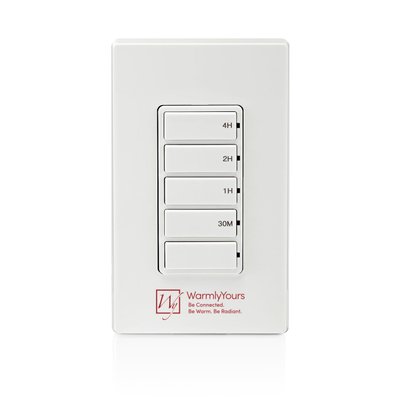
Hardwired 4-Setting Countdown Timer (GK16-30090-0006)
This support page provides publications, manuals, videos, support articles, and common support questions
Notices
Quebec Repairability Notice
Avis important pour les consommateurs du Québec:
WarmlyYours ne fournit ni services de réparation ni pièces de rechange pour ce produit. Si votre thermostat de chauffage de sol intérieur tombe en panne pendant la période de garantie, nous remplacerons l'unité complète conformément à notre politique de garantie. Notre équipe de soutien technique est disponible par téléphone 24h/24 et 7j/7 pour l'assistance à l'installation et au dépannage. Pour tous les détails, veuillez consulter notre Politique de Retour. Cet avis est fourni conformément à l'article 39 de la Loi sur la protection du consommateur du Québec (telle que modifiée en 2025).
Important Notice for Québec Consumers:
WarmlyYours does not provide repair services or replacement parts for this product. If your indoor floor heating thermostat fails within the warranty period, we will replace the entire unit according to our warranty policy. Our technical support team is available 24/7 by phone for installation and troubleshooting assistance. For full details, see our Return Policy. This notice is provided in accordance with Québec’s Consumer Protection Act, section 39 (as amended in 2025).
Support Questions
Showing all 3 questions
A GFCI/GFEP (Ground Fault Circuit Interrupter / Ground Fault Equipment Protection) works differently than a circuit breaker by specifically detecting a small imbalance in electrical current between the hot and neutral wires, which indicates a potential ground fault (like a person touching a live wire), and instantly shutting off the power to prevent shock, while a circuit breaker only trips when there's a significant overload in current flow on the circuit, like a short circuit or too many appliances plugged in.
No, a circuit breaker will NOT protect against a power surge; a circuit breakers primary function is to protect against excessive current flow (overload), while a surge protector is specifically designed to handle voltage spikes, which are what power surges are considered to be.
GFCI can fail for various reasons, such as wear and tear, moisture, corrosion, power surges, faulty wiring, or improper installation. Some of these causes can be prevented by regular inspection and maintenance, while others may require professional assistance. It is important to note that GFCI devices (ex. thermostat, breakers, outlets) should be tested regularly as these do wear out over time.