

In This Article
Installing bathroom tile heating is a straightforward process, but callbacks and failures almost always stem from poor subfloor preparation or skipped testing steps rather than a faulty heating cable. To protect your margins and ensure a flawless installation, every trade professional should follow a strict pre-install protocol. This 5-step checklist covers the critical layout rules, multimeter tests, and documentation required before the thinset ever touches the floor, ensuring a flawless installation of a heated tile floor and protecting your warranty.
Pro Series · Part 1 of 2 — Before the Thinset. Continue with Part 2: The During-Install and Handoff Playbook for Pros.
The 5-Step Pre-Install Checklist
Before mixing your thinset, ensure you have completed each of the following steps to verify the system’s integrity and prepare the space:
| Step | Action | Key Requirement |
|---|---|---|
| 1 | Identify No-Heat Zones | Keep 4” from wax ring, 3” from walls |
| 2 | Multimeter Testing | Verify core resistance and insulation (OL) |
| 3 | Subfloor Preparation | Flat within 1/8” over 10’, clean of debris |
| 4 | Floor Sensor & Thermostat | Center between wires, install backup sensor |
| 5 | 3-Photo Documentation | Wide shot, sensor close-up, multimeter reading |
Watch: The 5-Step Pre-Install Checklist
Download the Pro Checklist
Get the official Bathroom Install - 5 Step Pre-Install Checklist (PDF) to keep on the job site.
Step 1: Identify No-Heat Zones
Before rolling out any cable, mark your no-heat zones directly on the subfloor. Keep the heating wire 3 inches away from walls and ensure no heat is placed under solid base cabinets or permanent fixtures. If your project includes a high-end feature like curbless shower floor heating, be sure to plan those specific clearances early.
Marking these zones does more than protect fixtures—it right-sizes your order. In a typical bathroom, only about 40–60% of the floor actually needs heat once you subtract the vanity, tub, toilet footprint, and wall clearances. Don’t order cable for the whole room; measure the true heatable area and buy for that, or you’ll be left with cable you can’t use.
PRO Tip: The Wax Ring Rule
Heating elements must be kept at least 4 inches away from the toilet wax ring. This prevents the heat from melting the wax and causing severe water leaks.
Watch: The Turn Radius Mistake That Kills a System
No-heat zones are only half of the layout equation—cable spacing and turn radius are the other half. Bending a heating cable tighter than its minimum turn radius, or crowding runs together, creates a hot spot that can fail the entire circuit even after a perfect resistance test. This 60-second clip shows exactly how one over-tight bend takes down a whole system, and why a designed layout (not freelanced spacing) is your best protection.
Step 2: Multimeter Testing
Quick Definitions
Before diving in, you’ll need to understand two critical testing terms: Resistance (measured in ohms, this confirms the heating cable is intact and the correct wattage) and OL (Open Loop) (a multimeter reading indicating infinite resistance, which verifies there are no shorts in the system).
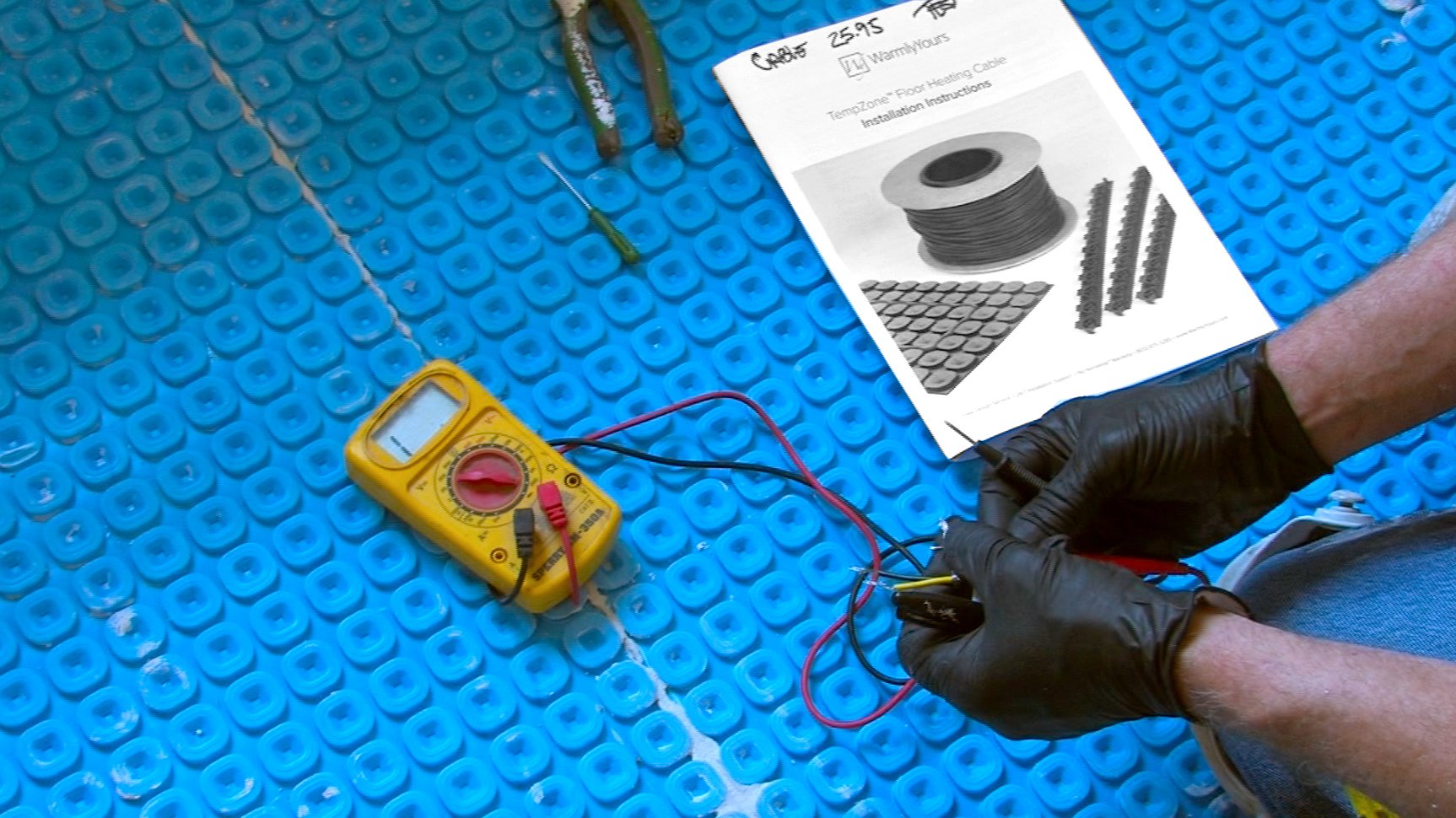
Never install a heating element without verifying its integrity first. You must perform two specific multimeter tests out of the box. First, check the core resistance to ensure it falls within +/- 10% of the factory specification (using the formula R=V²÷W if needed). Second, perform an insulation test to verify there are no shorts; your digital multimeter should read “OL” (open loop) when testing between the core wire and the ground sheath.
Don’t test just once. The manual references the ohmmeter dozens of times for a reason—test the element three times: out of the box before you start, midway once it’s positioned, and again at the end before hooking up the thermostat. Catching a nicked cable midway is a minor fix; catching it after the thinset is down is a floor demolition.
| Test Type | Expected Reading | What It Means |
|---|---|---|
| Core Resistance | Within +/- 10% of factory spec | Verifies the heating cable is intact and correct wattage. |
| Insulation (Ground) | “OL” (Open Loop) or Infinity | Verifies there are no shorts or damage to the protective sheath. |
PRO Tip: Multimeter Core Resistance
If you don’t have the factory specification handy, you can calculate the expected core resistance using the formula R=V²÷W (Resistance = Voltage squared divided by Wattage). Your reading should always fall within +/- 10% of this value.
Step 3: Subfloor Preparation
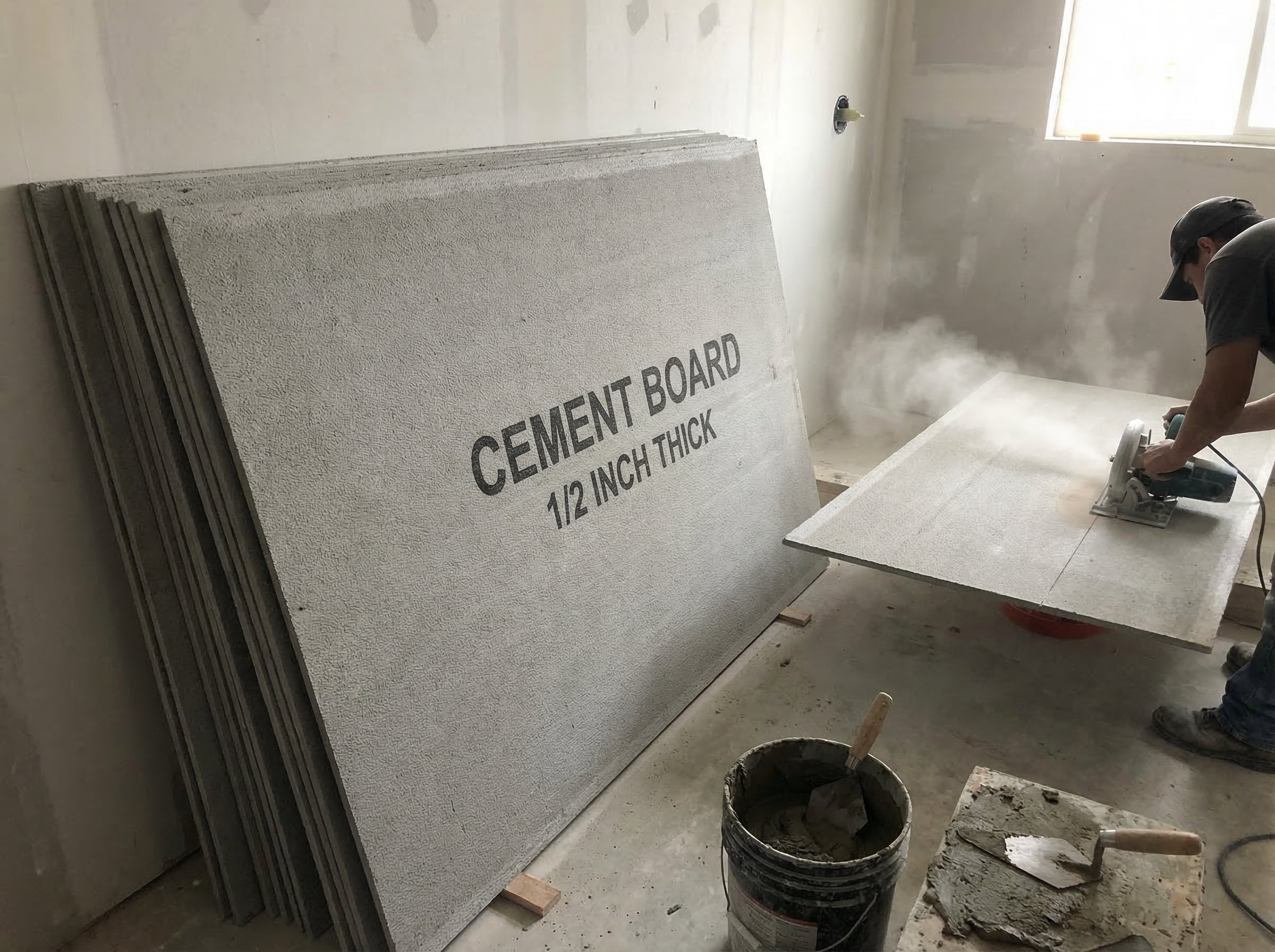
A perfectly prepped subfloor is non-negotiable. Perform the “hand test” by rubbing your hand across the surface to check for grit, sharp edges, or debris that could nick the cable. The floor must be flat within 1/8-inch over a 10-foot span. If you are using a self-leveling underlayment (SLU), always apply the correct primer beforehand to prevent the SLU from pulling moisture out of the thinset too quickly. For more tips on what to watch out for, read our guide on common tile installation mistakes to avoid.
While you’re at the subfloor stage, field-verify every measurement—don’t trust an old plan. Fixtures change during a remodel (a bigger tub or vanity gets swapped in) and quietly eat into your heatable square footage. Re-measure the actual space before you finalize the cable length so the layout you ordered still fits the room you’re standing in.
To prevent tile lippage and ensure a perfectly flat surface, review our guide on how to ensure a level tile floor with radiant floor heating. If you need a complete walkthrough, check out our step-by-step guide on how to install floor heating under tile.
Step 4: The Floor Sensor & Thermostat
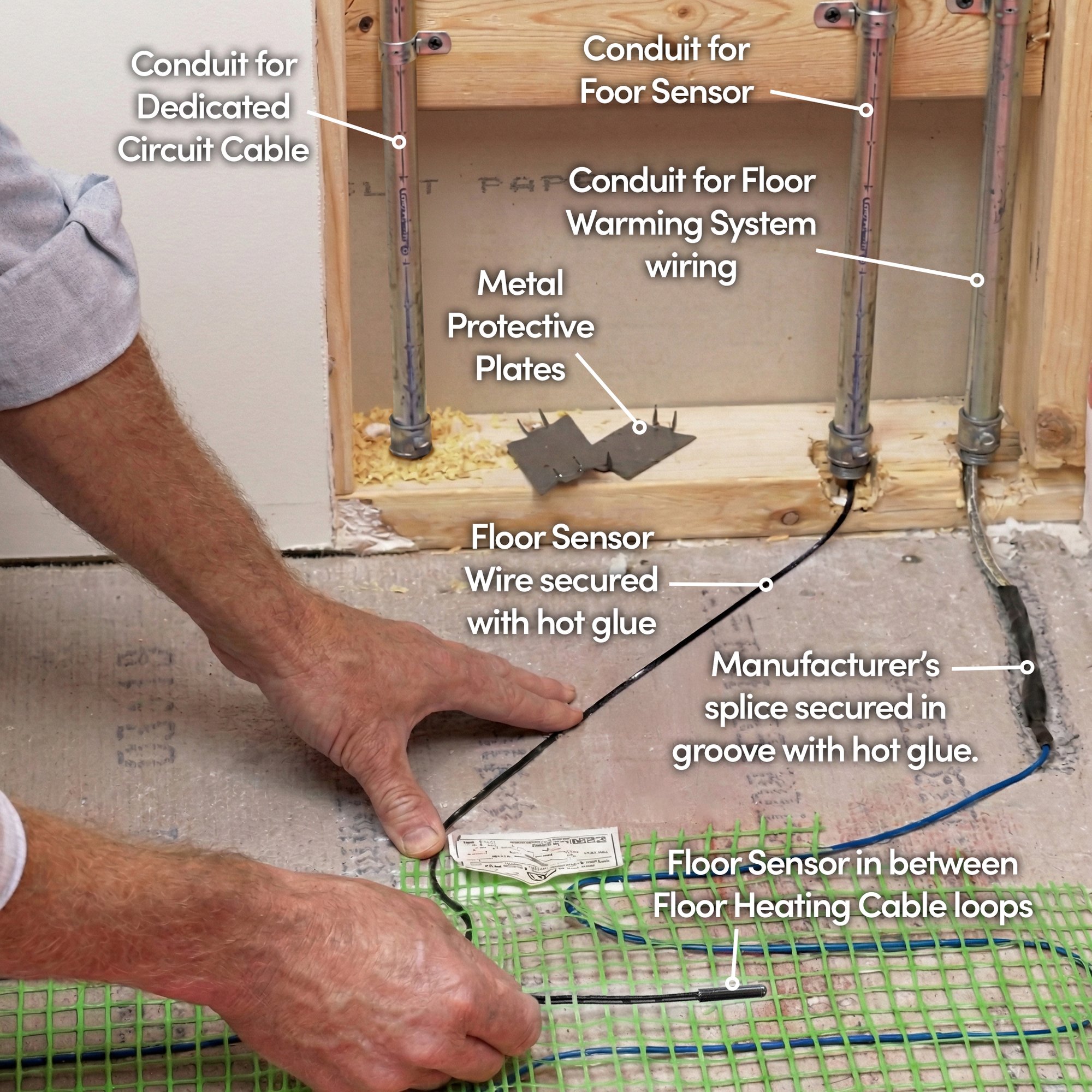
Proper sensor placement dictates how well the system performs. Center the floor sensor exactly between two heating wires—never let it cross or touch the heating cable, which causes short cycling. As a pro tip, always run a second, backup sensor to the thermostat box. It costs almost nothing upfront but saves you from tearing up the floor if the primary sensor ever fails.
The Power Plan: Voltage, GFCI & Thermostat Placement
Before you finalize the order, lock down the electrical plan—these three decisions prevent the most common day-of-install surprises and post-install callbacks.
240V Is Not “More Efficient”
A common misconception is that 240V heats faster or runs cheaper. It does neither. Voltage only changes how much floor area you can cover per amp—240V covers roughly twice the area on a single circuit. Most bathrooms under about 120 sq ft run perfectly on a single 120V circuit and one breaker slot; reach for 240V only when the heated area is large enough to need it.
Just as important is how you provide GFCI protection. The required ground-fault protection comes from the WarmlyYours thermostat, not from a GFCI circuit breaker. Pairing the system with a GFCI breaker as well creates nuisance tripping and needless service calls—wire the thermostat to a standard breaker and let the thermostat do its job.
Finally, plan your thermostat location during rough-in: mount it at an accessible, code-compliant height (roughly 60 inches to center) on an interior wall—never buried inside a vanity cabinet or behind a door swing where it can’t read the room or be reached.
Step 5: The 3-Photo Documentation Protocol
Protect your warranty and your business by documenting the installation before the thinset goes down. Take three specific photos: a wide shot showing the overall layout and clearances, a close-up of the floor sensor placement, and a clear photo of the final ohms reading on your multimeter. Record the product serial numbers on your test log.
For more best practices, be sure to review The Golden Rules of In-Floor Heating Installations to ensure your projects always meet professional standards.
Once your heating system is laid and the tile is set, the final step is finishing the surface. Check out our top tips for installing tile grout to ensure a professional, long-lasting finish.
This checklist ends where the thinset begins. For the field decisions that follow — routing cable around floating vanities and wall-hung toilets, choosing between an uncoupling membrane and fixing strips, securing loose cable, wiring dual sensors for redundancy, logging resistance at all three stages, and the 28-day cure and homeowner handoff — continue with Bathroom Tile Heating: The During-Install and Handoff Playbook for Pros.
Get a Free SmartPlan™ for Your Next Bathroom
Your Free, Custom Layout & Product List
Don’t leave your margins to chance. A free, custom SmartPlan™ gives you a precise layout, a complete electrical plan, and an exact product list tailored to your floor plan—so you install your heated tile floor with confidence and get to the next job faster.
Frequently Asked Questions
To ensure proper installation, use a digital ohmmeter and a Circuit Check™ tool. Test the heating element's resistance out of the box, after positioning it, during flooring installation, and before hooking up the thermostat. The Circuit Check™ will sound an alarm if a short occurs, alerting you to damage immediately.
A successful floor heating project requires careful planning and execution. Key steps include verifying your subfloor is clean and level, mapping out no-heat zones, performing multimeter tests before and after installation, and taking photos of the layout and sensor placement before applying thinset.
No, radiant heating elements should never be installed under permanent fixtures like bathtubs, toilets, or solid-base vanities. Doing so traps heat, which can damage the fixtures, waste energy, and cause the heating cable to overheat and fail. Always maintain proper clearances.
Yes, DIY installation is possible, but professional help is recommended for certain steps. You can plan the layout, position the heating mats, and secure the cables yourself. However, a licensed electrician must complete all electrical connections, including the thermostat and GFCI setup, to ensure safety and maintain your warranty.
Essential tools include a measuring tape, tile cutter, levelers, thinset mixer, and grout float. For radiant heating, you also need an ohmmeter to test cable resistance before, during, and after installation. WarmlyYours offers complete installation kits that include these specialized tools to ensure a successful project.
The correct order is critical for moisture control. First, prepare and seal the concrete slab. Next, install a vapor barrier, followed by ThermalSheet insulation. Then, lay the heating element and secure it. Finally, cover the element with self-leveling cement or thinset before installing your final flooring.
Bathrooms account for about 70% of electric floor heating installations. The system eliminates the shock of cold tile, providing barefoot comfort. Additionally, radiant heat helps dry wet floors faster, which reduces slip hazards and prevents mold growth in these compact, moisture-prone spaces.
Voltage does not affect efficiency or heat-up speed—it only changes how much floor area a single circuit can cover. 240V covers roughly twice the area per amp. Most bathrooms under about 120 sq ft run perfectly on a single 120V circuit and one breaker slot; choose 240V only for larger heated areas.
No. You cannot cut or shorten the factory heating cable, and you cannot splice two mats together. The cable is manufactured to a fixed resistance, so trimming it changes the electrical load and voids the warranty. Measure your heatable area first and order the correct length for the space.
No. The required ground-fault protection is built into the WarmlyYours thermostat, so you wire the system to a standard breaker. Adding a GFCI circuit breaker as well causes nuisance tripping and needless service calls. Let the thermostat provide the GFCI protection.
Have Questions About Your Project?
Our team of Radiant Experts is ready to help!
Related Articles

Stay Updated
Get the latest radiant heating news and tips delivered to your inbox.