
ThermalSheet Insulating Underlayment (2′ x 3′) - 6 Sq. Ft. - 1 Sheet


- Single 2′ x 3′ sheet of synthetic cork insulating underlayment that functions as a thermal break
- Heat and cold resistant, and will not rot, support mold and mildew, or absorb moisture
- ThermalSheet has a 1.5 R-value, and it offers crack isolation of up to 1/4″
- This lightweight insulating underlayment will increase the energy efficiency of your floor heating system
- Can be used under a wide range of floor coverings like tile, stone, LVT, and laminate and can be used over any acceptable subfloor
ThermalSheet Insulating Underlayment Description
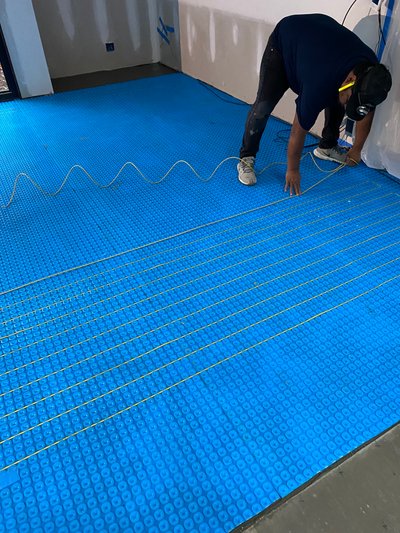
ThermalSheet is a synthetic cork underlayment that is installed on top of a subfloor and below a heating element. It is recommended when installing an electric floor heating system over a concrete slab to prevent heat loss. By creating a thermal break, the heat is prevented from sinking into the concrete, and more heat radiates into the floor covering and room. In addition to preventing unnecessary heat loss, ThermalSheet provides sound dampening benefits and double the crack isolation benefits when compared to cork.
ThermalSheet is lightweight—up to 25 times lighter than traditional 1/4” backer board. This product is a 6 mm (less than 1/4 in.) thick, synthetic cork underlayment that can be installed with modified thinset and is specifically designed for setting tile and stone. It is an excellent insulation choice under our TempZone™ or Environ™ electric radiant floor-heating products. It’s a very resilient underlayment with compressive strength of 41 psi at 25% strain, 54 psi at 50% strain, and 110 psi at 75% strain. ThermalSheet has been rated for residential use according to the Robinson Test.
This item is a 2’ x 3’ (6 sq. ft.) single sheet.
Specifications
Insulation Specification
| Acoustic testing on 6" slab, no ceiling | IIC 52 wood construction. FIIC 59 - 7.5″ concrete slab. ΔIIC 20 - 6″ concrete slab |
| Compressive Strength | 41 psi at 25% strain, 54 psi at 50% strain, and 110 psi at 75% strain |
| Material | Expanded Polypropylene (EPP) |
| Thermal Insulation | 1.5 R-Value |
Product Dimensions
| Coverage | 6 ft² |
| Depth | 0.24″ |
| Length | 36″ |
| Weight | 0.4 lbs |
| Width | 24″ |
Identifiers
| SKU | TS-SH6MM-24x36 |
| UPC (GTIN-12) | 881308077037 |
Warranty / Certifications
| TCNA Robinson test | Residential |
| Warranty | 5 years |
Documents
Installation
- ThermalSheet Insulating Underlayment Installation Instructions (English)
- ThermalSheet Insulating Underlayment Installation Instructions (Spanish)
Technical Information
- PRO Field Checklist: Electric Floor Heating Diagnostics & Troubleshooting (English)
- ThermalSheet Energy Efficiency Report (English)
- ThermalSheet Underlayment Data Sheet (English)
Sell Sheets
Frequently Asked Questions
Showing all 5 questions
When installing electric floor heating over a concrete slab, an insulating underlayment like ThermalSheet is highly recommended to ensure efficient operation, faster heating times and warmer floor temperatures.
When WarmlyYours electric floor heating systems are being installed on a concrete slab, we strongly recommend adding a layer of insulation over the slab prior to installing the system. While our electric floor heating provides up to 25% more heating power per square foot than many of our competitors, the slab will always act as a "heat sink." Some of the heat that would otherwise be transferred to the flooring surface will remain in the slab, causing the floor’s surface temperature to be considerably lower. This is true with any electric radiant floor heating system.
When installed on top of a concrete slab without insulation, it is generally accepted that electric floor heating will take the chill away from the floor and provide a small amount of warmth. Adding insulation on top of the slab and beneath any electric radiant floor heating system will allow a greater percentage of the heat generated to transfer to the flooring surface. This results in greater efficiency and therefore faster warm up times, higher expected surface temperatures and lower energy usage. The floor will have the capacity to warm to a comfortable temperature, and in some cases can be employed as the primary heat source for that room.
The recommended types of insulation are natural cork, insulated tile backer boards and insulated underlayment, such as ThermalSheet™ synthetic cork.
Insulating underlayments and uncoupling membranes share some key characteristics like providing crack isolation benefits, but they are separated by their primary functions.
Insulating underlayments, like WarmlyYours ThermalSheet, provide a thermal break between a subfloor and the heating elements, which can help prevent the concrete from acting as a “heat sink” and increase energy efficiency. ThermalSheet has a 1.5 R-value, and it offers crack isolation of up to ¼”. This can be particularly beneficial if you are trying to heat a room above a cement slab or above an unheated garage.
Uncoupling membranes, like the Prodeso membrane, are great for protecting relatively fragile floor coverings like tile from foundational movement. They also allow for faster installation times than many other types of floor heating.
No, for the installation of an Environ heating system with a floating floor like laminate, it is not necessary to adhere the ThermalSheet underlayment to the subfloor. The underlayment should instead be allowed to float freely on the subfloor. Make sure to stagger adjacent sheets of underlayment and tape them together to prevent any overlaps, ensuring a flat and even layer beneath your flooring. This method helps accommodate the natural expansion and contraction of the floating floor.
Any type of underlayment/padding may be used as long as it has a density of 6-8 pounds per cubic foot. Certain underlayment, such as ¼” (6mm) thick cork, or 6mm ThermalSheet are recommended for Environ™ Flex Rolls. It is also acceptable to place a vapor barrier, such as a plastic sheet, under the underlayment. Underlayment papers are not compatible with Environ™ Flex Rolls. Underlayment is necessary to prevent Environ™ Flex Rolls from damage from the weight of the floor, furniture, and people. Unavoidable wooden floor movements will not harm Environ™ Flex Rolls. Wooden floors expand and contract with temperature and moisture change. The wooden floor “moves” on top of Environ™ Flex Rolls. This movement will not damage Environ™ Flex Rolls when the installation is done correctly and the underside of the final floor covering is installed evenly. Some underlayment materials also have a noise reducing and insulating effect. When installing over concrete, a ¼” underlayment is mandatory. Any underlayment available in ¼” size is acceptable in most cases. ThermalSheet, cork, or ¼” to 3/8” of expanded polystyrene (EPS) with a density of 2 pounds per cubic foot or more, are recommended for installation under Environ™ Flex Rolls. When installing over a concrete slab, choose the underlayment with the highest R-Value.


