
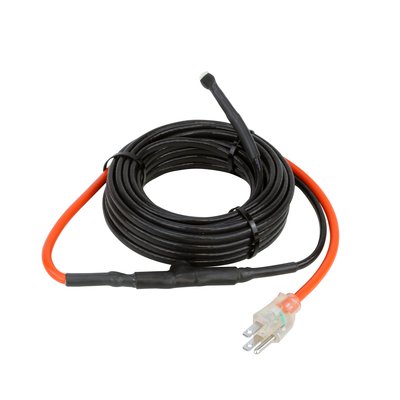
PRO-Tect Plug-In Heat Tape for Pipes — 3 ft, 7 W/ft, 120V
This support page provides publications, manuals, specifications, videos, support articles, and common support questions
Support Questions
Showing 10 of 16 questions
Heat tape is electrical equipment: improper installation, damaged cable, or misuse can cause fire or electric shock. Select cable approved for your pipe and location, follow its layout and insulation requirements, provide the specified electrical protection, and inspect it before each cold season. Do not use damaged equipment or overlap cable unless the exact product instructions permit it.
Yes, it can be used for both application types to prevent pipes from freezing and bursting during cold weather.
Heat trace, heat tape, or heating cable for pipes is typically an electric heating cable that can be attached to the pipe which helps keep non-flowing water pipes in poorly insulated perimeter walls flowing despite harsh winter temperatures.
Pipe heat tape is intended for freeze prevention, not as a guaranteed way to thaw an already frozen pipe. A frozen pipe may be damaged. Have the plumbing assessed and thawed safely by a qualified professional; never use an open flame. Before future cold weather, verify cable selection, thermostat placement, insulation, and electrical protection.
Cable temperature depends on the product, surrounding conditions, installation, and controls. Do not assume a universal surface-temperature range. Follow the exact cable and pipe manufacturers’ limits, particularly for plastic pipe, and use the specified insulation and thermostat placement.
Pipe heat tape electricity use depends on cable length, power output, run time, and controls. For a fixed-output cable, watts = length in feet × W/ft. A 30-foot, 7 W/ft kit draws 210 watts while energized; eight energized hours uses 1.68 kWh. Multiply by your local rate for cost. Thermostat duty cycle and self-regulating output change actual consumption.
PRO-Tect plug-in pipe heat tape carries a 2-year warranty. Service life depends on installation, exposure, operation, and maintenance; the warranty is not a service-life prediction. Inspect cable, insulation, thermostat contact, and electrical protection before each cold season and stop using damaged equipment.
No. Do not run constant wattage heating cable through walls, ceilings, or floors. The constant wattage cable must be installed 1/2“ away from combustible material.
Only use on water pipes with a length greater than 3‘. Maximum pipe diameter of 1.5“. Never use a cable that is longer than the pipe. Never install constant wattage pipe heat on plastic/PVC/PEX piping unless it is filled with water at all times. Never install on pipes heated above 149°F/65°C such as steam lines.
Never spiral heating cable on pipes. Apply the constant wattage cable straight along the bottom of horizontal pipe, or the "weather side" of verticle pipe. For pipes 1“-1.5“ in diameter, apply two separate cables on opposite sides of the pipe. Please refer to the installation manual for further information.
Heating cable may remain on the pipe year round, but WarmlyYours recommends turning off or disconnecting the power when air temperatures remain above 50°F/10°C. Always inspect the heating cable and its power connection at the beginning of the heating season.
WarmlyYours does not recommend using an extension cord for permanent installations. Pipe heat should always be plugged directly into a receptacle or hardwired to the circuit that is powering it.
No. It is not listed for this application, and it is not warrantied for use in direct burial or wet applications.
Constant wattage cable cannot be used on plastic pipe unless it is filled with water at all times. Never spiral or wrap heating cable around pipes. Keep the heating cable straight along the pipe. In order to obtain even heat distribution, WarmlyYours recommends wrapping plastic pipe with aluminum foil before applying the heating cable. Never use more than ½“ of fiberglass or other non-flammable pipe insulation because this can cause the cable to overheat and cause a serious fire hazard or electrical shock.
Use good quality electrical tape with a minimum 176°F/80°C temperature rating at 5.9“ (15cm) intervals. Never use metal binding to secure heating cable to pipe.
Ice Shield is 120V and outputs 5W/ft, and is designed for roof and gutter deicing applications.
PRO-Tect is 120V and outputs 7W/ft, and is designed for pipe freeze protection applications.
Documents
Installation
Sell Sheets
Project Planners
Specifications
Electrical
| Amps | 0.18 A |
| Cable Construction | Twin conductor |
| Cable Type | Constant Wattage |
| Conductor Insulation | XLPE |
| Connection Method | Plug-in |
| Ohms | 685.7 Ω |
| Outer Insulation | PVC |
| Plug-Type | NEMA 5-15 (Type B) |
| Plug-in Cable Diameter | 0.31″ / 8mm |
| Plug-in Cord Length | 24″ |
| Voltage | 120 V |
| Watts | 21 W |
| Watts Per Linear Ft. | 7 W |
Warranty / Certifications
| Approvals | cUL Listed, CSA Listed, and cETLus Listed |
| Warranty | 2-year warranty |
Product Dimensions
| Cable Cross Section | 0.31″ x 0.23″ / 8mm x 6mm |
| Heating Cable Length | 3′ |
| Splice Dimensions | 0.56″ x 6.69″ x 0.94″ / 1.4cm x 17.5cm x 2.4cm |
| Weight | 0.2 lbs |
Installation
| Maximum Pipe Diameter | 1 ½″ (3.81cm) |
| Minimum Bend Radius | 1″ (2.54cm) |
| Minimum Installation Temperature | 15°F (-10°C) |
Identifiers
| SKU | PTC120-7W-003 |
| UPC (GTIN-12) | 881308062330 |
Controls
| Thermostat | Built-in: ON setpoint 37.4°F (3°C), OFF setpoint 50°F (10°C) |
Videos
Similar Items
Do you need support or specifications for a specific model? Identify your model below.