
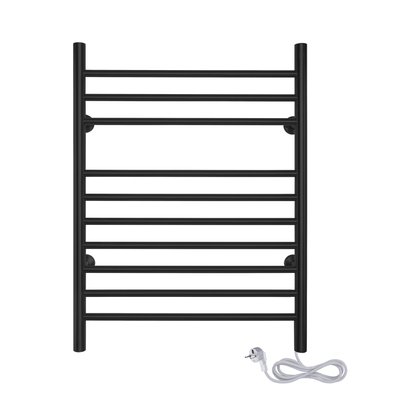
Infinity Towel Warmers, Black Finish with White Power Cord, 150W, 230V, 10 Bars
This support page provides publications, manuals, specifications, videos, support articles, and common support questions
Support Questions
Showing all 9 questions
A WarmlyYours electric towel warmer can't be installed in a tub or shower enclosure. A WarmlyYours electric heated towel rack should be installed at least 24” away from a wet location like a shower, tub, etc. Always install a WarmlyYours electric towel warmer in compliance with all local building and electrical codes.
Yes. WarmlyYours towel warmers are to be installed in accordance with the instructions in the manual and CEC, NEC, and local code guidelines relating to electrical fixtures in bathrooms. A towel warmer with a hardwired connection must be on a GFCI-protected circuit and be wired by a professional who is certified to do electrical wiring. Towel warmer models with plug-in connections should be used with a GFCI outlet.
WarmlyYours towel warmers are all 120VAC units. Towel warmers are available in wattages from 35 watts all the way up to 250 watts. A single towel warmer would typically range from 1-2 amps based on the model. Wire size and breaker size need to be selected based on the total amperage of the towel warmer(s). For towel warmers installed in bathrooms, a GFCI breaker is required.
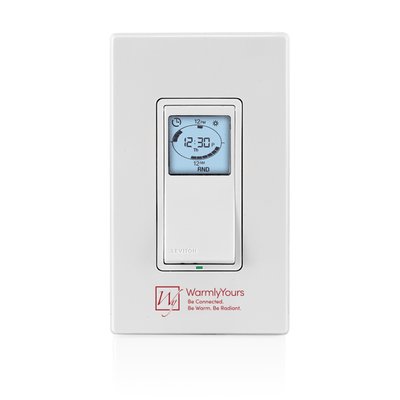
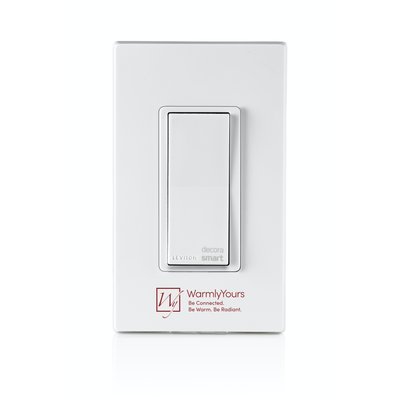
Yes, a regular (non-dimming) light switch can be used as an external switch to control a towel warmer, in addition to the built-in switch on the towel warmer itself.
However, do not use a dimmer switch — dimmer switches are not compatible with electric towel warmers and can damage the unit or create a safety hazard.
Note: A GFCI breaker powering the switch may be required by local Electrical Code.
A good starting point is to follow the recommendation often provided in the installation manual. The location of your electric towel warmer should take building code, safety, functionality, and aesthetics into consideration. If the towel warmer is mounted too low, towels may drag on the floor, causing tripping or mold issues. Mounting it higher reduces risk of burn, especially for children or those who may accidentally bump into it. If you are unsure what height is best for you, consult your WarmlyYours representative at +1 (800) 875-5285.
Yes! Unlike bucket-style warmers designed only for dry towels, heated towel racks with exposed bars are built to handle both wet and dry towels. In fact, drying damp towels is one of the primary benefits of owning a heated towel rack.
Drying wet towels: The gentle warmth (typically 100-140°F on the bars) evaporates moisture, keeping towels fresh and reducing musty odors, mildew, and bacteria. Most towels dry within a few hours depending on thickness and bathroom humidity.
Warming dry towels: Hang dry towels about 15-30 minutes before your shower or bath for a luxuriously warm towel when you step out—like a spa experience at home.
Tips for best results:
- Spread towels across multiple bars rather than bunching them up
- This maximizes surface contact with the heated bars and speeds drying
- Our heated towel racks are UL/cUL listed for safe use in humid bathroom environments
Heated towel racks offer many benefits, though there are a few considerations to keep in mind:
Pros:
- Warm, cozy towels – Step out of the shower to spa-like luxury every day
- Towel drying – Keeps towels dry between uses, extending time between washes
- Reduces mildew & bacteria – Dry towels don't develop musty odors
- Energy efficient – Costs only 15-25¢ per day to operate
- Bathroom heating – Adds supplemental warmth to cold bathrooms
- Versatile – Also dries swimsuits, delicates, and winter gear
- Style enhancement – Modern designs in finishes like brushed gold and matte black
- Year-round use – Benefits extend beyond winter
Cons:
- Installation required – Wall-mounted models need mounting; hardwired units need an electrician
- Wall space needed – Requires dedicated bathroom wall space (or floor space for freestanding)
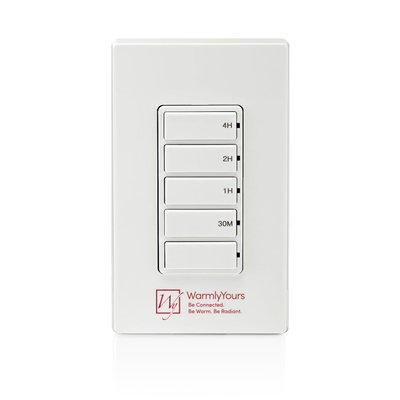
- Not instant – Takes 15-30 minutes to fully warm towels (solution: use a timer)
- Initial cost – Higher upfront investment than a basic towel bar (but long-term savings on laundry)
For most homeowners, the daily comfort and hygiene benefits far outweigh these minor considerations.
Bucket towel warmers and heated towel racks both warm your towels, but they work differently and serve different needs:
Bucket towel warmers:
- Enclosed cabinet that heats towels placed inside
- Best for dry towels only—not designed to dry wet towels
- Sits on a counter or floor, taking up surface space
- Typically holds 1-2 towels at a time
- Higher energy use (around 500 watts)
- Must remove towel to use it
Heated towel racks:
- Open bars that warm towels hung on them
- Dries wet towels between uses AND warms dry towels
- Wall-mounted options save floor space; freestanding available too
- Holds multiple towels simultaneously
- Energy efficient (50-150 watts, about 15¢/day)
- Towels always accessible and on display
- Adds bathroom style in finishes like brushed gold, matte black, and stainless steel
Bottom line: If you want to warm AND dry towels while saving space and energy, a heated towel rack is the better choice. Bucket warmers work for quick warming of dry towels but can't dry them after use.
The ideal location for your towel warmer depends on your bathroom layout and how you plan to use it. Here are the best placement options:
1. Near the shower or tub (recommended)
Install your heated towel rack within arm's reach of your shower or bathtub, but outside the splash zone. This lets you grab a warm towel immediately when stepping out. Electrical codes require towel warmers to be at least 24 inches from the edge of a bathtub or shower.
2. On an interior wall
Mounting on an interior wall (not an exterior wall) can make installation easier and may provide better heat retention. Interior walls often have easier access for electrical wiring.
3. Away from drafts
Avoid placing your towel warmer near windows, doors, or HVAC vents where drafts could reduce its efficiency.
4. At proper height
Wall-mounted towel warmers are typically installed with the bottom bar about 24-36 inches from the floor, allowing easy access while keeping towels off the ground.
Freestanding option: If wall mounting isn't ideal, our freestanding towel warmers offer flexibility—place them anywhere with access to a standard outlet.
Specifications
Electrical
| Amps | 0.65 A |
| Connection Methods | Plug-in or Hardwired |
| Cord Length | 1.9 m |
| Ingress Protection (IPxx) Rating | IP44 |
| Ohms | 352.67 Ω |
| On/Off Switch | Yes |
| Plug-Type | CEE 7/7 |
| Thermal Power | 0.15 kW |
| Voltage | 230 V |
| Watts | 150 W |
Performance
| Average Surface Temperature | 65 °C |
| BTU Per Hour | 512 Btu |
| Heat-up Time | 15-20 minutes |
| Heating Area | 1 m² |
| TempSmart Safety Limit | 65°C - 75°C |
| Towel Capacity | 1-2 |
Appearance
Product Dimensions
| Bar Thickness (Radius) | 9.5 mm |
| Depth | 121 mm |
| Height | 813 mm |
| Size | 600 x 813 x 121 mm |
| Weight | 10 lbs |
| Width | 600 mm |
Installation
| Mounting Method | Wall Mounted |
| Rotatable | No |
Logistics
| Package Contents | Towel Warmer, installation manual and hardware kit |
Identifiers
| SKU | TWE-F10KS-HP |
| Towel Warmer Collection Name | Classic Collection |
| UPC (GTIN-12) | 881308067267 |
Videos
Articles
Related Items
Do you need support or specifications for a specific model? Identify your model below.
Similar Items
Do you need support or specifications for a specific model? Identify your model below.