

In This Article
Can you put radiant floor heat under hardwood? Yes—with the right approach, electric radiant heat works safely and beautifully beneath solid nailed hardwood. When planning a flooring upgrade, few combinations rival the timeless elegance of natural hardwood paired with the luxurious comfort of radiant heated floors. While tile bathrooms are the most common application for electric floor heating, warming up a hardwood floor is highly achievable and increasingly popular. If you are planning a traditional tongue-and-groove (T&G) nail-down installation, you might be wondering how to safely combine metal fasteners with electric heating cables. The answer lies in the wood sleeper method—a specialized installation technique designed specifically to protect your heating system while delivering perfect, even warmth under your hardwood floors.
Quick Facts: Radiant Heat Under Hardwood Floors
- Can you put radiant heat under hardwood? Yes, electric floor heating works safely under both nailed hardwood and engineered wood.
- What is the installation method? Wood sleepers are installed to provide a nailing surface, and the heating element is placed between them.
- What heating elements are best? TempZone™ Flex Rolls or Cable are highly recommended and approved for wood floors.
- Is self-leveling cement required? Yes, applying self-leveling cement over the heating element ensures an even surface and protects the system.
Will Radiant Heat Damage My Hardwood Floors?
This is the question behind the question—and the honest answer is no, not when the system is controlled correctly. Wood is hygroscopic: it expands and contracts as its moisture content responds to temperature and humidity, and trouble (gapping, cupping, or warping) only arises when the floor is heated too aggressively or unevenly. The sleeper method solves this by encasing the cable in self-leveling concrete, which spreads heat gently and evenly across the entire underside of the planks instead of creating hot spots.
Just as importantly, the temperature is capped at the source. A WarmlyYours floor-sensing thermostat reads the actual floor temperature through an in-floor sensor and holds the surface in the comfortable 80–85°F (27–29°C) range, letting you set a ceiling that matches your wood manufacturer’s recommended maximum floor temperature. Staying at or below that limit is exactly what keeps solid hardwood dimensionally stable—so the floor warms evenly and never exceeds the threshold your flooring was warranted for.
One more reassurance for the planning phase: while hydronic (water-based) radiant heat is common under wood, it typically requires raising the floor height by several inches for tubing and manifolds. Electric radiant heat using the sleeper method is a low-profile alternative—the cable sits within the thin sleeper layer, so you gain warmth without losing meaningful ceiling height or rebuilding the subfloor.
How the Wood Sleeper Method Works
The primary challenge with a traditional nail-down hardwood installation is ensuring that nails or staples do not puncture the electric heating cables. The nail-down method—the gold standard for tongue-and-groove (T&G) solid wood—drives fasteners through the edge of the plank directly toward the subfloor. To safely combine this flooring with radiant heat, installers use the wood sleeper method. Wood sleepers are thin strips of wood fastened to the subfloor, creating parallel channels. The heating cables are laid safely inside these channels, and the hardwood planks are then nailed directly into the sleepers. This ensures the heating element is never pierced, allowing you to enjoy the beauty of solid wood without sacrificing warmth.
Can You Put Underfloor Heating Under Engineered Wood Floors?
Absolutely! Engineered wood is actually one of the most popular floor coverings for radiant heat because its manufactured core naturally resists the expansion and contraction that can affect solid wood. While most engineered wood floors are floated or glued down, some very thick engineered planks are designed for a tongue-and-groove nail-down installation. If your engineered wood requires nailing, the installation process is identical to solid hardwood: you must use the wood sleeper method to protect the heating cables from fasteners.
If you have a choice, engineered hardwood is the most stable option for radiant heat, because its cross-layered core minimizes the movement that bare solid wood is prone to. That doesn’t rule out radiant heat under solid hardwood—it just means the cut and species matter more. Quartersawn and riftsawn boards handle the expansion and contraction of a heated floor significantly better than plainsawn planks, because their vertical grain orientation moves mostly in thickness rather than width. Pairing a stable cut with a narrower plank width and a dimensionally stable species gives solid wood the best chance of staying flat and gap-free over a heated subfloor.
How to Install In-Floor Heating Under Wood Floors
Navigating the installation of in-floor heating under wood floors demands precision and expertise. Based on our expert video guide, here are the essential steps for a successful installation:
Learn from an Industry Expert: Our team is led by Scott Rosenbaum, Manager of Technical Support, who served on the National Wood Flooring Association Radiant Heating Committee. Watch him walk through the installation process below.
The Sleeper Assembly, Layer by Layer
- Layer 1 — Subfloor: Your existing structural base.
- Layer 2 — Wooden sleepers + heating cable: Sleepers fastened to the subfloor with the electric cable routed in the lanes between them.
- Layer 3 — Self-leveling concrete: Poured flush to the top of the sleepers, encasing the cable and creating a flat, even base.
- Layer 4 — Nailed hardwood: Planks nailed into the sleepers—never into the cable.
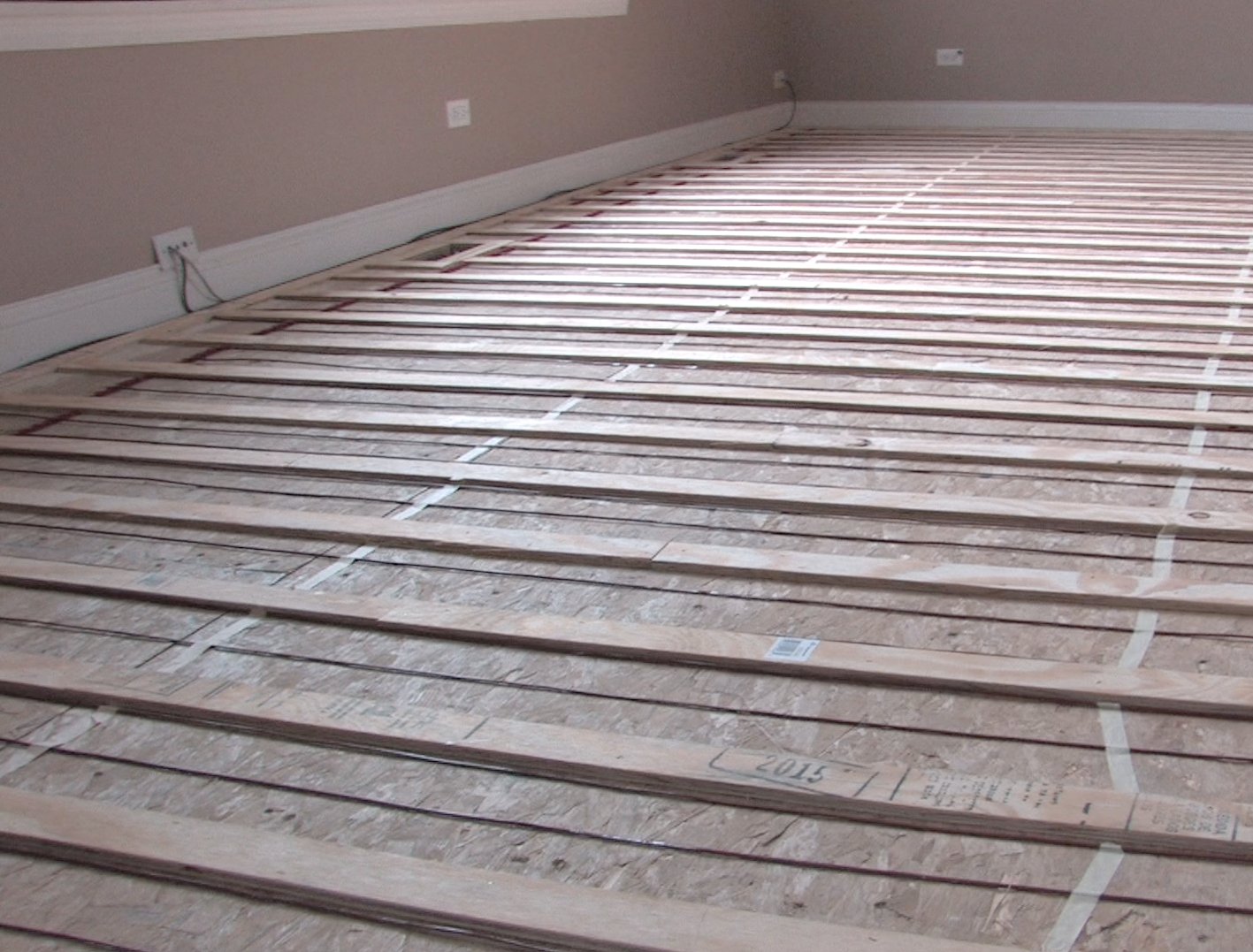
- STEP 1: Install Wood Sleepers. Install wood sleepers (strips of wood 1” to 2” wide and 3/8” to 1/2” high) to create the lanes the heating cable will run between. A common question from installers is how a hardwood floor can be fastened on the tight schedule the NWFA recommends—every 3–4” along the tongue—if the sleepers look widely spaced. The answer is that sleeper layouts are not a fixed grid: they are engineered specifically to your plank width and subfloor orientation so every fastener lands in solid wood. You supply WarmlyYours with your flooring’s nail-spacing parameters, and the SmartPlan is drawn so the sleeper spacing satisfies the manufacturer’s and NWFA fastening schedule—leaving the floor fully supported with no deflection, movement, or squeaking. Always confirm with your flooring manufacturer that the product is approved for installation over radiant heat.
- STEP 2: Lay The Cable Heating System. Lay the floor heating cable into the lanes created by the sleepers, carefully route the heating cable through gap in sleeper to the adjacent “lane”. Repeat for each “lane”. Attach cable fixing strips and route the cable around them. Anchor the cable to the subfloor every 2’-3’ using cable fixing strips, tape or hot glue to keep the cable from floating to the top of the self-leveling cement.
- STEP 3: Cover Cables With Self Leveling Cement. Once the system is in place, the warming cable should be covered with self leveling cement up to and even with the top of the wood sleepers, to create a flat surface to install the wood over. There should be no gap between the wood and self-leveling cement.
- STEP 4: Install Hardwood Flooring. Once the self leveling cement has dried and cured to the manufacturer’s specifications, the hardwood floor can be installed by nailing it into the wood sleepers. Be careful not to place nails or staples near the system’s heating cable or power leads.
Showcase: Cozy Comfort for a Large New York Living Room
Looking for inspiration? Check out this Living Room in Babylon, New York showcase. A homeowner partnered with CZ Construction to solve a common problem in older, traditional homes: a drafty floor over an uninsulated crawlspace. By installing WarmlyYours TempZone™ Cable using the wood sleeper method, they were able to provide primary, energy-efficient heating for the massive 820 sq. ft. room while safely laying down beautiful, solid nailed hardwood floors. It’s a perfect example of how radiant heat can transform a drafty space into a cozy retreat without sacrificing your choice of premium flooring.

Installing radiant heat under wood floors is simpler than it seems. With the right preparation, you can easily elevate your home’s comfort.
Ready to begin your radiant heat project?
Contact sales@warmlyyours.com for a personalized installation plan. Prepare for a smooth process using the tools recommended by WarmlyYours, all accessible for evaluation - here.
Frequently Asked Questions
Yes, you can put radiant floor heat under hardwood. Electric floor heating systems are designed to work safely and efficiently under both nailed hardwood floors and engineered wood. They provide consistent, comfortable warmth without damaging the wood, making radiant heat an excellent choice for your hardwood flooring.
Engineered wood is the most structurally stable option for floor heating. For solid hardwood, dimensionally stable species like Mesquite, Teak, and American Cherry work best. We recommend using quartersawn or riftsawn narrow planks and maintaining consistent indoor humidity to ensure the longevity of your wood floors.
WarmlyYours nSpiration controls are equipped with an in-floor sensor to precisely control the floor's temperature to comply with the wood manufacturer's temperature recommendation.
No, most in-floor heating is designed to be added to new flooring. If you do have existing wood floors you would like to add radiant heating to - it is possible to do so with an under-joist heating system.
We recommend our floating floor heating system for floating wood floors, such as laminate or bamboo. With an insulating layer between the subfloor and heating system, the heating cables will settle into the underlayment making for a flat surface for the floor covering.
Have Questions About Your Project?
Our team of Radiant Experts is ready to help!

Related Articles
Floor Heating Installation Under Hardwood

TempZone™ Radiant Heating Receives Gold Star from Launstein Hardwood Floors

Radiant Heated Hardwood Flooring: The New “Bling” in Home Remodeling
Protecting A Hardwood Flooring Investment In Your Kitchen
Stay Updated
Get the latest radiant heating news and tips delivered to your inbox.
Comments