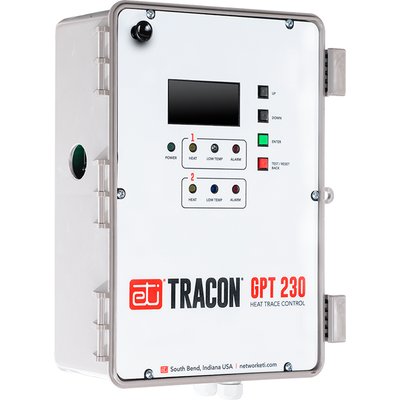
PRO-Tect: Pipe Freeze Protection Dual-Zone Control with GFEP
This support page provides publications, manuals, specifications, videos, support articles, and common support questions
Support Questions
Showing all 9 questions
Yes, you can use a 3-wire RTD Sensor: Platinum, Alpha = 0.00385, ITS–90,100 ohms. Once it is installed you will need to configure the controller for it by navigating to the sensor type screen and changing it to RTD. The GPT-230 will allow you to use a different sensor on each channel or you can use one sensor for both channels. It is simply a matter of how you wish to configure it.
Do not wrap self regulating cable around the pipe in a coiled or spiral fashion, and do not use electric tape to attach it. WarmlyYours recommends attaching the cable in a straight run and to use aluminum or fiberglass tape, pipe straps, or plastic zip ties to attach the cable. Then cover the assembly with fire-resistant insulation and assure it is waterproof. Place electrical heating cable WARNING labels every 10‘, and where the label will be clearly visible.
The GPT-230 displays a number of alarms, beside the ground fault it will also alarm for low current. If you have disconnected the load to trouble shoot a possible ground fault in the heater cable, then you probably have a Low Current Alarm and a very low default ground fault current reading.
You can tell the difference by looking closely at the display, it will tell you what the alarm is for. If you want to clear the low current alarm so you can test the controller then go into the configuration menu and disable the Low Current Alarm. You will need to do this for each channel.
Remember to re-enable the Low Current Alarms when you are done testing and ready to put the unit back into service.
Documents
Technical Information
Sell Sheets
Installation
Operation Manuals
Specifications
Electrical
| Activation Temperature | -99.9 to 999 °F |
| Connection Method | Hardwired |
| Ground Fault Equipment Protection (GFEP) | Self-test GFEP (Adjustable 1-300mA) |
| Maximum Load (Resistive Only) | 2 x 30 A |
| Voltage | 100 - 277 VAC |
Warranty / Certifications
| Approvals | UL and CSA listed |
| Area of Use | Non-hazardous locations |
| Ingress Protection (IPxx) Rating | IP66 |
| Warranty | 2 years |
| Waterproofing | NEMA 4X |
Product Dimensions
| Depth | 5.9″ |
| Height | 12.8″ |
| Installed Depth | 0.75″ |
| Weight | 5.8 lbs |
| Width | 9″ |
Thermostat
| Included Sensor | 2 x 100k ohms, 20′ lead |
Identifiers
| SKU | PT-DUAL |
| UPC (GTIN-12) | 881308058302 |
Videos
Similar Items
Do you need support or specifications for a specific model? Identify your model below.