
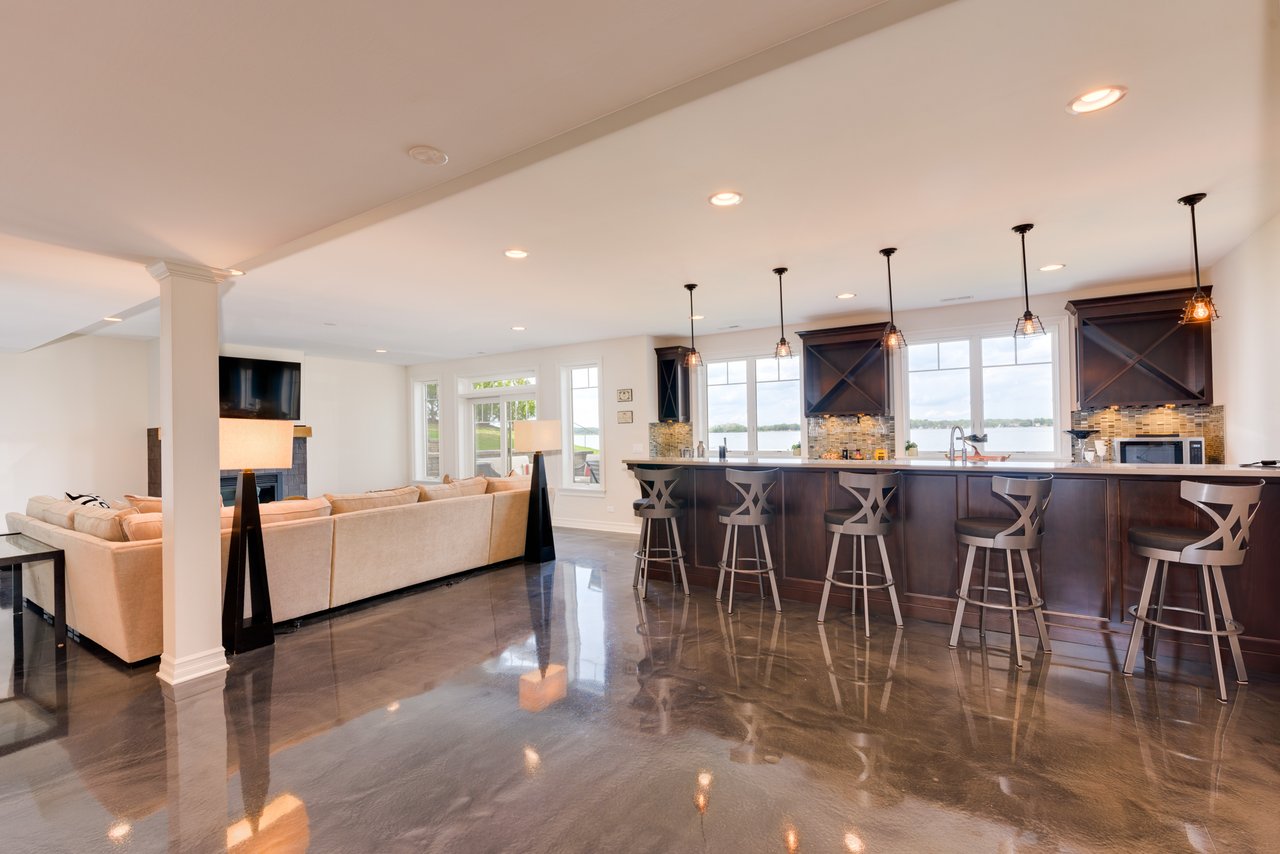
Transforming Lower-Level Living from the Ground Up
Homeowners often avoid using their walk-out basements during the winter because subterranean concrete slabs act as massive heat sinks, draining warmth from the room and creating a perpetually chilly environment. When Stoneridge Builder designed this expansive 671 sq. ft. lower-level bar and recreation space, they knew traditional forced-air heating would leave the floors freezing and the air unevenly heated. By embedding a heavy-duty electric radiant floor heating system directly into the new concrete pour, they transformed a notoriously cold zone into a luxurious, warm extension of the home.
Project Details
| Specification | Detail |
| Location | Crystal Lake, Illinois |
| Space Type | Walk-out Basement (Bar & Open Recreation Space) |
| Surface / Flooring | Exposed Concrete Floor (New Pour) |
| System Type | Electric Floor Heating (Slab Heating) |
| Total Square Footage | 671 sq. ft. |
| Technical Specs | 240V / 10,770W / 45A |
| Wattage per Sq. Ft. | 16 Watts per sq. ft. |
| Products Used | WarmlyYours Slab Heat Mats, SmartStat™ Programmable Thermostat, CT230-GA Power Modules |
| Professional Installer | Stoneridge Builder |
The Story: Engineering Warmth into a New Concrete Pour
The Problem
Large walk-out basements offer incredible potential for entertainment and extra living space, but they suffer from a fundamental architectural flaw: cold floors. A standard concrete slab absorbs the ground's ambient temperature, making the entire room feel damp and uninviting. For this Crystal Lake home, leaving the new concrete pour unheated meant the custom bar and open recreation layout would remain underutilized during freezing Illinois winters, as forced-air vents simply cannot overcome the thermal mass of a frigid floor.
The Solution
Stoneridge Builder took a proactive approach by integrating comfort directly into the structural foundation. Because this project involved a fresh concrete pour, the team selected the robust WarmlyYours Slab Heat Mat system. Engineered specifically for burial inside 4- to 8-inch concrete slabs, these high-output mats turn the entire floor into an efficient, slow-release radiant thermal mass. The installation was strategically divided into two primary zones to optimize energy use, utilizing external power modules to safely manage the substantial 10,770-watt electrical load through a single centralized control point.
The Outcome
What could have been a drafty, cold basement is now a premium, comfortable living space. Radiant floor heating warms people and objects directly, eliminating the dry air currents and noisy blowers associated with traditional HVAC systems. The homeowners now enjoy total peace of mind and barefoot comfort across all 671 square feet, maximizing their home's square footage regardless of the weather outside.
Featured Products
- WarmlyYours Slab Heat Mats (240V): These heavy-duty heating mats are engineered to withstand the rigorous environment of a new concrete pour. They deliver consistent heat distribution through high-durability cables fixed onto mesh, guaranteeing uniform thermal output across the entire slab.
- SmartStat™ Programmable Thermostat: Selected for its precision and energy-saving capabilities, this premium control monitors floor temperatures and allows the homeowners to set customized heating schedules that match their lifestyle.
- Power Modules (CT230-GA): Crucial for large-scale installations, these modules act as a relay to safely handle the 45-amp draw of the 10,770-watt system, enabling a single thermostat to seamlessly command the entire heated floor.


