Heated Driveway Operating Costs: What to Expect on Your Electric Bill
last updated april 6, 2026

In This Article
You’ve done the math on installation. Now comes the question everyone actually wants answered: what will a heated driveway do to my electric bill? The short answer is: far less than you probably think — and far less than paying a plow service every storm. This article breaks down the real numbers by region, explains how seasonal usage works, and shows you exactly how smart controls can cut the costs for your electric snow melt system even further.
Quick Facts: Heated Driveway Operating Costs
- Cost per hour: $0.12–$0.60/hr depending on system size and local electricity rate.
- Cost per storm: $0.72–$3.60 for a typical 6-hour snow event.
- Seasonal cost: $100–$300 for most homeowners in moderate snow climates.
- Wattage: Systems run at ~50 watts per square foot of heated area.
- Runtime: Systems only activate during actual snow/freezing events — not 24/7.
- Smart control savings: Automatic sensors can reduce unnecessary runtime by 30–50%.
- Tire-track option: Heating only tire paths cuts operating costs by ~60% vs. full coverage.
The Simple Math: How Electricity Use Is Calculated
Every WarmlyYours snow melt system runs at approximately 50 watts per square foot of heated area. That’s the baseline. From there, your operating cost comes down to three steps — and the key thing to understand is that electricity is billed in kilowatt-hours (kWh), not hours:
- Square footage × 50 watts = total system wattage
- Total watts ÷ 1,000 = kilowatts (kW)
- kW × hours running = kilowatt-hours (kWh) consumed — multiply by your local kWh rate to get cost
For a standard two-car driveway (20’ × 20’ = 400 sq. ft.) with full coverage, that’s 20 kW. Running for one hour consumes 20 kWh. At the current U.S. average rate of ~$0.17/kWh, that’s $3.40 per hour of active operation. Here’s how a complete storm event — including after-run time — adds up:
| Phase | Duration | Energy Used | Cost @ $0.17/kWh (U.S. avg.) |
|---|---|---|---|
| Active Melting | 6 hours | 120 kWh | $20.40 |
| After-Run (Drying) | 3 hours | 60 kWh | $10.20 |
| Total per Storm | 9 hours | 180 kWh | $30.60 |
| $0.17/kWh is the U.S. residential average. Rates vary significantly by state — check your utility bill for your actual kWh rate. In high-cost states like Massachusetts or California ($0.30+/kWh), storm costs can approach $60 for a full-coverage system. | |||
About $30 per storm — for a 400 sq. ft. full-coverage driveway at the national average rate. That’s typically less than a single professional plowing visit. And two things almost always bring that number down further in real life: sensor controls that keep the system off when conditions don’t require it, and tire-track coverage that reduces the heated area by ~60%.
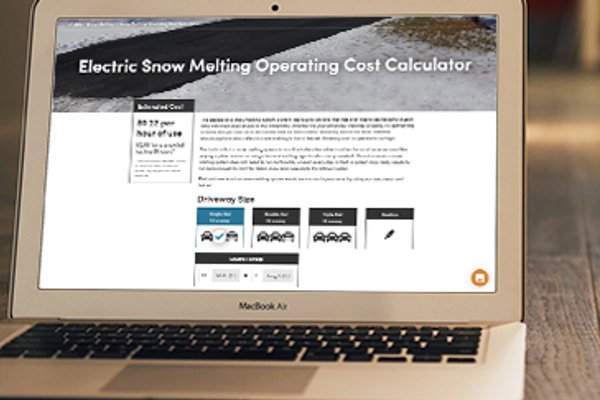
Want to skip the math entirely? Use our Electric Snow Melting Operating Cost Calculator below — enter your zip code and driveway dimensions and it pulls your local electricity rate automatically to give you a personalized estimate down to the dollar per storm and per season.
Operating Cost Calculator for Snow Melting
Calculate driveway heating costs based on size, coverage type, and local energy rates.


"A snow melting system is the ultimate set-it-and-forget-it solution. No more shoveling, no more slipping—just safe, clear walkways and driveways whenever you need them!"
— Rae RadiantMonthly Cost by Region: How Electricity Rates Change Everything
The single biggest variable in your operating cost isn’t your driveway size — it’s where you live. Electricity rates across the U.S. range from under $0.10/kWh in states like Louisiana and Idaho to over $0.30/kWh in Hawaii and parts of New England. Here’s how that plays out for a standard 400 sq. ft. full-coverage driveway running during a 6-hour active storm (not including after-run):
| Region / State | Avg. Rate ($/kWh) | Cost/Hour (400 sq. ft.) | Cost/Storm (6 hrs active) | Est. Season (15 storms) |
|---|---|---|---|---|
| Louisiana / Idaho | ~$0.10 | $2.00 | $12.00 | ~$180 |
| Midwest (IL, OH, MN) | ~$0.16 | $3.20 | $19.20 | ~$288 |
| U.S. National Average | ~$0.17 | $3.40 | $20.40 | ~$306 |
| Northeast (NY, MA, CT) | ~$0.22 | $4.40 | $26.40 | ~$396 |
| California | ~$0.31 | $6.20 | $37.20 | ~$186 (fewer storms) |
| Canada (ON average) | ~C$0.22 | C$4.40 | C$26.40 | ~C$396 |
Even in the highest-rate Northeast markets, a full-coverage system costs less per storm than a single professional plowing visit ($50–$150). And for most Midwest homeowners — where snow melting systems are most popular — the seasonal cost lands well under $300.
Tire Tracks: The Budget-Friendly Option
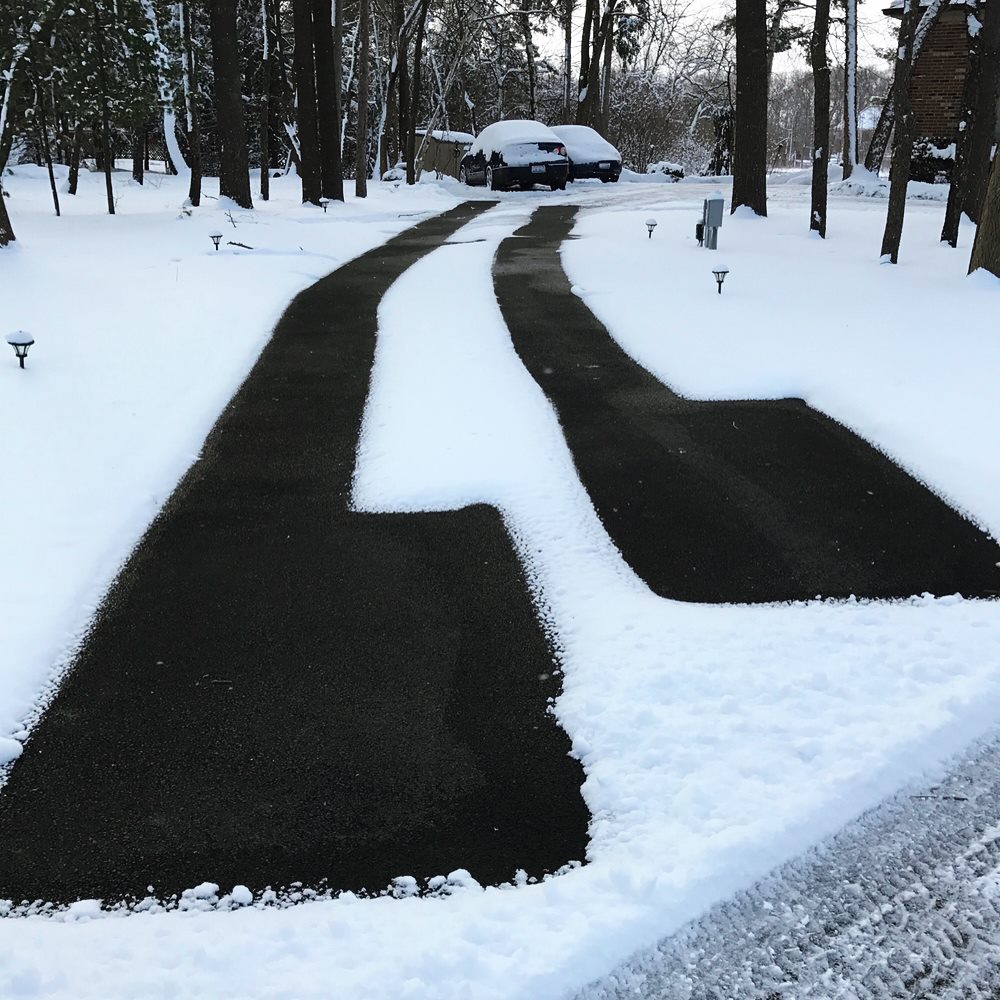
Choosing tire-track coverage instead of full coverage reduces your heated area to roughly 40% of the full driveway — and your kWh consumption drops proportionally. That $30.60-per-storm figure for full coverage becomes $12.24 per storm with tire tracks (8 kW × 9 hrs × $0.17/kWh). At $12 a storm, the system pays for itself in convenience almost immediately.
Seasonal Usage Patterns: Your System Isn’t Running All Winter
One of the most common misconceptions about heated driveways is that they run continuously from November through March. They don’t. A properly controlled system only activates when two conditions are met simultaneously: precipitation is detected and the surface temperature is below freezing. On a dry 20°F day, your system stays off. On a 35°F rainy day, it stays off too.
In practice, most systems in the Midwest and Northeast run for a total of 50–120 hours per season — spread across 10–20 individual storm events. That’s the equivalent of leaving a single 20-amp circuit on for just 2–5 days out of an entire winter.
Time-lapse of a tire-track system clearing a driveway during an active winter storm — the system runs only while snow is falling and the surface is below freezing.
Smart Controls: How WiFi Sensors Cut Your Bill
The control system you choose has a bigger impact on your operating costs than almost any other factor. Here’s how the main options compare:
| Control Type | How It Works | Cost Impact | Best For |
|---|---|---|---|
| Manual / Timer | You turn it on; spring-loaded timer shuts it off after up to 12 hours | Highest — risk of running when not needed | Very small systems, tight budgets |
| WiFi Control (SCW-120-15A) | Remote on/off via smartphone app; integrates with Alexa/Google | Lower — you can respond to weather forecasts in real time | Homeowners who want remote control |
| Automatic Sensor Control | Aerial snow sensor detects precipitation + temperature; activates automatically | Lowest — system only runs when conditions require it | Most driveways; maximum efficiency |
| Multi-Zone (ZoneBraker) | Splits large driveways into 4 zones; cycles zones to reduce peak load | Lowest for large systems — reduces amperage and runtime per zone | Large driveways, limited electrical capacity |
Automatic aerial sensors are the gold standard for operating cost efficiency. Because they respond to real-time conditions — not a timer or a homeowner’s schedule — they eliminate the most common source of wasted energy: running the system when it isn’t needed. Studies of automatic vs. manual systems consistently show 30–50% lower seasonal energy use with sensor-based controls.
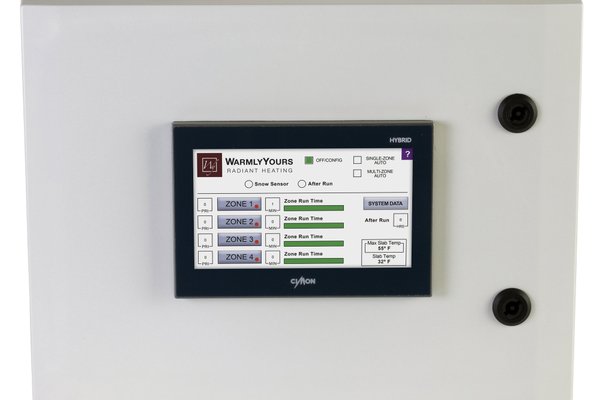
For very large driveways or projects with limited electrical service, the ZoneBraker multi-zone controller takes this further by cycling up to four zones sequentially — so you never have the entire system drawing power simultaneously. This can dramatically reduce both your peak electrical load and your operating costs.
What About After-Run Time?
Most automatic controls include an after-run period — typically 1–3 hours — where the system stays on after precipitation stops to fully evaporate residual moisture and prevent re-freezing. This is normal and intentional. It adds roughly 30–50% to each storm’s kWh total, but prevents the ice sheet that forms when a wet driveway refreezes overnight.
How a Heated Driveway Compares to Other Home Systems
Context matters. Here’s how a heated driveway’s seasonal operating cost stacks up against other common home systems and winter maintenance alternatives:
| System / Service | Typical Seasonal Cost | Notes |
|---|---|---|
| Heated driveway (400 sq. ft., full coverage, Midwest) | $150–$300/season | Electricity only; runs ~50–100 hrs/season |
| Heated driveway (tire tracks, same area) | $60–$120/season | ~60% less heated area = ~60% lower kWh consumption |
| Professional snow plowing service | $400–$1,500/season | $50–$150 per visit × 10–15 events |
| Rock salt / chemical deicers | $100–$300/season | Plus driveway surface damage over time |
| Central air conditioning (3-ton unit) | $300–$600/summer | Runs daily for 3–4 months |
| Electric water heater | $400–$600/year | Runs year-round |
| Radiant floor heating (200 sq. ft. bathroom) | $50–$120/season | Typically 1–2 hrs/day in winter months |
The takeaway: a heated driveway costs about the same as — or less than — a single month of running your central AC. And unlike a plow service, it’s available at 3 a.m. during a surprise storm, requires no scheduling, and never damages your driveway surface.
Real-World Example: Kildeer, IL Tire-Track System
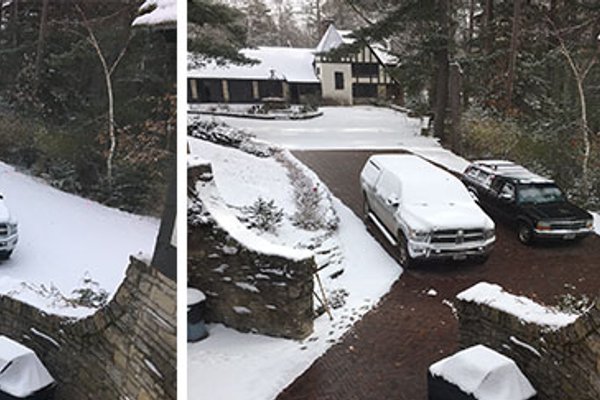
A homeowner in Kildeer, IL — right in the heart of Chicago’s snow belt — chose a tire-track snow melting system for their driveway. By heating only the two tire paths rather than the full surface, they reduced their heated area by more than half. The result: an electric snow melt system that handled every storm of the season automatically, with operating costs well below what they had been paying for seasonal plowing. Read the full Kildeer project showcase →
This is exactly the kind of efficiency that makes tire-track systems so popular in high-snowfall regions: you get the critical benefit (safe traction for your vehicle) at a fraction of the kWh cost of full coverage.
Getting Your Personalized Cost Estimate
Every driveway is different — size, location, coverage type, and control choice all affect your final cost for your electric snow melt system. The most accurate way to know what your system will cost to run is to use our Snow Melting Operating Cost Calculator, which uses your actual zip code to pull your regional electricity rate and calculates costs by storm duration and season length.
For a complete picture — including installation cost, electrical requirements, and a custom layout — request a free SmartPlan. It’s included with every quote and order, and your electrician can use it to confirm your home’s service is ready.
Already know your driveway size? Start with our Snow Melting Quote Builder for an instant price on the heating elements and controls.
Operating Cost Calculator Get a Free SmartPlan Quote Builder
Frequently Asked Questions: Heated Driveway Operating Costs
Multiply the heated area by the installed watts per square foot, divide by 1,000 for kilowatts, then multiply by your electricity rate. At 50 W/sq ft, every 100 sq ft draws 5 kW, or $1.00 per energized hour at an illustrative $0.20/kWh. For example, a 400 sq ft full-coverage driveway draws 20 kW: $4.00 per energized hour, or $24.00 for six energized hours. Tire tracks heat less area, so they cost proportionally less. Your seasonal bill depends on how many hours the system is energized, including preheating and the controller’s drying cycle, which varies with the weather. These are examples, not typical bills; enter your own area, rate and runtime in our snow melting cost calculator.
Operating cost depends on the heated area, installed wattage, your electricity rate and how many hours the system is energized. For example, 100 sq ft at 50 W/sq ft draws 5 kW (100 × 50 ÷ 1,000). At an illustrative $0.20/kWh, that is $1.00 per energized hour, or $6.00 for six energized hours. This is an example, not a typical bill. What changes your total:
- Heated area and coverage (full area or tire tracks)
- Installed watts per square foot
- Your local electricity rate
- Runtime, including preheating, snowfall and the controller’s drying cycle
Enter your own numbers in our snow melting cost calculator.
Have Questions About Your Project?
Our team of Radiant Experts is ready to help!
Related Articles

Heated Driveway Cost in 2026
WarmlyYours Launches Electric Snow Melting Operating Cost Calculator
WarmlyYours Launches Affordable WiFi Control for Snow Melting Systems
WarmlyYours Unveils New Multi-Zone Snow Melting Control
Stay Updated
Get the latest radiant heating news and tips delivered to your inbox.