
Snow Melting for Walkways, Stairs & Patios: A Complete Planning & Installation Guide
last updated july 2, 2026

In This Article
A snow melting system turns walkways, stairs, and patios into the safest surfaces on the property — no shoveling, no salt, no ice where people actually walk. But for the pros installing them, the real payoff is in the details: an embedded system done right protects both the homeowner’s safety and your margins, because there are no callbacks and no demolition to fix a fault buried in cured concrete. The difference between a system that performs for decades and one that fails its first winter comes down to precision on a handful of non-negotiable rules.
This guide covers how to choose between mats and cable, what changes as you move from a flat walkway to a set of stairs, and the core technical rules — never cutting the cable, embedding the factory splice, testing three times, and prioritizing the leading edge on stairs — that keep an installation reliable and code-compliant. Get these right and you deliver a high-performance system that quietly does its job every winter.
Quick Facts
- The big idea: A successful snow melting install is decided in the planning stage, not on the job site.
- Stairs are cable-only: Mats can’t navigate the geometry of treads and risers — flexible cable can.
- Never cut the cable: Heating cable is a fixed length; absorb any excess with tighter spacing.
- Test three times: On delivery, after layout, and after the pour — and log every reading.
- 30 mA GFEP: The NEC-required breaker for outdoor snow melting — not a 5 mA GFCI.
Before we get into the planning details, here’s a field briefing — a little over a minute — from Lyn on our team. It walks through the pro tips that keep an outdoor snow melting job on track — the moves that protect your margins and eliminate callbacks, because once the concrete sets, there’s no going back to fix a buried mistake.
The Big Idea: It’s All in the Plan
Snow melting success is engineered before a single cable is unrolled. Because embedded heating elements are permanently buried in concrete, mortar, or paver-setting material, there is no “fixing it later.” Every decision — layout, spacing, where the power lead exits, how expansion joints are handled — has to be settled on paper first.
That’s why WarmlyYours builds a custom SmartPlan for each project: a scaled installation drawing that maps the exact cable route, spacing, and electrical requirements for your specific surface. Requesting that plan before the pour is the single biggest predictor of a smooth install.
A complete SmartPlan spells out the three things installers rely on: the exact heating mat or cable layout with calculated spacing, an electrical load breakdown to hand your electrician, and an estimated operating cost so the homeowner knows what the system costs to run. To build it accurately, we need real numbers from the site — not estimates:
- Exact surface dimensions — measured post-to-wall, not “fudged.” Too little information at the start is the number-one cause of layout problems, because if the length is wrong you end up with too much cable or too little.
- Available power — the voltage and the number of open breaker spaces in the panel. A large system will not run off a single breaker.
- Junction box locations — the non-heating cold lead is only 20 ft on most 120/240 V residential systems, so the heating element has to start within reach of the J-box.
- Expansion joints — cable can never cross one, so the layout has to route around every joint.
- Handrail positions — mark them so posts can be pre-sleeved and the design steers cable clear of them.
If anything changes on site — a resized patio, a new fire-pit — send the revised dimensions before installing. Our engineering team can usually return a reworked layout within a few hours so you use the material already on site rather than re-ordering.
System Selection: Mats vs. Cable
Both formats use the same heating cable — the difference is how it reaches the site. That cable radiates heat only about 1.5 to 2 inches to each side, which is exactly why spacing is engineered rather than guessed: at 3-inch spacing you get full, even coverage, while wider 4-inch spacing saves product and electricity but heats more slowly. Your climate sets the target using ASHRAE snowfall data, and the SmartPlan calls out the exact spacing for each zone.
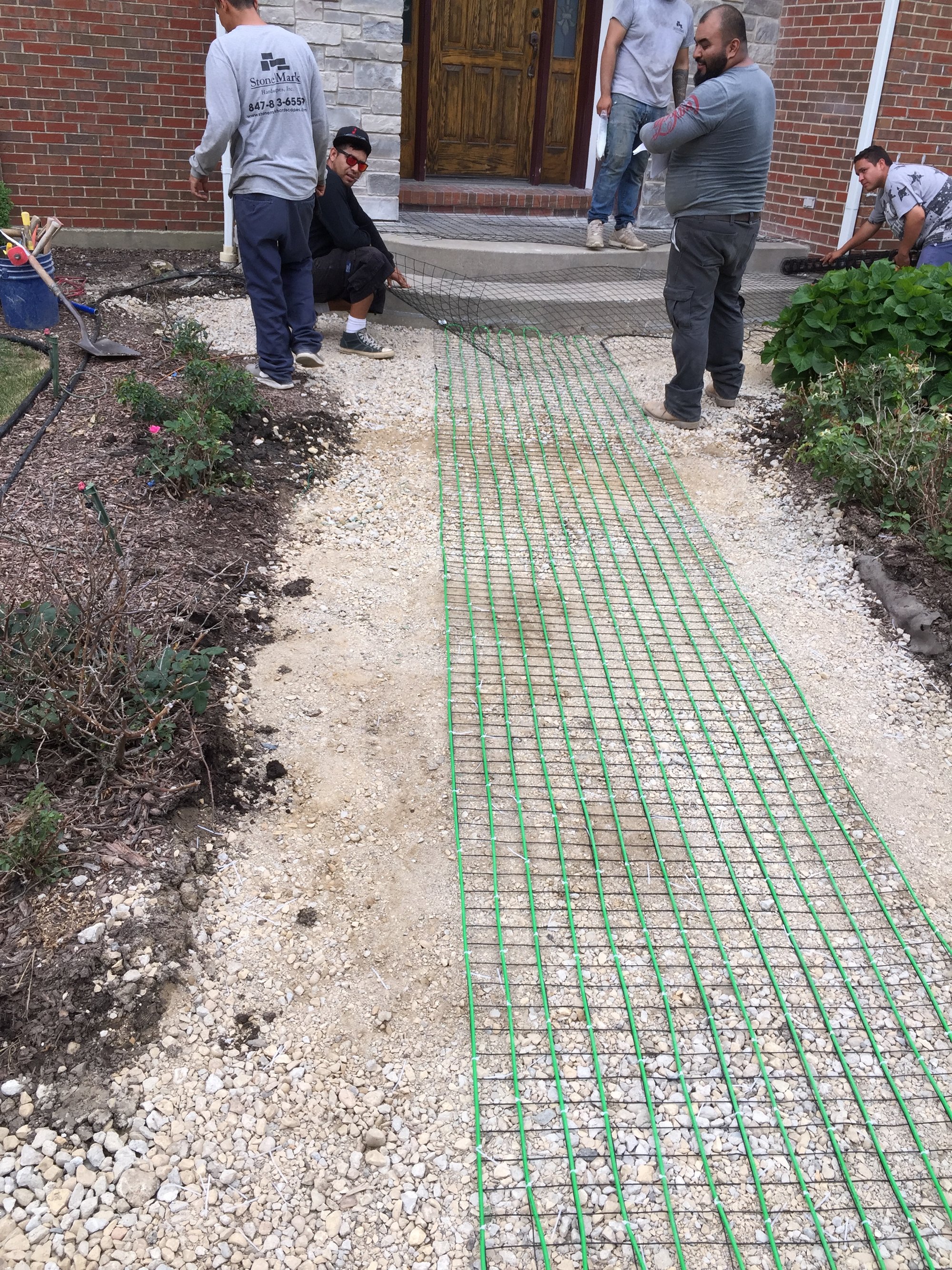
- Snow melting mats pre-space the cable on a mesh backing for fast, consistent rollout across large, open, rectangular areas like a straight patio or a wide walkway. Less measuring, quicker installs.
- Loose snow melting cable gives you complete control over spacing and routing, which is essential for irregular shapes, tight radii, and — critically — stairs. When a surface has curves, cut-outs, or changing geometry, cable is the tool.
Many real-world projects combine both: mats for the open runs and loose cable to detail the edges and transitions. For a deeper look at surface prep and pour sequencing, see our Concrete Driveway Snow Melting installation guide.
A note on voltage: 240 V does not melt snow any faster than 120 V — it simply carries more total wattage, so most larger jobs use 240 V while smaller steps or short walkways run fine on 120 V. Be realistic about labor, too. Because loose cable is fastened by hand at precise spacing, a cable job can burn through roughly 10,000 zip ties where a mat job uses about 2,000 — and on tight timelines, especially asphalt where crews won’t wait for hand-spacing, mats are usually the faster call.
Application Specifics: Walkways, Stairs & Patios
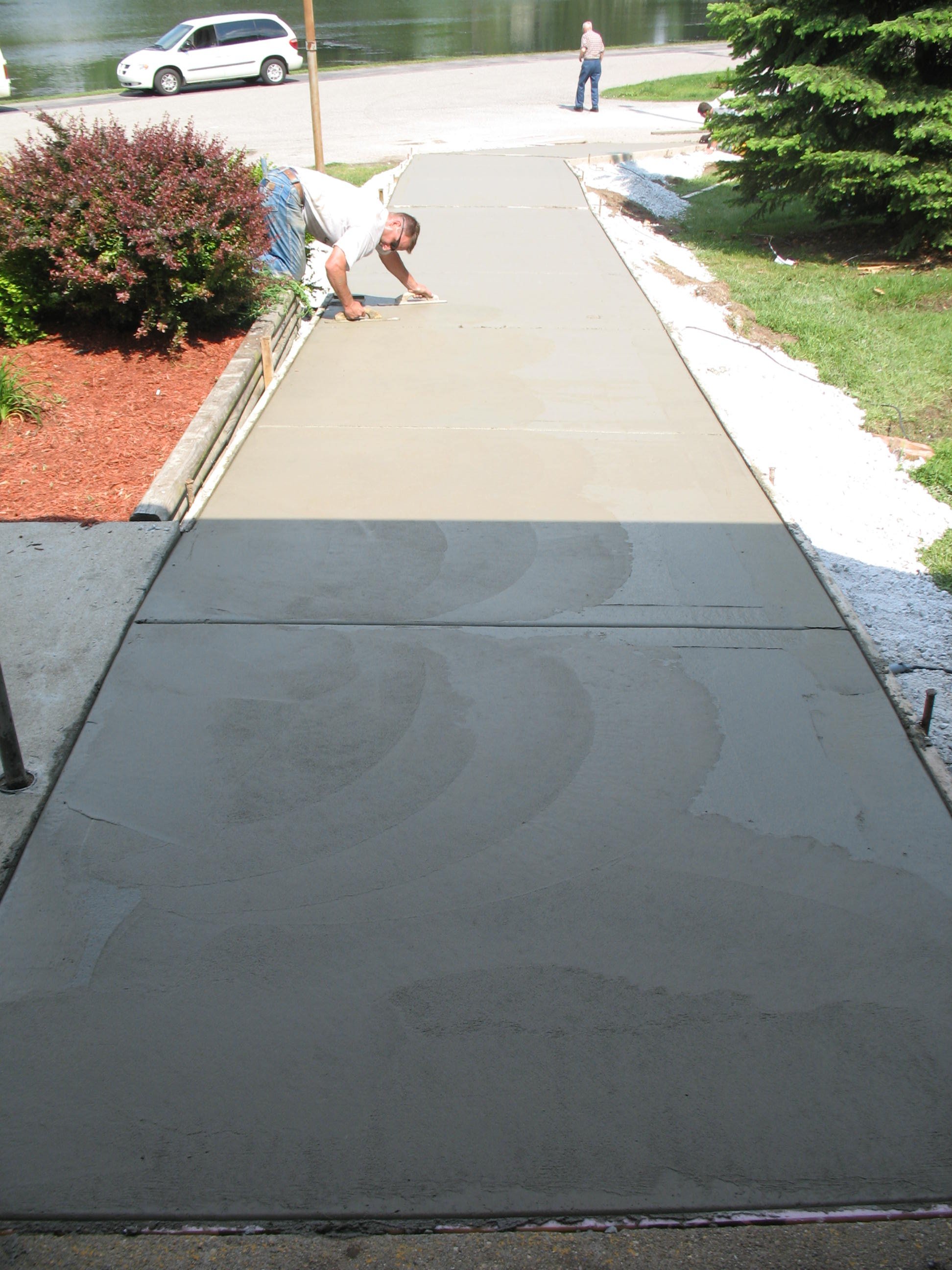
Walkways & patios. Prioritize melt coverage across the full traffic path. For heated paver and stone applications, the cable is set in the bedding layer beneath the pavers; for concrete, it’s tied to the reinforcing mesh before the pour.
You rarely need to heat every square inch. On a wide 4-foot walkway, a single 2-foot heated strip down the center usually delivers a clear, safe path while cutting both product and power. Heat the exact route people walk and skip the areas no one uses — reducing coverage strategically is often what keeps a project inside the available power budget.
Stairs are a special case — and cable-only. Mats can’t wrap the geometry of treads and risers, so stairs always call for loose cable. The key field guidance:
- Prioritize the leading walking edge of each tread — that’s where ice is most dangerous.
- Secure the cable tightly so it can’t shift during the pour.
- Pre-sleeve handrail penetrations before pouring, so posts can be set later without ever contacting the heating element.
Two field details make or break a staircase. First, avoid a heavy bullnose if code allows — a large overhang pushes the front lip of the tread too far from the cable, and that leading edge stays frozen even when the rest of the step melts. Second, carry the cable down the riser to the next tread with a gentle loop rather than a hard 90-degree bend, and recess it slightly so masons setting limestone or stone caps can’t slice it as they seat the caps.
On existing concrete steps, an embeddable attachment grid fastened with concrete screws gives the cable a rigid framework for tight, even spacing up every riser and across every tread — the layout that melts the full surface right to the walking edge.
Patios and pavers. Heat travels only about 2.5 inches through a paver, so stick to a 2.5-inch paver thickness for reliable melting to the surface — thicker pavers still work but heat slower and may not warm fully at the top. For a concrete patio, the cable is propped in the middle of the slab on rebar and 10-gauge wire mesh (not chicken wire) so foot traffic and the pour can’t push it to the bottom, and the mix must use sub-¾-inch aggregate so the concrete flows fully around the cable instead of straining out.
Check out our dedicated post for more information about how to install a snow melting system in a patio.
Automatic Activation: Choosing & Placing the Sensor
Almost no one wants to run outside at 2 a.m. to switch the system on, so most snow melting installs are automatic. A sensor watches for two conditions at once — temperature at or below roughly 38°F and moisture — and only fires the system when both are met, so it never wastes power on a dry cold night or a warm rain.
An aerial sensor mounts on a wall or mast and detects snowfall in the air. Place it where snow always lands and where you can still reach it to wipe the top clean — the only maintenance it needs — but keep it away from dryer and HVAC vents, overgrowing shrubs, and the side of the house, where drifting and warm exhaust cause missed activations. An in-ground slab sensor sits flush in the surface and is ideal for mission-critical spots like a doorway or a car-wash apron; use it for concrete and asphalt, but choose an aerial sensor over pavers, since pavers settle over time and leave a flush sensor sitting proud.
The 5 Golden Rules of Snow Melting
These five rules are non-negotiable. They come straight from our Pro Field Guide and apply to every embedded snow melting installation, regardless of surface.
Free download: The 5 Golden Rules Pro Field Guide
Keep the master checklist and three-stage test log on every job. Download the WarmlyYours 5 Golden Rules of Snow Melting Pro Field Guide (PDF) — a printable one-page reference plus a sign-off test log for your project file.
Rule 1 — Never cut the cable
Heating cable is a fixed-length, factory-terminated element. Cutting it destroys the system. If you have more cable than the layout seems to need, you absorb the excess by tightening the spacing (down to 3” loop-to-loop) or routing it through a buffer zone — never by trimming.
Rule 2 — Embed the factory splice
The factory splice that joins the cold lead to the heating cable must be 100% buried in concrete or mortar. It must never sit in a conduit or a junction box, where a lack of surrounding mass can cause it to overheat. Bury it fully in the pour.
Rule 3 — Isolate at expansion joints
Heating elements must never cross an existing or planned expansion joint. The slab movement at those joints will shear the cable over time. Route around every joint and treat each pour section as its own zone.
Rule 4 — Follow the three-stage test protocol
Verify the cable with an ohmmeter and a megger at three checkpoints: (1) on delivery, straight out of the box; (2) after layout, before the pour; and (3) after the pour. Log every reading — a documented resistance and insulation history is your proof the element was undamaged at each stage.
Grab the free test log
Our Pro Field Guide includes a printable three-stage test log so you can record ohm and megger readings at every checkpoint. Download the 5 Golden Rules Pro Field Guide (PDF) and keep a copy with the project file — it’s the fastest way to diagnose a fault later.
Rule 5 — Protect the circuit with 30 mA GFEP
Outdoor snow melting requires a dedicated Ground Fault Equipment Protection (GFEP) breaker rated at 30 mA — an NEC requirement for fixed outdoor deicing equipment. This is not the same as the 5 mA GFCI used for personal protection at receptacles. For a full breakdown of activation and controls, see the Snow Melting Controls Training.
Talk to a snow melting expert
Our technical team is available 24/7 during install season at (800) 875-5285 or techteam@warmlyyours.com. Request a custom SmartPlan before your pour and we’ll map the exact layout, spacing, and electrical requirements for your project.
Frequently Asked Questions
The most common spacing for snow melting systems is 3“ from wire to wire. However, we can design snow melting systems based on your local climate and weather expectations that might have different cable spacings to ensure the most efficient system possible. We also offer snow melting mats with 3" and 4" spacing.
GFEP is the National Electric Code (NEC) required protection for fixed outdoor deicing and snow-melting equipment, which may be accomplished by using circuit breakers equipped with ground-fault equipment protection (GFEP) of 30 mA. It is important to understand that this required equipment protection is NOT the same as a 5 mA GFCI used for personal protection.
Absolutely. Snow melting systems are highly effective for walkways, patios, and outdoor stairs. They eliminate slip-and-fall hazards and prevent ice buildup, providing a critical safety upgrade and ensuring accessible, clear paths for everyone during winter.
Operating cost depends on the heated area, installed wattage, your electricity rate and how many hours the system is energized. For example, 100 sq ft at 50 W/sq ft draws 5 kW (100 × 50 ÷ 1,000). At an illustrative $0.20/kWh, that is $1.00 per energized hour, or $6.00 for six energized hours. This is an example, not a typical bill. What changes your total:
- Heated area and coverage (full area or tire tracks)
- Installed watts per square foot
- Your local electricity rate
- Runtime, including preheating, snowfall and the controller’s drying cycle
Enter your own numbers in our snow melting cost calculator.
Have Questions About Your Project?
Our team of Radiant Experts is ready to help!
Related Articles

How to Plan for a Snow Melting System: 8 Things to Know Before You Get a Quote
How to Install a Snow Melting System in a Patio
Choosing the Best Snow Melting System for Your Driveway Material

From Zero to Hero: Fixing a Snow Melt System Failure in Outdoor Stairs
Stay Updated
Get the latest radiant heating news and tips delivered to your inbox.


