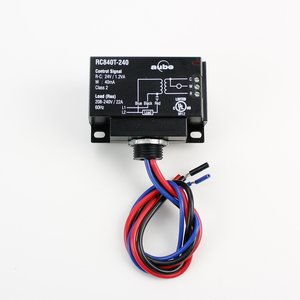
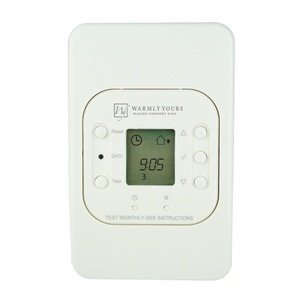
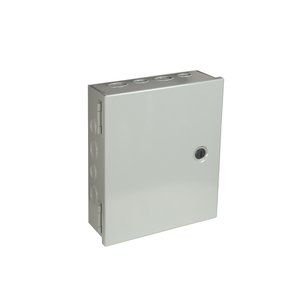
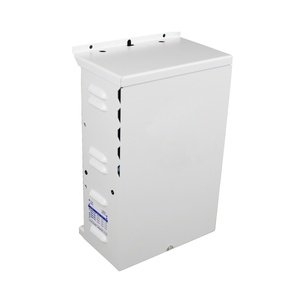
Relay Contactor (RC-40AMP)
This support page provides publications, manuals, specifications, videos, support articles, and common support questions
Support Questions
Showing 10 of 18 questions
The breaker and wire sizes are selected based on the total amperage of the WarmlyYours heating system connected to a single thermostat. This information is on the WarmlyYours heating system's installation plan, electrical plan, or UL label. Based on guidelines from the National Electrical Code: loads up to 16 Amps may utilize 12 gauge wire with a 20-Amp breaker, and loads up to 12 Amps - 14 gauge wire with a 15-Amp breaker. Local code and/or other factors may change these guidelines.
In theory, it is possible, if no other options are available. We do not recommend it, but If the thermostat is controlling the floor temperature with a floor sensor, then it can go on an exterior wall. It is important that the floor sensor gets located in an area of the floor not hit by sunshine.
If the thermostat will be controlling the air temperature with the built-in ambient sensor, then it should go on an interior wall.
Relays can fail due to excessive current or voltage. When a relay is exposed to too much current, the contacts can burn out. High voltage can also damage the coil. Other reasons include mechanical wear and tear, dust or dirt buildup, and moisture. These factors can cause the relay to malfunction or stop working entirely. Regular maintenance and using the relay within its specified limits can help prevent failures.
A GFCI/GFEP (Ground Fault Circuit Interrupter / Ground Fault Equipment Protection) works differently than a circuit breaker by specifically detecting a small imbalance in electrical current between the hot and neutral wires, which indicates a potential ground fault (like a person touching a live wire), and instantly shutting off the power to prevent shock, while a circuit breaker only trips when there's a significant overload in current flow on the circuit, like a short circuit or too many appliances plugged in.
No, a circuit breaker will NOT protect against a power surge; a circuit breakers primary function is to protect against excessive current flow (overload), while a surge protector is specifically designed to handle voltage spikes, which are what power surges are considered to be.
Yes, radiant floor heating can be a primary heat source if its heat output exceeds the room's heat loss. For best results, we recommend using a 15-watt system, covering at least 80% of the floor, and ensuring the space is well-insulated. Use our Heat Loss Calculator to verify your specific needs.
Yes, radiant floor heating is an excellent primary heat source for tiny houses in mild to moderate climates. Because tiny houses have small footprints, the 15-watt output of TempZone™ can easily maintain comfort while saving valuable wall space. Ensure the structure is well-insulated and use our Heat Loss Calculator to confirm.
Yes, we strongly recommend installing insulation like ThermalSheet™ over concrete slabs. Concrete acts as a "heat sink," absorbing warmth that should go to your floor. Insulation directs the heat upward, significantly improving efficiency, reducing warm-up times, and allowing the system to function effectively as a primary heat source.
Underlayment is recommended for floating floors (laminate, LVP, wood) and installations over cold subfloors like concrete. It provides thermal insulation to prevent heat loss and improves system efficiency. For tile and stone, the system is typically embedded in thinset, so a separate underlayment is often unnecessary.
WarmlyYours TempZone™ Flex Rolls and Easy Mats deliver 15 watts per square foot, the maximum allowed by the National Electrical Code. This provides 25% more heating power than the 12-watt industry standard. TempZone™ Cable can be spaced to deliver between 8 and 15 watts per square foot depending on your needs.
Yes, electric radiant floor heating is ideal for basements because it warms the cold concrete slab and provides consistent heat from the ground up. In well-insulated finished basements, it can serve as the primary heat source, turning a typically chilly space into a comfortable, year-round living area.
Radiant floor heating can heat a sunroom if the space has high-quality insulation and double-pane glass. Since sunrooms have high heat loss, a 15-watt system is essential. In extremely cold climates or poorly insulated sunrooms, it is best used as a supplemental source to keep the floor comfortable.
Yes, radiant heating is highly efficient in cold weather. Unlike forced-air systems that lose heat through ductwork and rising air, radiant heat warms objects directly via far-infrared energy. This method is up to 45% more energy-efficient, providing consistent comfort while significantly lowering monthly heating costs in frigid environments.

The best home features for cold climates include a simple gable roof to shed snow, covered entrances for protection, airtight triple-pane windows to prevent heat loss, and radiant heating systems. These features work together to maintain interior warmth, reduce energy bills by up to 25%, and ensure structural safety during harsh winters.


GFCI can fail for various reasons, such as wear and tear, moisture, corrosion, power surges, faulty wiring, or improper installation. Some of these causes can be prevented by regular inspection and maintenance, while others may require professional assistance. It is important to note that GFCI devices (ex. thermostat, breakers, outlets) should be tested regularly as these do wear out over time.
Most systems provide only 12 watts per square foot, which often lacks the power for primary heating in cold climates. WarmlyYours TempZone™ delivers 15 watts—a 25% increase. This higher output allows the system to overcome heat loss more effectively, providing reliable primary warmth even when outdoor temperatures drop.
Documents
Wiring Diagrams
- RC-40AMP Electrical Rough-In for 240 V Solid State Relay Contactor (English)
- RC-40AMP Relay Wiring Diagram with Environ™ Mat 120V Round Lead (English)
- RC-40AMP Relay Wiring Diagram with TempZone™ (Single) (English)
- RC-40AMP Relay Wiring Diagram with TempZone™ (Twin) (English)
- Wiring Diagram for 120V & 240V Floor Heating Products with Relay with Thermostat (English)
Specifications
Electrical
| Connection | 2 single pole relays , 2 wires, line 1 & line 2 |
| Connection Method | Hardwired |
| Maximum Current | 40 A |
| Maximum Load (Resistive Only) | 120/240 V, 40 A |
| Voltage | 120 V |
Product Dimensions
| Length | 6″ |
| Weight | 7.3 lbs |
| Width | 6″ |
Identifiers
| SKU | RC-40AMP |
| UPC (GTIN-12) | 881308020392 |