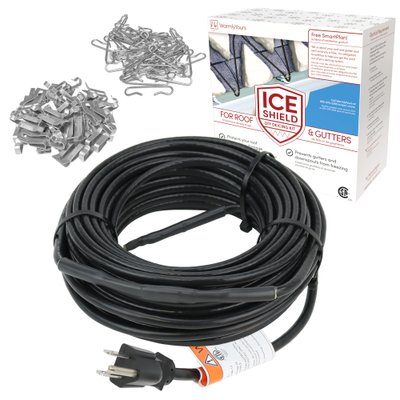
Ice Shield: DIY Roof and Gutter Deicing Kit (160’)
This support page provides publications, manuals, specifications, videos, support articles, and common support questions
Support Questions
Showing all 10 questions
GFEP is the National Electric Code (NEC) required protection for fixed outdoor deicing and snow-melting equipment, which may be accomplished by using circuit breakers equipped with ground-fault equipment protection (GFEP) of 30 mA. It is important to understand that this required equipment protection is NOT the same as a 5 mA GFCI used for personal protection.
NEVER use an extension cord. If you do not understand the electrical requirements needed regarding the electrical receptacle plug, contact your local electrical inspector or a licensed electrician.
The reason for this is due to safety and performance of the system. Extension cords are often not properly selected and will degrade, potentially leading to electrical shorts or other hazards such as fire. Roof de-icing cables are designed to be connected directly to a properly rated outlet, and the length and type of extension cords may not be rated for the same power load, leading to insufficient power supply, potential damage to the cables, and further safety risks including their ability to prevent ice dams on your roof.
A 2 pole single-phase 240V circuit works by continuously monitoring the current flowing through both hot wires of the circuit. If it detects even a slight imbalance between the current on each hot wire (indicating a ground fault), it will quickly trip, cutting off power to the circuit. Essentially, it compares each leg of the 240V circuit and trips if they are not precisely equal.
WarmlyYours roof and gutter deicing self-regulating cable loses its power ramp-up ability at about 5-10 years, but it will still work at its rated wattage for years. Properly installed WarmlyYours roof and gutter constant wattage cable usually lasts well beyond its warranty period.
Two good reasons for this:
- Constant Wattage cables maintain a consistent heat output regardless of the surrounding temperature. Metal roofs, being highly conductive, can cause rapid temperature fluctuations which can lead to overheating and potential damage to the cable's insulation, potentially causing a fire hazard.
- The UL approved installation method requires self-regulating cable for metal roofs. If not installed per UL guidelines, there is no listing and thus no warranty.
Documents
Sell Sheets
Installation
- Ice Shield Roof And Gutter Constant Wattage Kits Installation Manual (English)
- Ice Shield Roof And Gutter Constant Wattage Kits Installation Manual (Spanish)
Project Planners
Specifications
Electrical
| Amps | 6.7 A |
| Cable Construction | Twin conductor |
| Cable Type | Constant Wattage |
| Conductor Insulation | XLPE |
| Connection Method | Plug-in |
| Ohms | 18 Ω |
| Outer Insulation | PVC |
| Plug-Type | NEMA 5-15 (Type B) |
| Plug-in Cord Length | 6′ |
| Watts | 800 W |
| Watts Per Ft. | 5 W |
Warranty / Certifications
| Approvals | cUL Listed, CSA Listed, and cETLus Listed |
| Warranty | 2 Year Warranty |
Product Dimensions
| Cable Cross Section | 1/4" x 3/16" |
| Cold Lead Length | 6′ |
| Heating Cable Length | 160′ |
| Height | 0.1875″ |
| Length | 1920″ |
| Weight | 6.4 lbs |
| Width | 0.25″ |
Installation
| Minimum Bend Radius | 1″ |
| Minimum Installation Temperature | 15°F (-10°C) |
Identifiers
| SKU | ETC120-5W-160-WY |
| UPC (GTIN-12) | 881308071974 |
Videos
Articles
Similar Items
Do you need support or specifications for a specific model? Identify your model below.