
Do Heated Driveways Work in Heavy Snow? Performance Facts
last updated april 8, 2026

In This Article
When the forecast calls for a “bomb cyclone” or a “Nor’easter,” homeowners in cold climates have one question on their minds: Do heated driveways actually work in heavy snow?
It’s a fair question. When you’re looking at two feet of accumulation and sub-zero temperatures, it’s hard to imagine a set of snow melting cables buried under concrete keeping up. However, the performance of a electric snow melt system isn’t based on magic—it’s based on physics, specifically the relationship between snow rate and melt rate.
Quick Facts: Heated Driveway Performance
- Melt Rate: Most systems are designed to melt 1–3 inches of snow per hour.
- Power Output: Standard systems provide 39–50 watts per square foot.
- Activation: Automatic sensors trigger the system before snow accumulates.
- Extreme Cold: Systems remain effective even in temperatures well below zero.
- After Run: Systems run 2–4 hours after snow stops to evaporate moisture.
Snow Rate vs. Melt Rate: The Science of Staying Clear
The effectiveness of a heated driveway depends on its ability to melt snow as fast as it falls. In most regions, a “heavy” snowfall is considered 1 inch per hour. WarmlyYours snow melting systems are engineered to handle this rate and more.
The key is the melt rate. By generating consistent radiant heat, the system creates a “melted buffer” on the surface. As snow hits the heated pavement, it turns to water and drains away. If the snowfall rate exceeds the melt rate (e.g., over 3 inches per hour), you may see some temporary accumulation, but the system will continue to melt the bottom layer, preventing the snow from bonding to the surface and making it effortless to clear later.
Performance in Extreme Cold and Different Climates
Does extreme cold “kill” the system’s effectiveness? Not if it’s designed correctly. In regions like the American Midwest or the Canadian Prairies, temperatures can drop to -20°F (-29°C) or lower. While the electric snow melt system has to work harder to overcome the ambient cold, the insulation of the ground and the surface material (concrete or asphalt) helps retain the heat.
For these extreme environments, system design is critical. A snow melt system in Virginia might perform perfectly with 35W/sqft, but a driveway in Eagle River, WI or Ottawa, ON requires a more robust approach.
System Design for Heavy Snow: Mats vs. Cables
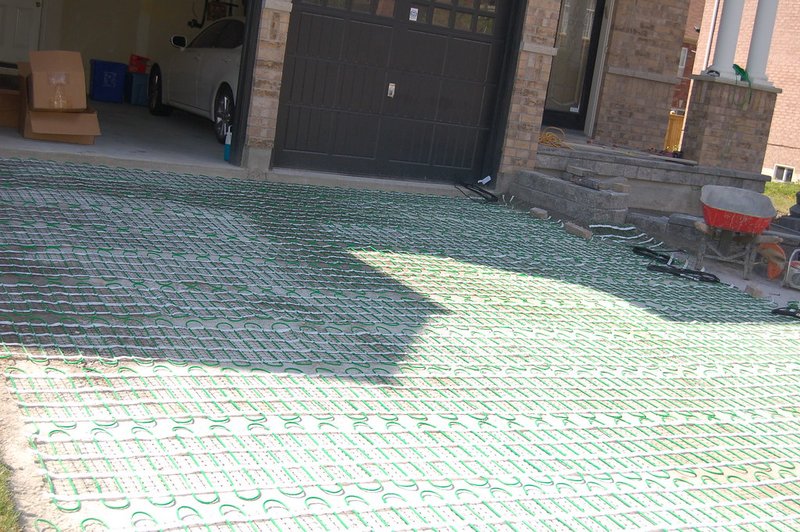
When we design a system for a heavy snow region, we look at the wattage density. This is the amount of heat produced per square foot of surface area. You can achieve the right density using either pre-spaced mats or free-form cables.
- PowerMat (50W/sqft): This is our “heavy hitter.” Designed for high-performance in the toughest climates, the 50-watt output provides the fastest melt rate and the best performance in extreme cold. It is the gold standard for commercial applications and residential driveways in the “Snow Belt.”
- OmniMat (39W/sqft): A highly effective and efficient option for most residential applications. While slightly lower in wattage, it still provides ample power to keep driveways clear in moderate to heavy snow regions.
- Snow Melt Cable: For maximum flexibility, loose cable can be spaced at 3”, 4”, or 5” intervals. This allows you to customize the installation to provide the exact spacing and watt density required for your specific climate and project shape.
Choosing between these often comes down to your local climate and how quickly you want the snow to disappear. In a place like Bartlett, IL, where the Jain Society Temple installed a massive 3,413 sq. ft. system, the priority was safety and high-volume clearing, making a high-output design essential.
Project Spotlight: Jain Society Temple
Discover how this spiritual community in Bartlett, IL, used a SmartInstall snow melting system to eliminate the need for snow removal across 3,413 sq. ft. of high-traffic walkways. Read the full showcase here.
Managing Runoff: The Importance of After-Run Time
Melting the snow is only half the battle. If your snow melting system turns off the moment the snowfall stops, the remaining slush and water can quickly refreeze into dangerous “black ice.” This is especially critical for steep driveways, where runoff can pool at the bottom or create slick patches on the slope.
To prevent this, WarmlyYours controls feature “after-run” (or Hold-On) time. This setting keeps the heating elements active for a set period after the sensors stop detecting precipitation, ensuring the surface is completely dry and safe. Here are the top controls we recommend for managing runoff effectively:
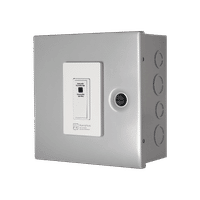
Advanced Snow & Ice Control (SCA-DUAL)
The SCA-DUAL is our most popular residential control. It features an adjustable hold-on timer that can be set for up to 8 hours, providing plenty of time to clear runoff from most concrete or paver driveways.

Premium Snow & Ice Control (SCP-120)
For larger or more complex projects, the SCP-120 offers a fixed 10-hour after-run timer. This is ideal for asphalt driveways or high-demand environments where ensuring a bone-dry surface is paramount.
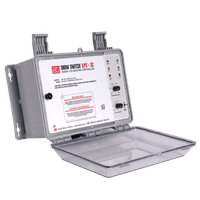
WiFi Snow & Ice Control (SCW-120-15A)
If you want the ultimate in flexibility, our WiFi-enabled control allows you to customize your after-run logic using smart home scenes or IFTTT. You can trigger the electric snow melt system to stay on based on local weather forecasts or your own preferences.
Real-World Proof: Customer Stories from the Coldest Regions
The best way to judge a system is by its performance in the field. We’ve helped homeowners and businesses across North America’s coldest regions eliminate shoveling forever.
- Ottawa, ON: The O’Malley residence faced constant shoveling until they installed a heated paver driveway. Even in Canada’s capital, the system keeps their steep drive clear.
- Eagle River, WI: Known for some of the highest snowfall totals in Wisconsin, this 1,280 sq. ft. paver driveway operates automatically, ensuring the owners never have to lift a shovel.
- Elmsdale, NS: In Nova Scotia, heavy, wet “Atlantic” snow is the challenge. A heated asphalt driveway solved the problem for this homeowner.
- Montana: Homeowners in the Big Sky state rely on concrete snow melting mats to handle high-altitude storms and sub-zero stretches.
- Toronto, ON: These Toronto homeowners found the solution in a snow-melting system for their asphalt driveway.
To see how a large-scale system comes together, check out our Project Spotlight on the Jain Society Temple above, which details the installation of a massive 3,413 sq. ft. system in Bartlett, IL.
Is a Heated Driveway Right for Your Climate?
If you live in a region where snow is a regular part of winter life, a heated driveway isn’t just a luxury—it’s a safety investment. It eliminates the need for salt (which damages vehicles and landscaping), prevents slip-and-fall accidents, and saves hours of back-breaking labor.
Whether you’re in Toronto dealing with lake-effect snow or Maine facing a Nor’easter, a properly designed electric snow melt system will keep your path clear, no matter how much falls from the sky. Get a free instant quote for your driveway today.
Frequently Asked Questions
Heated driveway installation typically costs $8 to $25 per square foot. This includes the heating elements, which range from $12 to $22 per square foot, plus labor and controls. For an accurate estimate, use our online Snow Melting Cost Calculator.
Multiply the heated area by the installed watts per square foot, divide by 1,000 for kilowatts, then multiply by your electricity rate. At 50 W/sq ft, every 100 sq ft draws 5 kW, or $1.00 per energized hour at an illustrative $0.20/kWh. For example, a 400 sq ft full-coverage driveway draws 20 kW: $4.00 per energized hour, or $24.00 for six energized hours. Tire tracks heat less area, so they cost proportionally less. Your seasonal bill depends on how many hours the system is energized, including preheating and the controller’s drying cycle, which varies with the weather. These are examples, not typical bills; enter your own area, rate and runtime in our snow melting cost calculator.
Yes, you can install a snow melting system under an asphalt driveway. The heating cables or mats are laid directly on the binder coat before the final top layer of asphalt is applied, adding minimal time to the paving process.
Yes, a properly designed heated driveway can melt heavy snow accumulations. High-output systems, like our 50-watt per square foot PowerMat, are specifically engineered for extreme climates. They can keep up with heavy snowfall rates of 1 to 2 inches per hour, preventing dangerous buildup.
Yes, snow melting systems are highly effective against freezing rain and ice. By keeping the driveway surface above freezing, they prevent ice from forming entirely. The moisture simply drains away, keeping your driveway safe and slip-free even during severe ice storms.
A heated driveway typically melts snow as it falls, preventing accumulation entirely. If the system is turned on after snow has already piled up, it can take a few hours to clear, melting at an average rate of 1 to 2 inches per hour.
Have Questions About Your Project?
Our team of Radiant Experts is ready to help!
Related Articles

Is a Heated Driveway Worth It? ROI & Payback Period Explained
Heated Driveway Operating Costs: What to Expect on Your Electric Bill
Snow Melting Systems for Steep Driveways: What Homeowners Need to Know
Heated Driveway Maintenance & Lifespan Guide
Stay Updated
Get the latest radiant heating news and tips delivered to your inbox.


