

Thermostats and Power Relays Support
Main Products
Do you need support or specifications for a specific model? Identify your model below.
Support Questions
Showing 10 of 12 questions
One thermostat can control multiple heating mats/cables as long as all the heating elements are using less than 15 amps:
TempZone™ will cover aprx. 120 sq. ft. for 120V systems and 240 sq. ft. for 240V systems on one thermostat.
Environ™ will cover aprx. 150 sq. ft. for 120V systems and 300 sq. ft. for 240V systems on one thermostat.
Slab Heat will cover aprx. 90 sq. ft. for 120V systems and 180 sq. ft. for 240V systems on one thermostat.
In theory, it is possible, if no other options are available. We do not recommend it, but If the thermostat is controlling the floor temperature with a floor sensor, then it can go on an exterior wall. It is important that the floor sensor gets located in an area of the floor not hit by sunshine.
If the thermostat will be controlling the air temperature with the built-in ambient sensor, then it should go on an interior wall.
A GFCI/GFEP (Ground Fault Circuit Interrupter / Ground Fault Equipment Protection) works differently than a circuit breaker by specifically detecting a small imbalance in electrical current between the hot and neutral wires, which indicates a potential ground fault (like a person touching a live wire), and instantly shutting off the power to prevent shock, while a circuit breaker only trips when there's a significant overload in current flow on the circuit, like a short circuit or too many appliances plugged in.
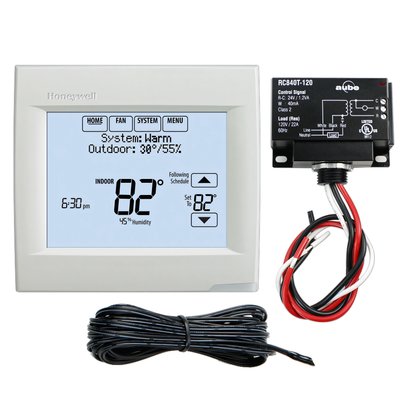
Relays can fail due to excessive current or voltage. When a relay is exposed to too much current, the contacts can burn out. High voltage can also damage the coil. Other reasons include mechanical wear and tear, dust or dirt buildup, and moisture. These factors can cause the relay to malfunction or stop working entirely. Regular maintenance and using the relay within its specified limits can help prevent failures.
Turn the power (circuit breaker typically) to the thermostat off for 5 minutes and then back on to reset the thermostat.
If there is power to the thermostat and it still doesn't appear to work, then the next step toward a solution is to take Ohm measurements of the floor heating system.
This is done with a digital multi-meter that can select a low 200 Ohm (Ω) scale. To conduct this test, turn off the circuit breaker. Remove the thermostat completely from the wall and disconnect the wires connected to the LOAD connections at the back of the thermostat. Disconnect the ground wires from the house ground, and do the test shown on the links below. If you are uncomfortable doing this test, contact a qualified electrician.
Please follow one of these guides based on the type of heating system installed:
For a quick overview of the testing process:
Here is a video showing how the test is done
Here is a video showing how to locate and identify the floor heating wires
If the system still does not function, contact +1 (800) 875-5285 WarmlyYours Technical Support and provide the Ohm measurements for further assistance.
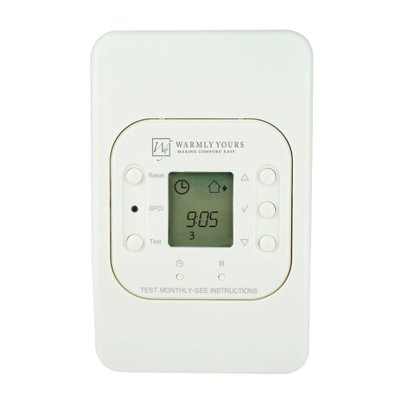
WarmlyYours controllers incorporate built-in Class A GFCI protection for all new floor heating systems. Class A GFCI provides personnel protection and trips when ground fault current exceeds 5 mA (milliamps). Class B GFCI protection is pretty much obsolete, but older systems may still require it. WarmlyYours controllers with built-in Class B GFCI provide equipment and circuit protection and operates when a fault to ground exceeds 15 mA.
GFCI can fail for various reasons, such as wear and tear, moisture, corrosion, power surges, faulty wiring, or improper installation. Some of these causes can be prevented by regular inspection and maintenance, while others may require professional assistance. It is important to note that GFCI devices (ex. thermostat, breakers, outlets) should be tested regularly as these do wear out over time.
Documents
Installation
- Connecting the nJoy Thermostat with a Mobile Device (English)
- RC840 Installation Guide (English)
- RC840T (Integration Kit) Installation Guide (English)
- WarmlyYours nSpire Touch WiFi Thermostat Controller Driver Setup For Control4 (English)
- WarmlyYours nSpire Touch WiFi Thermostat Controller Integration Notes For Elan Home Automation (English)
- nSpiration Series Rough-in Kit-03 installation (2 conduits)
- nSpiration Electrical Rough-in Kit Installation (Single Gang Box with Single Conduit) (English)
- nSpiration Series Rough-in Kit-01 Installation (no conduit)
- nJoy Startup Guide UWG5-4999-WY (English, French)
- nJoy Startup Guide UWG5-4999-WY (English, Spanish)
- Setting Up the nJoy UWG5-4999 without an App (English)
- nJoin (USG-4000) Installation Instructions (English, French, Spanish)
- nTrust 2.0 UTN5 Touch Nonprogrammable Thermostat Startup Guide (English, French)
- nTrust 2.0 UTN5 Touch Nonprogrammable Thermostat Startup Guide (English, Spanish)
- Setting Up the nTrust 2.0 UTN5-4999 (English)
- nHance (UDG-4999) Installation Instructions (English, French, Spanish)
- Retro-Fit Kit Installation Guide (English)
- TH115-AF-GA-08 SmartStat Installation Manual (English, French, Spanish)
- CT230 Power Module Installation Guide (English, French, Spanish)
Technical Information
Technical Specifications
Wiring Diagrams
- nSpiration Series Thermostat Slab Heating Wiring Diagram (English)
- nSpiration Series Thermostat TempZone Single Custom Wiring Diagram (English)
- TempZone™ Custom & Standard Mat Wiring Diagram (English)
- WIRING DIAGRAM 120V & 240V Heating Products with PB112D-GA (English)
- Wiring Diagram for 120V & 240V Floor Heating Products with Relay with Thermostat (English)
- Wiring Diagram for TempZone™ Cut & Turn Single Conductor (Multiple rolls) 120V & 240V with SmartStat™, EasyStat™ and Comfort Regulator (English)
- Wiring Diagram for TempZone™ Cut & Turn Twin Conductor (Multiple Rolls) 120V & 240V with SmartStat™, EasyStat™, Comfort Regulator and Power Modules (English)
- nSpiration Series Thermostat Environ Wiring Diagrams (English)
- nSpiration Series Thermostat TempZone Twin Wiring Diagrams (English)
- nSpiration Series Thermostat Wiring Diagram (120V & 240V) (English)
- Wiring Diagram for Multiple Twin Floor Heaters with nSpire Series Thermostat Using a Junction Box (English)
- nJoin (USG-4000), nJoin 2.0 (USG5-4000) Power Module Wiring Diagram (English)
- Slab Heat Wiring Diagram for TH115, TH114 and a Relay (English)
- Slab Heat Wiring Diagram for TH115, TH114, Power Module (English)
- SmartStat TH115 to TempZone Flex Wiring Diagram (English)
- SmartStat™, EasyStat™ Wiring Diagram with Multiple Environ™ using a Junction Box (English)
- SmartStat™, EasyStat™, Comfort Regulator, Power Module Wiring Diagram with Environ™ 120V or 240V Flat Lead (English)
- SmartStat™, EasyStat™, Comfort Regulator, Power Module Wiring Diagram with TempZone™ Twin Conductor or Environ™ (120V or 240V) (English)
- Wiring Diagram for TempZone™ Cut & Turn Twin Conductor 120V & 240V with SmartStat™ and EasyStat™ (English)
- Wiring Diagram for TempZone™ Cut & Turn Twin Conductor 120V & 240V with SmartStat™, EasyStat™ and Comfort Regulator (English)
- Master Thermostat with Dual Voltage Power Modules Wiring Diagram (English)
- Master Thermostat with Dual Voltage Power Modules Wiring Diagram and Instructions (English)
- T1033-A Timer Wiring Diagram with Environ™ Round Lead 120V (Legacy) (English)
- T1033-A Timer Wiring Diagram with TempZone™ Single Conductor 120V (Legacy) (English)
- T1033-A Timer Wiring Diagram with TempZone™ Twin Conductor 120V (Legacy) (English)
Operation Manuals
- nSpire Touch (UDG4-4999) Interactive User Manual (English)
- nSpire Touch (UDG4-4999) Interactive User Manual (French)
- nSpire Touch (UDG4-4999) Interactive User Manual (Spanish)
- nSpire Touch (UDG4-4999) Quick Start Guide and Specifications (English, French, Spanish)
- nSpire Touch UDG4-4999 Interactive User Manual (French)
- nSpire Touch UDG4-4999 Interactive User Manual (Spanish)
- nJoy WiFi LED Touch Thermostat User Manual (English)
- nJoy WiFi LED Touch Thermostat User Manual (French)
- nJoy WiFi LED Touch Thermostat User Manual (Spanish)
- nSpire Touch WiFi (UWG4-4999) Interactive User Manual (English)
- nSpire Touch WiFi (UWG4-4999) Interactive User Manual (Spanish)
- nSpire Touch WiFi (UWG4-4999) Quick Start Guide and Specifications (English, French, Spanish)
- nSpire Touch WiFi (UWG4-4999) WiFi Settings, Remote Control, and Voice-Control Integration Setup Guide (English)
- nSpire Touch WiFi UWG4-4999 Interactive User Manual (French)
- nJoin (USG-4000) Quick Start Guide and Specifications (English, French, Spanish)
- nJoin 2.0 USG5 Power Module Quick Start Guide (English, French, Spanish)
- nTrust 2.0 UTN5 Touch Nonprogrammable Thermostat User Manual (English)
- nTrust 2.0 UTN5 Touch Nonprogrammable Thermostat User Manual (French)
- nTrust 2.0 UTN5 Touch Nonprogrammable Thermostat User Manual (Spanish)
- nHance (UDG-4999) Quick Programming Guide (English, French, Spanish)
- nHance (UDG-4999) Quick Start Guide and Specifications (English, French, Spanish)
- nHance (UDG-4999) User Manual (English, French, Spanish)
- nTrust (UTN4-4999) Quick Start Guide and Specifications (English, French, Spanish)
- TH115 / PB112 Series SmartStat™ Quick Programming Guide (English)
- TH114 A/F/AF Thermostat Installation Manual (English)
- T1033-A Timer Single Pole Programming Guide (Legacy) (English)
Sell Sheets
- Radiant Heating Controls Comparison Chart CANADA (English)
- nJoy WiFi LED Touch Programmable Thermostat Sell Sheet Canada (English)
- nTrust 2.0 UNT5 Touch Nonprogrammable Thermostat Sell Sheet Canada (English)
- Electrical Rough-in Kits Sell Sheet - Canada (English)
- Comparison Chart for Timers and Switches for Towel Warmers or Infrared Heating Panels (English)
Technical Support
Videos
Articles
- Choosing wood flooring for electric radiant heating
- Electric radiant heat under LVT, vinyl and resilient flooring
- ETI Floorstat FWT-3: operation and replacement considerations
- Extending floor-heater cold leads and sensor wiring
- Finding LVT products compatible with electric floor heating
- Floor heating and implanted pacemakers: checking compatibility
- FLOR carpet tiles over radiant floor heating
- How to reduce winter gaps in wood flooring


